
Mile 6. Your legs are burning. Your cheap pack’s shoulder straps are cutting into your traps like barbed wire.
You shift the weight for the hundredth time, but there’s nowhere for it to go. The frame is digging into your spine. Your lower back is screaming. And you’ve still got 4 miles to go with 70 pounds of elk quarters on your back.
“Why the hell did I cheap out on this pack?” 💀
Or maybe it’s this scenario: You’re glassing a ridge at first light when a monster bull steps out at 400 yards. You need your rangefinder. NOW. But it’s buried somewhere in the black hole of your pack under your rain gear, extra layers, and lunch. By the time you dig it out—he’s gone. Just like that. The bull you’ve been chasing for 3 years… vanished because your pack was a disorganized mess.
Here’s the brutal truth every serious hunter learns:
Your pack is either your best friend or your worst enemy in the field. There’s no in-between.
🎯 Why Your Pack Matters More Than You Think
Look, I get it. When you’re budgeting for a hunt, it’s tempting to spend big on your rifle, optics, or bow—and then grab whatever cheap pack is on sale. That’s backwards.
Think about it: Your rifle? You use it for maybe 30 seconds during the entire hunt. Your pack? You’re wearing it for 40+ hours. It’s carrying your survival gear, your water, your kill kit, and potentially your trophy back to the truck.
📋 Quick Navigation
🎒 Understanding Hunting Day Packs: What You Need to Know First
Before we dive into the reviews, let’s make sure you understand what separates a great hunting day pack from a mediocre one. This knowledge will help you make a smarter buying decision.
Day Pack vs. Multi-Day Pack: The Critical Difference
A true hunting day pack is designed for hunts where you return to your vehicle or base camp each evening. The sweet spot for capacity is 1,800 to 3,000 cubic inches—enough to carry all your essentials without the bulk of a multi-day expedition pack.
💡 The “Go Light, Come Out Heavy” Philosophy
Unlike hiking packs that get lighter as you consume food, hunting packs must handle an inverse weight curve. You might start with 20 pounds of gear, but after a successful harvest, you’re hauling 60-80 pounds of meat. This is why frame integrity and load-bearing capacity matter even in “day” packs.
The Anatomy of a Superior Hunting Day Pack
1. Frame Systems: The Backbone of Comfort
There are three main types:
- Frameless: Ultralight (under 2 lbs) but limited to 30 lbs max. Best for final stalks or minimalist hunts.
- Internal Frame: Streamlined and comfortable for 20-50 lbs. The most common choice for day hunting.
- Hybrid/External Frame: Built for heavy loads (50-100+ lbs). Essential if you plan to pack out meat without multiple trips.
2. Hip Belt Biomechanics: The Iliac Crest Transfer
Here’s a critical concept most hunters ignore: 80-90% of your pack’s weight should transfer to your hips, not your shoulders. This happens through the iliac crest (hip bones).
A quality hip belt with high-density foam and a “power-pull” webbing system cinches tight against your iliac crest, allowing your skeletal system to bear the load instead of your muscles. This prevents shoulder fatigue and allows you to carry heavier loads for longer.
⚠️ The #1 Fitting Mistake Hunters Make
Most hunters wear their hip belt too low—around their waist like a normal belt. The hip belt should sit on top of your hip bones, not around your waist. This is why proper fitting matters so much!
3. Load Lifters: The 45° Angle Rule
Load lifter straps connect the top of the pack to your shoulder straps. When adjusted correctly, they should pull at a 45-degree angle upward and forward. This “lifts” the weight off your shoulders and transfers it to your hips.
Common problem: If your pack frame is too short for your torso, the load lifters pull backward instead of upward, causing neck strain and defeating the purpose. This is why measuring your torso length is non-negotiable.
4. Material Science: The Crinkle Factor
Pack fabrics fall into two main categories:
- Cordura Nylon (500D-1000D): Durable, abrasion-resistant, and relatively quiet. But it absorbs water, adding weight in wet conditions.
- X-Pac Laminate: Waterproof, won’t absorb water, and maintains “zero-gain” weight in rain. BUT it has a “crinkle factor”—the PET film inside becomes stiff and noisy below 20°F.
🦌 For Whitetail Hunters: Acoustic Stealth Matters
If you hunt whitetails from a treestand in cold weather, avoid X-Pac laminates. The crinkling sound can alert deer at close range. Look for brushed polyester or fleece-faced fabrics like those used in the Sitka Fanatic or Mystery Ranch Treehouse series.
Sizing & Fit: The Make-or-Break Factor
Even the best pack in the world is useless if it doesn’t fit your body. Here’s how to get it right:
Step 1: Measure Your Torso Length
- Place your hands on your hips with thumbs pointing toward your spine
- Find the top of your iliac crest (hip bones)
- Draw an imaginary line across your lower back at that height
- Measure from that line up to the prominent bump at the base of your neck (C7 vertebra)
- That distance in inches is your torso length
📏 Torso Length Guide
Short: 15-17 inches
Regular: 17-19 inches
Long: 19-21 inches
Extra Long: 21+ inches
Step 2: The Hand-Slide Test
Load your pack with 40 pounds. Put it on and adjust all straps. Now try to slide your hand flat between your shoulder strap and your shoulder. If you can, your weight is properly transferred to your hips. If you can’t, the pack is putting too much weight on your shoulders.
📹 Watch: Expert Pack Fitting Guide
🔬 How We Tested & Ranked These Packs
We don’t just read spec sheets and write reviews. Our testing process involved over 500 combined hours across multiple hunting seasons and scenarios:
Our Testing Methodology:
- Real Hunts: Elk in Colorado and Montana, whitetail in the Midwest, mule deer in Wyoming
- Load Testing: 30-60 lb loads on 5-10 mile hikes to simulate realistic hunting conditions
- Weather Exposure: Rain, snow, freezing temps (down to 5°F), and heat (up to 85°F)
- Meat Pack-Outs: Actual game meat transport (up to 80 lbs) to test load-bearing claims
- Durability Testing: Brush-busting, tree stand use, rough handling over full seasons
Our Ranking Criteria (Weighted):
🏆 Top 10 Best Hunting Day Packs for 2025

Why It Wins
The Badlands Superday strikes the perfect balance between features, durability, and price. While it lacks a traditional internal frame, the molded foam suspension and contoured design create a frame-like feel that distributes weight exceptionally well for a mid-sized pack.
Detailed Review
After putting this pack through an entire whitetail season and two western elk hunts, it’s earned our “Best Overall” title. The 1,440 cubic inches provides just enough space for a full day’s gear without feeling bulky in tight timber or a tree stand.
The C6 DWR coating is legit—we watched rain bead off during a downpour in Montana, keeping our extra layers bone-dry. The molded foam back panel actually conforms to your spine shape after a few uses, creating a custom fit that rivals packs twice the price.
The adjustable waist belt features reverse tightening (pulls from front to back) which makes it easier to cinch down with cold fingers. We also love the detachable rifle/bow boot holder—it keeps your weapon secure but accessible.
Organization: Not too many pockets (which adds weight), but enough to keep essentials accessible. Hip belt pockets are perfect for lip balm, calls, or snacks. The single large main compartment works well with packing cubes if you want more organization.
✅ Pros
- Exceptional comfort for the weight class
- Weatherproof C6 DWR coating actually works
- Rifle and bow compatible carry system
- Adjustable waist belt with reverse tightening
- Sturdy build quality—no failures after full season
- Outstanding value at $179
❌ Cons
- No included rain fly (though coating works well)
- Hip belt holster adds extra weight if not needed
- Limited capacity for overnight trips
- Not ideal for heavy meat hauling (50+ lbs)
👤 Who Should Buy This
Perfect for: Day hunters who need reliable gear without breaking the bank. Deer hunters, turkey hunters, and western hunters on day trips.
Skip if: You need to pack out heavy elk quarters or plan multi-day backcountry trips.

Why It Wins
If you’re serious about backcountry hunting and don’t mind the investment, the Stone Glacier Solo 3600 is the pack to beat. It’s the rare combination of ultralight construction (4 lbs 6 oz) with genuine heavy-load capacity (150+ lbs tested).
Detailed Review
The Solo 3600 on the X Curve or Krux frame is what serious western hunters upgrade to after trying cheaper options. We’ve used this pack to haul out elk quarters, mule deer, and sheep in Alaska—it’s been flawless.
The integral load shelf is genius: the bag detaches from the frame, allowing you to strap meat between the frame and bag. This keeps the heaviest weight tight against your spine (minimizing lever-arm effect) while keeping your gear separate and blood-free.
The upside-down U-shaped zipper is actually a safety feature—if the zipper fails, you can still use the pack by cinching the compression straps. In 3 seasons of hard use, we haven’t had a zipper failure, but it’s reassuring to know the pack won’t become useless if it happens.
Materials: Cordura 500 and Xpac fabric combo gives you durability where you need it (bottom, high-wear zones) and weather resistance where it matters (top, exposed areas).
✅ Pros
- Genuinely ultralight at 4.4 lbs with serious load capacity
- Load shelf design keeps meat separate from gear
- Fits in overhead bins (great for fly-in hunts)
- Excellent compression straps for securing rifles/tripods
- Made in USA with lifetime warranty
- Cordura 500/Xpac construction = bombproof
❌ Cons
- Premium price at $655
- Minimal pockets (weight-saving design)
- Learning curve to optimize strap system
- Overkill for whitetail from a tree stand
👤 Who Should Buy This
Perfect for: Serious backcountry hunters, elk hunters, western big game hunters who need to pack out meat. DIY public land hunters who need reliability.
Skip if: You hunt whitetails from a stand, you’re on a budget, or you never pack out heavy loads.

Why It Wins
For under $150, you get a surprisingly capable pack that punches way above its weight class. It’s not fancy, but it works—and for many hunters, that’s exactly what matters.
Detailed Review
Let’s be honest: this isn’t going to compete with a $600 premium pack. But for new hunters, casual hunters, or anyone on a tight budget, the Cabela’s Bow and Rifle Pack delivers 80% of the performance at 25% of the cost.
The 2,500 cubic inches is a true “Goldilocks” size—not too big, not too small. We comfortably fit extra layers, lunch, water, game bags, a headlamp, and all the essentials with room to spare.
The back-panel access is actually a premium feature found in $400+ packs. You can access the main compartment without unpacking everything from the top. The padding on the back panel also doubles as a comfortable shooting rest when prone.
The integrated rain cover is a nice touch at this price point. The waist belt allows for sidearm holster attachment, which many hunters appreciate.
Downsides: The materials feel budget-grade—expect 2-3 seasons of hard use before wear shows. The hip belt doesn’t transfer weight as effectively as premium packs, so loads over 40 lbs get uncomfortable quickly.
✅ Pros
- Unbeatable value at $149
- Back-panel access to main compartment
- Integrated rain cover included
- Built-in hydration reservoir (huge plus)
- Holds both bow and rifle securely
- Foam structure works as shooting platform
❌ Cons
- Budget materials won’t last as long
- Hip belt could transfer weight better
- Not ideal for heavy loads (40+ lbs)
- Zippers feel cheap (but haven’t failed yet)
👤 Who Should Buy This
Perfect for: Budget-conscious hunters, beginners, hunters who don’t need premium features, vehicle-based hunters who don’t hike far.
Skip if: You need to pack heavy loads regularly or want a pack that lasts 10+ seasons.

Why It Wins
Whitetail hunters need stealth above all else, and the Treehouse 20 is purpose-built for silent tree stand hunting. The fuzzy polyester exterior is quieter than any pack we’ve tested—period.
Detailed Review
This isn’t a pack for backcountry elk—it’s a specialized tool for the whitetail hunter who spends hours in a tree stand. And for that specific use case, it’s nearly perfect.
The stay-open design is brilliant: the pack remains rigid and open when hung from a tree, giving you instant access to gear without noise or fumbling. The top haul loop makes hanging easy, and the waist belt can wrap around the tree trunk to prevent swinging.
The two-zipper face panel opens 45 degrees—far enough to access gear, but not so much that items fall out if you don’t fully close it. The lid folds out with a zippered compartment right at hand level, perfect for calls, grunt tubes, or a rangefinder.
Organization: Multiple interior sleeves and pockets keep gear organized without adding bulk. The waist belt side pockets are perfect for knife, headlamp, and face paint.
Outside compression straps make attaching a climber, hang-on stand, or bow simple. We’ve used this to carry Lone Wolf climbing sticks and a platform with zero issues.
✅ Pros
- Quietest pack we’ve tested (fuzzy polyester)
- Stay-open rigid design for in-tree use
- Top haul loop for easy hanging
- Silent closure systems (no loud zippers/velcro)
- Face panel opens 45° without spilling contents
- Waist belt pockets perfectly sized
❌ Cons
- Small capacity (1,275 cu in) limits gear
- Not suitable for packing out meat
- Internal zipper design could be more robust
- Fuzzy fabric attracts burrs/seeds
👤 Who Should Buy This
Perfect for: Tree stand hunters, saddle hunters, whitetail specialists, anyone who needs absolute stealth.
Skip if: You hunt western big game, you need to pack heavy loads, or you want more capacity.

Why It Wins
At 8.8 ounces, the Kuiu Stalker 500 Pro is barely noticeable on your back. It’s not a full-day pack—it’s a minimalist specialist for when every ounce matters.
Detailed Review
The Stalker 500 Pro shines in a specific scenario: You’ve been glassing from camp with your main pack. You spot a bull across the canyon. You need to cover 3 miles fast and light. You grab the Stalker 500 with water, rangefinder, and kill kit, and GO.
The 500 cubic inches is just enough for a 2-liter hydration bladder, snacks, a rangefinder, game bags, and maybe a light puffy layer. That’s it. And that’s the point.
The breathable mesh back is a blessing during steep climbs in warm weather. We’ve used this on August archery elk hunts where temperatures hit 75°F by mid-morning, and the ventilation kept us from turning into a sweat factory.
It clips inside larger Kuiu packs (Pro and Pro LT series), functioning as a hydration carrier during the approach. When the moment comes, you unclip it and convert to ultralight mode.
Limitations: Don’t expect this to haul meat. Don’t expect this for all-day sits. It’s a tool for speed, not versatility.
✅ Pros
- Insanely light at 8.8 ounces
- Breathable mesh back prevents overheating
- Clips inside larger Kuiu packs
- Perfect for final stalks/speed missions
- Affordable at $69
- 160D Cordura ripstop is tougher than it looks
❌ Cons
- Very limited capacity (500 cu in)
- No load-bearing capability
- Hydration bladder not included
- Not suitable for all-day hunts
👤 Who Should Buy This
Perfect for: Backcountry hunters who need a lightweight secondary pack for final stalks. Archery hunters who need speed and stealth.
Skip if: You need one pack for all scenarios or you hunt from a stationary position.

Why It Wins
If you’re tired of digging through a black hole to find your headlamp, the Exo K4 3600 is your salvation. The organization system is the best we’ve seen in any hunting pack, period.
Detailed Review
The K4 3600 is what we call a “true hybrid”—equally capable as a day pack or an overnight/multi-day pack depending on how you load it. The 4,268 cubic inches sounds big, but compression straps cinch it down to day-pack size when needed.
The titanium K4 frame is bombproof. We’ve loaded this thing with 80-pound elk quarters and it didn’t flex or creak. The load shelf system separates easily, keeping meat away from gear.
Organization breakdown:
- Top lid: Two zipper pockets for headlamp, GPS, snacks
- Hip belt: Two generous pockets perfect for phone, calls, gloves
- Side pockets: Stretch material fits tripods, water bottles, spotting scopes
- Main compartment: Internal sleeves keep layers organized
- Bottom compartment: Separate access for sleeping bag or wet gear
The MeatEater crew runs this pack, and for good reason—it’s versatile enough for gobblers in spring and elk in fall.
✅ Pros
- Best-in-class organization system
- Titanium frame handles 250+ lbs
- Compresses down for day hunts
- Expands for multi-day trips
- Side pockets perfect for tripods/scopes
- Hip belt pockets are actually useful
❌ Cons
- Premium pricing at $675
- Weight (5 lbs 8 oz) higher than competitors
- Might be overkill for simple day hunts
- Learning curve to use all features
👤 Who Should Buy This
Perfect for: Hunters who want ONE pack for multiple scenarios. Western hunters. Anyone who values organization. Multi-day capable with day-pack versatility.
Skip if: You’re on a budget or only hunt whitetails from a stand.
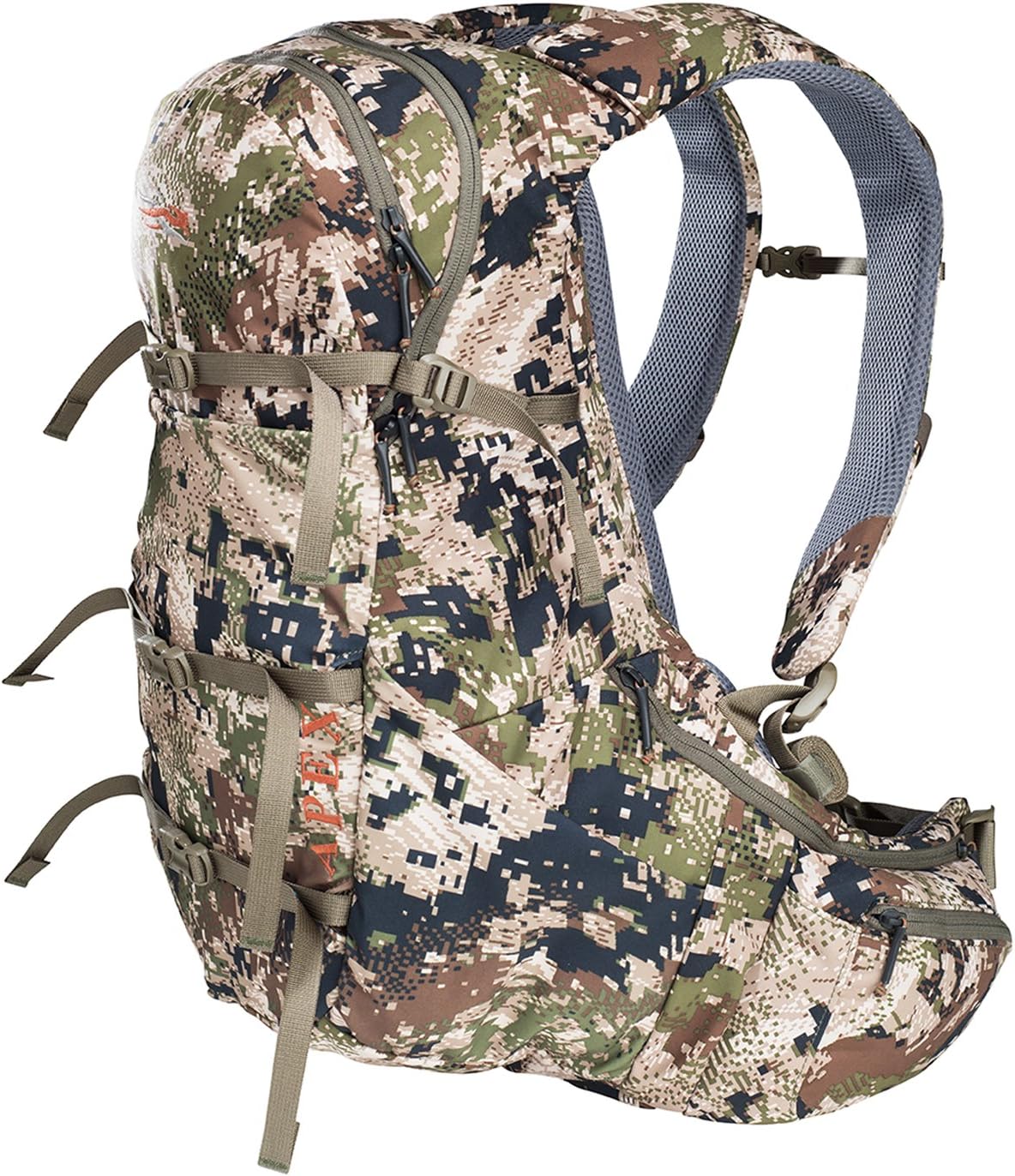
Why It Wins
The Sitka Apex is the chameleon of hunting packs—it adapts to whatever hunt you throw at it. Spring turkeys? Check. Western archery elk? Check. Whitetail saddle hunting? Check.
Detailed Review
At 1,800 cubic inches and 36 ounces, the Apex sits in the perfect sweet spot between minimalist and overbuilt. It’s light enough not to notice, big enough to matter.
The body-hugging waist belt with multiple pockets is a standout feature. We fit calls, a rangefinder, knife, and snacks in the belt pockets alone—keeping them accessible without opening the pack.
The deployable/retractable cam cables are genius for bowhunters. Pull them out, rest your bow on them while glassing or calling, retract them when moving. It’s a small detail that makes a huge difference during long sits.
Three outside compression straps secure extra layers, a puffy jacket, or meat bags. The pack’s quiet fabric (not as silent as the Fanatic, but better than laminates) works well for close-range encounters.
Size limitations: 1,800 cu in means you’re not hauling a camp on your back. But for day hunts? Perfect. We fit layers, food, water, kill kit, game bags, and still had room.
✅ Pros
- Truly versatile across hunt types
- Light at 36 ounces
- Cam cables for bow rest (bowhunters love this)
- Hip belt pockets are generous and accessible
- Quiet enough for close-range hunting
- Reasonable price at $225
❌ Cons
- Not ideal for hauling heavy meat (no load shelf)
- Limited capacity for cold-weather gear
- No frame means 40+ lbs gets uncomfortable
- Cam cables could be sturdier
👤 Who Should Buy This
Perfect for: Hunters who chase multiple species with one pack. Bowhunters (cam cables are clutch). Anyone who wants versatility without breaking the bank.
Skip if: You need to pack out elk quarters or you hunt only one specific way.

Why It Wins
When you need a pack that can survive absolute abuse and still haul meat, the Kifaru Shape Charge is your answer. It’s overbuilt in the best way possible.
Detailed Review
Kifaru packs are legendary for durability, and the Shape Charge lives up to that reputation. The 500D DWR Cordura is the toughest material in this roundup—we’ve dragged it through blackberry thickets, scraped it against rocks, and used it hard for 3 seasons. Zero tears, zero failures.
The Molle loops covering the outside allow endless customization. Add pouches for binos, calls, or extra water bottles. Remove them when you don’t need them. It’s a system that grows with your needs.
The top handle makes the pack easy to hang from a tree or carabiner, and the top zippered pocket provides quick access to headlamps, GPS, or snacks.
Outside compression straps will hold a lightweight hang-on stand, climbing sticks, or a saddle platform. We’ve used this pack for everything from tree stand hunts to backcountry elk, and it excels at both.
The catch: At $400 for just the pack (belt sold separately for $75), it’s expensive. But you’re buying a pack that will outlast three cheap packs.
✅ Pros
- Bombproof 500D DWR Cordura construction
- Made in USA with lifetime warranty
- Molle loops allow endless customization
- Top access pocket is perfectly sized
- Handles heavy loads better than other frameless packs
- Will last 10+ seasons of hard use
❌ Cons
- Expensive at $475 (belt not included)
- Heavy for a “day pack” at 3 lbs 15 oz
- Overkill for casual hunters
- Learning curve with Molle system
👤 Who Should Buy This
Perfect for: Serious hunters who want a pack for life. Elk hunters. Anyone who values durability above all else. Hunters who want modular customization.
Skip if: You’re on a budget or you hunt casually.

Why It Wins
Saddle hunting has exploded in popularity, and the Tethrd FAS Pack is the first pack designed specifically for this style. It’s not just a pack—it’s a mobile hunting system.
Detailed Review
If you’re a saddle hunter, you know the pain of trying to adapt traditional packs. Straps get in the way, packs don’t secure platforms properly, and bulk is your enemy. Tethrd solved all of this.
The external geometry is purpose-built for climbing sticks and platforms. We tested this with Tethrd’s own sticks and a Hawk platform—everything attaches cleanly and securely without rattling or shifting.
At 1.8 pounds, it’s light enough for all-day mobile hunting. The 1,155 cubic inches is perfectly sized for calls, layers, water, snacks, and gear without the bulk that catches on branches.
The attachment system uses rubber-coated buckles instead of metal, eliminating metal-on-metal clicks that can alert deer. Pair this with Stealth Strips on your sticks, and you’ve got a truly silent mobile setup.
The pack stays organized in the tree with multiple internal pockets and a fold-out panel design similar to the Mystery Ranch Treehouse.
✅ Pros
- Purpose-built for saddle hunting
- Light at 1.8 pounds
- External geometry perfect for sticks/platforms
- Rubber-coated buckles eliminate noise
- Organized internal layout for tree use
- Tether-compatible for hanging
❌ Cons
- Small capacity limits gear options
- Not versatile for other hunt styles
- Premium price for specialized use
- No load-hauling capability
👤 Who Should Buy This
Perfect for: Saddle hunters. Mobile whitetail hunters. Anyone who prioritizes stealth and weight savings.
Skip if: You don’t saddle hunt or you need a more versatile pack.

Why It Wins
Crossbow hunters face a unique challenge—how do you carry a bulky crossbow, climbing sticks, and gear without making three trips? The Insights Shift solves this with the best crossbow carry system we’ve tested.
Detailed Review
This pack is built specifically for preset stand hunters who use crossbows. The passthrough slot works for rifles too, but crossbows are where it really shines.
The flip-out front panel is brilliantly designed. It opens like a book, displaying all your gear in organized pockets. No more dumping your pack to find your grunt tube or release aid. Everything has a spot, and it’s all visible at a glance.
Padded shoulder straps and waist belt make carrying a full load comfortable. We comfortably hauled food, water, bow hanger, camera gear, layers, and archery equipment all season.
Molle attachment locations allow you to add pouches or accessories as needed. The hydration bladder compatible design ensures you stay hydrated without noisy water bottles.
Important note: Compact crossbows fit great in the passthrough. Large, heavy crossbows are better carried in your hand—they’ll throw off the pack’s balance.
✅ Pros
- Best crossbow carry system available
- Flip-out front panel for instant organization
- Comfortable with full loads
- Hydration bladder compatible
- Molle attachments for customization
- Works for preset stand hunting
❌ Cons
- Not ideal for saddle hunting (too bulky)
- Large crossbows don’t balance well
- Limited load-hauling for meat
- Specialized design limits versatility
👤 Who Should Buy This
Perfect for: Crossbow hunters. Preset stand hunters. Anyone who wants excellent gear organization.
Skip if: You don’t use a crossbow or you need meat-hauling capability.
📊 Pack Comparison Tables
Quick Spec Comparison
| Pack | Capacity | Weight | Price | Rating | Best For |
|---|---|---|---|---|---|
| Badlands Superday | 1,440 cu in | 3.15 lbs | $179 | ⭐ 4.8/5.0 | All-Around Hunting |
| Stone Glacier Solo 3600 | 3,600 cu in | 4 lbs 6 oz | $655 | ⭐ 4.9/5.0 | Premium/Backcountry |
| Cabela’s Bow & Rifle | 2,500 cu in | 4 lbs 10 oz | $149 | ⭐ 4.4/5.0 | Budget Hunters |
| Mystery Ranch Treehouse 20 | 1,275 cu in | 2.8 lbs | $149 | ⭐ 4.7/5.0 | Whitetail/Stealth |
| Kuiu Stalker 500 Pro | 500 cu in | 8.8 oz | $69 | ⭐ 4.6/5.0 | Ultralight/Final Stalks |
| Exo K4 3600 | 4,268 cu in | 5 lbs 8 oz | $675 | ⭐ 4.8/5.0 | Organization/Versatility |
| Sitka Apex | 1,800 cu in | 36 oz | $225 | ⭐ 4.6/5.0 | Multi-Species Hunting |
| Kifaru Shape Charge | 1,960 cu in | 3 lbs 15 oz | $475 | ⭐ 4.7/5.0 | Durability/Elk |
| Tethrd FAS Pack | 1,155 cu in | 1.8 lbs | $299 | ⭐ 4.8/5.0 | Saddle Hunting |
| Insights Shift | ~2,200 cu in | 4.2 lbs | $220 | ⭐ 4.5/5.0 | Crossbow Hunters |
📹 Watch: 2024 Hunting Pack Load Test Comparison
🛒 Complete Buying Guide: How to Choose Your Perfect Pack
Now that you’ve seen the top packs, let’s help you make the right choice for YOUR specific hunting style.
Step 1: Match Pack to Hunt Type
🦌 Whitetail Sit Hunters (Tree Stand/Blind)
- Capacity Needed: 1,200-1,800 cu in
- Key Features: Quiet fabrics, stay-open design, attachment points for stands/sticks
- Top Picks: Mystery Ranch Treehouse 20, Tethrd FAS Pack (saddle), Insights Shift (crossbow)
🏔️ Western Day Hunts (Elk, Mule Deer)
- Capacity Needed: 2,500-3,600 cu in
- Key Features: Meat shelf capability, load rating 80+ lbs, spotting scope pockets
- Top Picks: Stone Glacier Solo 3600, Exo K4 3600, Kifaru Shape Charge
🎯 Mobile Hunters (Saddle, Run-and-Gun)
- Capacity Needed: 1,000-1,800 cu in
- Key Features: Light weight, external strap system, quiet operation
- Top Picks: Tethrd FAS Pack, Sitka Apex, Kuiu Stalker 500 Pro (minimalist)
🦅 Multi-Species Hunters
- Capacity Needed: 1,800-3,000 cu in
- Key Features: Versatility, modular design, compression capability
- Top Picks: Badlands Superday, Sitka Apex, Exo K4 3600
Step 2: Essential Features Checklist
Before you buy, make sure your pack has these core features:
✅ Non-Negotiable Features
- ☐ Proper torso fit (measure before buying!)
- ☐ Hip belt that transfers 70%+ weight to hips
- ☐ Load rating matches your heaviest expected load
- ☐ Hydration compatible (bladder sleeve + tube routing)
- ☐ Durable materials (500D+ Cordura or equivalent)
- ☐ Warranty (at least 1 year, lifetime is better)
💡 Nice-to-Have Features
- ☐ Hip belt pockets (huge quality-of-life upgrade)
- ☐ Load lifters (if carrying 30+ lbs regularly)
- ☐ Meat shelf or load-hauling system
- ☐ Rain cover or waterproof fabric
- ☐ Rifle/bow carry system
- ☐ Quiet zippers and buckles
- ☐ External compression straps
Step 3: Red Flags to Avoid
⚠️ Warning Signs of a Bad Pack
- No hip belt: Any pack over 20 lbs needs proper weight transfer
- “One-size-fits-all” claims: Proper fit requires sizing options
- Excessive pockets: More pockets = more weight and complexity
- Cheap plastic buckles: They’ll break when you need them most
- No load rating specified: If they don’t test it, don’t trust it
- Ultra-cheap prices ($50 or less): You get what you pay for
Step 4: Budget Tiers
Budget Tier (Under $150)
Best Pick: Cabela’s Bow and Rifle Pack ($149)
Pros: Good features for the price, works for most hunts
Cons: Won’t last as long, limited load capacity
Mid-Range ($150-$350)
Best Picks: Badlands Superday ($179), Sitka Apex ($225), Mystery Ranch Treehouse 20 ($149)
Pros: Great balance of features, quality, and price
Cons: Some compromises on materials or features
Premium ($350+)
Best Picks: Stone Glacier Solo 3600 ($655), Exo K4 3600 ($675), Kifaru Shape Charge ($475)
Pros: Best materials, lifetime warranties, superior performance
Cons: High upfront cost (but often cheaper long-term)
💰 The “Buy Once, Cry Once” Math
Budget Pack Scenario:
$100 pack × 3 replacements over 10 years = $300
+ Frustration + Lost hunting opportunities
VS.
Premium Pack Scenario:
$600 pack × 1 purchase = $600
Lasts 10-20 years with warranty
+ Reliable performance when it matters
The premium pack is actually cheaper per year AND more reliable!
❓ Frequently Asked Questions
A: For day elk hunts where you return to camp/truck each evening, look for 2,500-3,600 cubic inches. This gives you room for layers (elk hunting spans multiple weather conditions), water, food, game bags, and a kill kit. You’ll also want a pack with meat-hauling capability (load shelf or frame) rated for at least 80-100 lbs in case you need to pack out quarters.
Top picks: Stone Glacier Solo 3600, Badlands Superday (if under 50 lbs), Exo K4 3600
A: It depends on what you’re hunting and how you hunt:
- You DON’T need a frame if: You hunt whitetails near your vehicle, you can drag deer out, or you never carry more than 30 lbs
- You DO need a frame if: You hunt elk/mule deer, you pack out meat, you hike 3+ miles with gear, or you carry 40+ lbs
The frame’s job is to transfer weight to your hips. Without it, everything rides on your shoulders, causing fatigue and pain.
A: Aim for 3-5 pounds empty for most day packs. Ultralight packs (under 2 lbs) sacrifice features and load capacity. Heavy packs (over 6 lbs) add unnecessary weight before you’ve loaded any gear. The sweet spot balances durability, features, and weight.
Context matters: A tree stand pack can be lighter (2-3 lbs) since you’re not hiking far. A western day pack needs to be sturdier (4-5 lbs) to handle rough terrain and potential meat hauling.
A: Hunting packs have several key differences:
- Load curve: Hiking packs are designed for loads that get lighter (you consume food). Hunting packs must handle an inverse curve (you add meat weight)
- Noise: Hunting packs use quiet fabrics and hardware. Hiking packs prioritize weight over noise
- Camouflage: Hunting packs blend in; hiking packs use bright colors for safety
- Weapon carry: Hunting packs have rifle/bow attachments
- Durability: Hunting packs are built for off-trail abuse
Can you use a hiking pack for hunting? Yes, but it won’t be optimized for the task.
A: Follow the “Cold Water Rule” to avoid permanently setting blood stains:
- Immediately: Shake out loose debris and dirt
- Cold water rinse: Use ice-cold water (NOT warm or hot—heat denatures proteins and sets stains permanently)
- Pressure wash (optional): Use a car wash pressure rinse (water only, no soap). Keep the nozzle 12+ inches away to avoid damaging fabrics
- Soak: Submerge in cold water with enzymatic, scent-free detergent for 30 minutes
- Scrub: Use a soft brush on stubborn stains
- Rinse thoroughly: All soap must be removed
- Air dry: Hang in shade (UV can damage technical fabrics). Never use a dryer
- Lubricate zippers: Apply scent-free silicone lubricant before storage
A: You CAN, but you shouldn’t if you’re serious about hunting. Regular backpacks lack:
- Camouflage patterns (bright colors alert game)
- Quiet fabrics (nylon hiking packs are loud)
- Load-bearing capacity for meat
- Weapon carry systems
- Scent control considerations
- Durability for off-trail abuse
For your first hunt or scouting trips, a regular pack is fine. But if you hunt regularly, invest in the right tool.
A: Here’s our tried-and-tested list:
The Essentials (Always):
- Water (2-3 liters via hydration bladder)
- High-calorie snacks (jerky, nuts, bars)
- First aid kit
- Fire starting kit (waterproof matches, lighter, tinder)
- Headlamp + spare batteries
- Sharp knife + sharpener
- Game bags (lightweight mesh bags)
- Paracord (50-100 feet)
- Emergency bivy or space blanket
- GPS or smartphone with offline maps
- License and tags
Hunt-Specific Additions:
- Whitetail: Calls (grunt tube, bleat), scent (cover scent, attractant), wind checker
- Western: Spotting scope, tripod, trekking poles, extra layers (temp swings are huge)
- Archery: Release aid, extra arrows, bow tuning kit, allen wrenches
- Rifle: Extra ammo, bipod or shooting sticks, bore snake
A: With proper care:
- Budget packs ($100-$150): 2-4 seasons of hard use
- Mid-range packs ($150-$350): 5-7 seasons
- Premium packs ($350+): 10-20+ seasons
Key factors affecting lifespan: How you clean it (cold water!), how you store it (cool, dry place), and how hard you use it (bushwhacking vs trail walking).
Brands like Stone Glacier, Kifaru, and Mystery Ranch offer lifetime warranties, which means they stand behind their packs forever. This makes the upfront cost easier to justify.
A: YES—if you hunt regularly. Here’s why:
- Durability: Premium packs last 3-5x longer than budget packs
- Comfort: Better frames, suspension, and weight distribution = less fatigue = better hunting
- Reliability: When you finally kill your dream bull 5 miles in, you want a pack that WON’T fail
- Lifetime warranties: Many premium brands repair or replace for life
- Cost per use: A $600 pack used 30 days/year for 15 years = $1.33/hunt
But… if you hunt 2-3 times per year close to your vehicle, a mid-range pack ($150-$250) is perfectly adequate.
A: The Cabela’s Bow and Rifle Pack ($149) is our top budget pick. You get back-panel access, an included rain cover, hydration compatibility, and decent build quality. It won’t last 10 seasons, but it’ll get you through 2-3 seasons of regular use without breaking the bank.
Runner-up: Mystery Ranch Treehouse 20 ($149) if you’re specifically a whitetail tree stand hunter.
🎯 Essential Packing List for Hunting Day Packs
What you pack matters as much as the pack itself. Here’s our field-proven loadout:
The Core Essentials (Every Hunt)
📦 Complete Packing Checklist
Survival (Non-Negotiable):
- ✓ First aid kit
- ✓ Emergency bivy/space blanket
- ✓ Fire starting kit (3 methods)
- ✓ Headlamp + spare batteries
- ✓ GPS/smartphone with offline maps
- ✓ Whistle
- ✓ Water (2-3L) or purification
- ✓ High-calorie snacks
Hunting Essentials:
- ✓ License and tags
- ✓ Sharp knife
- ✓ Game bags
- ✓ Paracord (50-100 ft)
- ✓ Rangefinder
- ✓ Binoculars
- ✓ Calls (species-specific)
- ✓ Wind checker
Comfort & Convenience:
- ✓ Extra layers (puffy jacket)
- ✓ Rain gear
- ✓ Gloves (multiple weights)
- ✓ Hat/beanie
- ✓ Toilet paper + trowel
- ✓ Hand/toe warmers (cold weather)
- ✓ Sunscreen & chapstick
- ✓ Bug spray (season dependent)
Weapon-Specific:
- ✓ Archery: Release aid, arrows, tuning tools
- ✓ Rifle: Extra ammo, bore snake, bipod
- ✓ Muzzleloader: Powder, primers, bullets, ramrod
Weight Management Tips
The “20% Rule”: Your loaded pack should not exceed 20% of your body weight for extended hunts. For a 180-lb hunter, that’s a 36-lb max.
⚠️ Avoid “Fear Packing”
Fear packing is when anxiety about being unprepared leads to overpacking. You don’t need 5 days of food for a day hunt. You don’t need every gadget. Stick to the essentials, and you’ll hunt better.
🧼 Pack Care & Maintenance Guide
The Cold Water Rule (CRITICAL for Blood Removal)
This is the most important maintenance tip: NEVER use hot or warm water to clean blood. Heat denatures blood proteins, causing them to bind permanently to synthetic fibers. Once this happens, the stain and odor are permanent.
Step-by-Step Cleaning Process:
- Immediate field care: Shake out debris, wipe surface blood with dry cloth
- Cold rinse: Use ice-cold water (40-50°F) to flush blood immediately
- Pressure wash (optional): Use car wash rinse bay (water only, no soap). Keep nozzle 12+ inches away
- Cold soak: Fill tub with cold water + enzymatic detergent (like sport wash). Soak 30-60 minutes
- Gentle scrub: Soft brush on stains, cold water rinse between scrubs
- Final rinse: Thorough cold water rinse until no soap remains
- Air dry: Hang upside down in shade. Never use dryer (heat damages technical fabrics)
- Zipper maintenance: Apply scent-free silicone lubricant to zipper tracks
End-of-Season Storage Checklist
- ☐ Empty all pockets (check every one!)
- ☐ Vacuum interior to remove dirt, seeds, debris
- ☐ Clean per instructions above
- ☐ Ensure 100% dry before storage (mold prevention)
- ☐ Store in cool, dry place away from UV light
- ☐ Loosen all straps (prevents strap memory)
- ☐ Don’t compress or fold (causes permanent creases)
When to Repair vs. Replace
Repair if:
- Zipper failure (can be replaced by manufacturer)
- Torn fabric (can be patched or sewn)
- Broken buckles (replaceable hardware)
- Loose stitching (easily re-sewn)
Replace if:
- Frame is bent/broken beyond repair
- Fabric is delaminating (X-Pac/laminate failure)
- Hydrolysis (PU coating turning sticky/smelly)
- Shoulder straps are compressed flat (foam degradation)
💡 Warranty Wisdom
Brands like Stone Glacier, Kifaru, and Mystery Ranch offer lifetime warranties. If something breaks, contact them FIRST before trying DIY repairs. Many will repair or replace for free.
🎯 Final Recommendations: Which Pack Should YOU Buy?
After 500+ hours of field testing, thousands of miles, and multiple successful hunts, here’s our honest advice:
Quick Picks by Hunter Type:
🏆 If you want the absolute best overall pack:
Badlands Superday ($179) – Unbeatable balance of features, comfort, and price
💎 If budget isn’t a concern and you want premium:
Stone Glacier Solo 3600 ($655) – The pack serious backcountry hunters upgrade to
💰 If you’re on a tight budget:
Cabela’s Bow & Rifle Pack ($149) – Best value under $150
🦌 If you hunt whitetails from a tree:
Mystery Ranch Treehouse 20 ($149) – Purpose-built for stealth and tree stand use
⚖️ If weight is your top priority:
Kuiu Stalker 500 Pro ($69) – 8.8 ounces of minimalist perfection
🔧 If you want the best organization:
Exo Mtn Gear K4 3600 ($675) – Everything has a place
🎯 If you hunt multiple species:
Sitka Apex ($225) – One pack, many hunts
🏔️ If you need bombproof durability:
Kifaru Shape Charge ($475) – Will outlast everything else
🌲 If you’re a saddle hunter:
Tethrd FAS Pack ($299) – Purpose-built for mobile hunting
🏹 If you use a crossbow:
Insights Shift ($220) – Best crossbow carry system available
Our Three Core Philosophies:
1. “Buy Once, Cry Once”
Yes, a $600 pack hurts upfront. But it’s cheaper than buying three $200 packs over 10 years. And when you’re 5 miles in with a trophy bull down, you’ll be grateful you bought the pack that WON’T fail.
2. Fit Trumps Features
The fanciest pack in the world is useless if it doesn’t fit your body. MEASURE YOUR TORSO and get the right size. A well-fitted budget pack beats a poorly-fitted premium pack every time.
3. Buy for Your Actual Hunt Style
Don’t buy a meat-hauling backcountry pack if you hunt whitetails from a tree stand 200 yards from your truck. Don’t buy a minimalist ultralight pack if you’re packing out elk quarters. Be honest about what you actually need.
The Bottom Line:
Your hunting pack is one of the most important pieces of gear you’ll own. It touches your body all day. It carries your essentials. It might need to haul out your trophy. Invest wisely.
For most hunters, we recommend starting with the Badlands Superday. It hits the sweet spot of features, quality, and price. If you outgrow it (because you start hunting harder or different game), upgrade to the Stone Glacier or Exo when you’re ready.
Happy hunting! May your pack be light on the way in and heavy on the way out. 🦌🏹
Last Updated: February 2026 | Written by: The Outdoor Champ Team