

An LPVO wins if you shoot past 300 yards, need true variable zoom, and want one optic that handles everything. A red dot and magnifier combo wins if you stay inside 200 yards, want faster 1x target acquisition, and prefer a more modular setup.
Not a guess — the U.S. military actually uses both. The Army adopted the SIG TANGO6 1-6x LPVO for its Squad Designated Marksman Rifle. The USMC selected the Trijicon VCOG 1-8×28 as its Squad Common Optic. Both choices were made for specific reasons — and that context matters for your build too.
What Are We Actually Comparing?
Both setups try to solve the same problem: shoot fast up close and accurately at distance. They just disagree on how to get there. Let’s keep the definitions clean before things get complicated.
What is an LPVO?
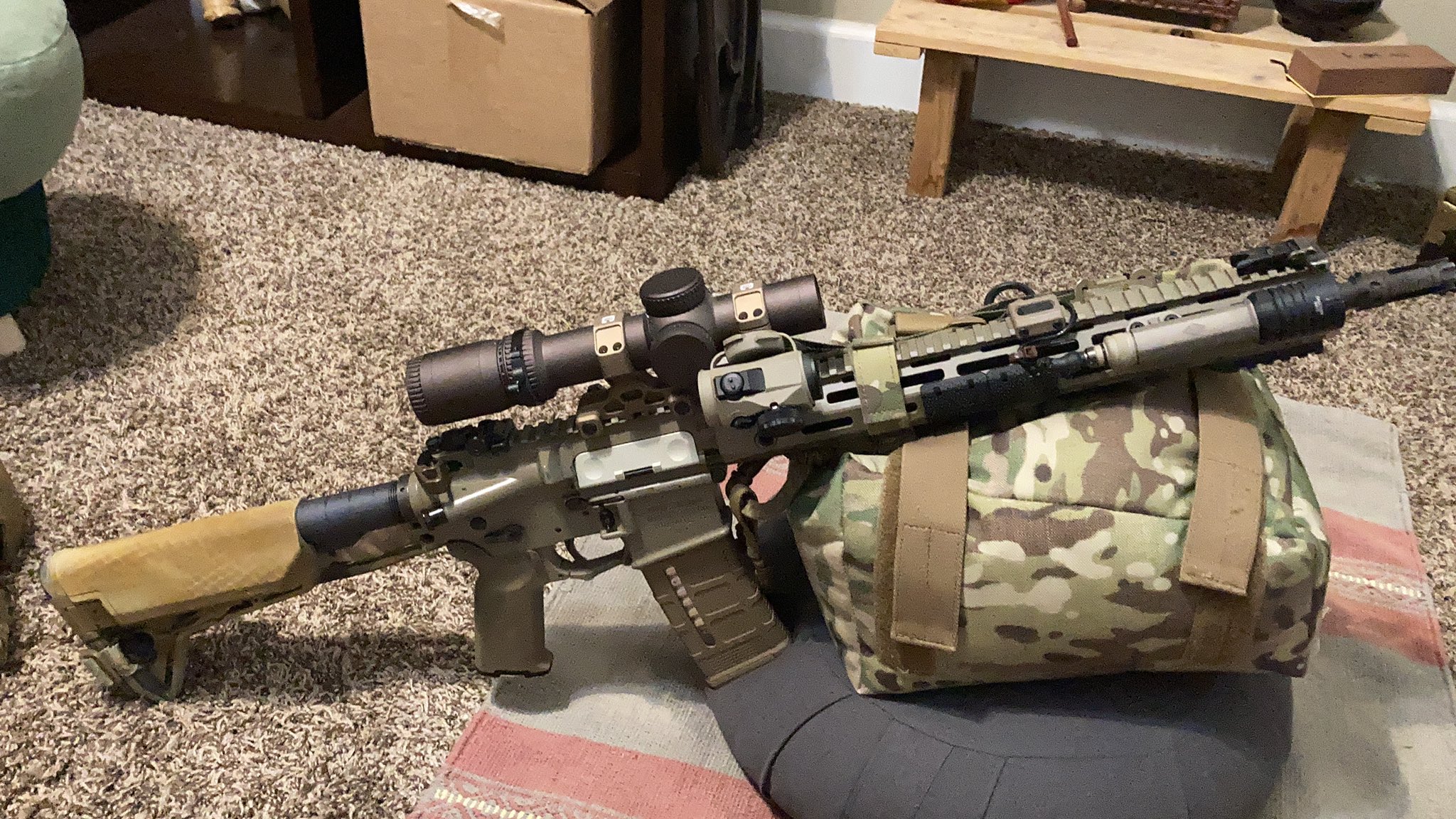
LPVO stands for Low Power Variable Optic. It is a single rifle scope that adjusts from 1x — which is essentially a red dot in terms of field of view — all the way up to 4x, 6x, 8x, or 10x magnification. Magpul describes it as the “do-it-all optic” for AR-15 platform rifles, and that framing is accurate.
Think Swiss Army knife for rifle optics. One tube, one zero, one mount. You turn the power ring and the world gets closer. Simple in concept — less simple in execution at the cheaper end of the market.
What is a red dot and magnifier combo?
This is two separate optics living on the same rail. The red dot stays at true 1x. The magnifier — typically 3x — sits behind it on a flip-to-side mount that swings out of the way instantly when you don’t need it. Outdoor Life calls it the “fastest close-range setup you can build for an AR.”
Common pairings: Aimpoint CompM5 + Aimpoint 3X-C, or the EOTech EXPS3 + EOTech G33 magnifier. Many hunters and competition shooters swear by this format for good reasons — particularly modularity.

Side-by-Side Spec Comparison
Numbers first, then context. This table is built from manufacturer specifications — no estimates, no forum speculation.
| Feature | LPVO (1-6x typical) | Red Dot + 3x Magnifier |
|---|---|---|
| Magnification range | 1x → 6x, 8x, or 10x (continuous) | 1x or 3x (flip in/out only) |
| Weight — optic only | 17–24 oz [TFB] | 18–22 oz combined [EOTech] |
| Eye relief | 3.0–3.8 in (requires consistent head position) | 2.2–2.6 in at magnifier [EOTech G33] |
| Battery dependency | Illumination only; ETD reticle still works | Red dot dies = no aiming point |
| 1x CQB speed | Good (better with throw lever) | Excellent — fastest format |
| Precision past 300 yd | Excellent | Limited to ~300 yd practical max |
| Night vision compatibility | Limited; NV-compatible LPVOs exist but cost more | Red dots pair naturally with NODs |
| Price range | $250–$2,500 [Lynx Defense] | $400–$1,800 |
| Mount complexity | One mount, fixed and rigid | Two units + flip mechanism to maintain |
| Hunting use | Excellent for variable-range hunting | Good inside 200 yd; limited past that |
Effective Range: Where the Real Gap Shows Up
Range is the number one reason shooters switch from a red dot to an LPVO. At 1x, a 2 MOA red dot covers roughly a human torso at 300 yards. That is not precision shooting — that’s guessing.
The chart below shows practical engagement envelopes based on AmmoMan School of Guns testing and field data from Gunnr Optics.
Practical engagement envelopes — not maximum ballistic range. Source: AmmoMan & Gunnr Optics field data.
If you’re hunting deer at varying distances — say a 60-yard shot in thick brush followed by a 350-yard shot across a field — a 3x magnifier is going to leave you squinting. An LPVO handles both scenarios without breaking a sweat. Check out our guide to the best rifle scopes for hunting for a deeper look at glass selection by use case.
Weight, Eye Relief, and the Stuff You Actually Feel
People obsess over weight numbers in spec sheets but rarely mention where the weight sits. A red dot and magnifier spreads mass across two mount points. An LPVO concentrates it in a single tube forward of the receiver. Both approaches have trade-offs.
The actual weight numbers
- EOTech G33 magnifier: 10.6 oz with mount, 2.2 in eye relief [T.REX ARMS]
- Aimpoint 3X-C magnifier: 7.8 oz, 6° field of view [Aimpoint]
- Trijicon MRO HD with magnifier: 2.6 in eye relief, 7.2° FOV [Trijicon]
- Vortex Strike Eagle 1-8x FFP: ~20.9 oz, 30mm tube — a popular mid-range LPVO
- Primary Arms SLx 1-6x: ~17.6 oz — one of the lightest entry-level LPVOs
Eye box: the silent frustration
An LPVO has a demanding eye box at higher magnifications. Move your cheek off the stock by an inch and your sight picture goes dark — fast. A true red dot has virtually no eye box restriction. Any angle, any head position, the dot is there.
This matters more than most people expect in the field. Try shooting from the weak side, around a vehicle door, or from an awkward prone position. The red dot wins those situations cleanly. Gunnr Optics covers this trade-off well in their CQB LPVO guide.
✅ LPVO Wins At
- Precise hits beyond 300 yards
- Single optic, single zero, no flip mount to fail
- Bullet drop reticles for field-estimated distances
- Hunting at variable ranges
- 3-gun and PRS gas gun competition
✅ Red Dot + Magnifier Wins At
- Sub-100 yard speed and reflex shots
- Forgiving eye box at 1x — any head position
- Modular — remove the magnifier completely
- Lower-third co-witness with iron sights
- Night vision and NOD compatibility
Price Reality Check
Both systems cover roughly the same price range, but the entry points feel different and there are hidden costs on the LPVO side that catch people off guard.
| Tier | LPVO Example + Price | Red Dot + Magnifier Example + Price |
|---|---|---|
| Budget ($300–$500) | Primary Arms SLx 1-6x ACSS (~$289) Amazon | Holosun HE503CU + HM3X (~$450) Amazon |
| Mid ($500–$1,000) | Vortex Strike Eagle 1-8x FFP (~$600) Amazon | Vortex UH-1 + VMX-3T (~$700) Amazon |
| Premium ($1,000–$2,500) | Vortex Razor Gen 3 1-10x (~$2,100) / Nightforce ATACR Amazon | EOTech EXPS3 + G33 (~$1,400) Amazon |
Also consider: if you already own a solid red dot, adding a magnifier can cost as little as $150–$200 (budget Vortex VMX-3T, for example). That is a meaningful upgrade for very little money. It won’t match a premium LPVO at 400 yards — but it will get you to 250 yards without replacing your entire optic system.
What the Military Actually Uses — and Why
Military optic choices are not made by a guy at a gun store. They go through extensive field trials, budget reviews, and mission analysis. When the Army or Marines pick an optic, it is worth paying attention.
U.S. Army — LPVO for the Designated Marksman
The Army selected the SIG SAUER TANGO6 1-6×24 for the M110A1 Squad Designated Marksman Rifle. The mission requirement was engaging enemy personnel at distances out to 600 meters. A 3x magnifier combo does not solve that problem.
U.S. Marine Corps — LPVO for every rifleman
The USMC took it further. They selected the Trijicon VCOG 1-8×28 as the Squad Common Optic under a $64 million contract. Every rifleman, not just designated marksmen. That is the most significant institutional endorsement an LPVO has ever received.
Special Operations — still a mixed picture
Special operations units run both. Close-quarters specialists favor red dots for speed. Overwatch and recon teams use LPVOs for reach and identification. The mission drives the optic choice — not brand loyalty. Gunnr Optics covers this trade-off well in their tactical scope breakdown.
Which One Is Right for You?
Forget what your buddy runs. Forget what looks cool at the range. Your use case is the only thing that matters here. Below is a decision guide built from common shooter profiles.
🔭 Choose an LPVO if you…
- Hunt deer, hogs, or coyotes at variable distances
- Shoot 3-gun or PRS gas-gun competitions
- Need positive identification past 200 yards
- Want one optic that handles everything reasonably
- Run a duty or patrol rifle in rural environments
- Shoot longer-range steel or varmint targets
🔴 Choose a Red Dot + Magnifier if you…
- Build a home-defense or truck gun
- Shoot drills inside 100 yards 90% of the time
- Have astigmatism that blurs LPVO reticles
- Use night vision — red dots pair far better with NODs
- Want the option to run pure 1x by removing the magnifier
- Already own a quality red dot and just want more reach
The astigmatism factor — don’t ignore this
Astigmatism blurs illuminated reticles in a scope’s eye box. Many LPVO shooters with mild astigmatism see a starburst or smear instead of a sharp crosshair. A holographic sight like the EOTech largely eliminates that problem. If this applies to you, test before you buy — or the internet forums will make this decision for you at 2 AM.
What about adding an offset red dot to an LPVO?
This is a popular solution — and a genuinely good one. A small red dot mounted at 12 o’clock or 45 degrees gives you instant 1x for CQB while your LPVO handles distance. You get the best of both worlds at the cost of about 1.5 oz extra weight. The Firearm Blog covered this setup in detail.
For more on how to set up a complete optics system for your rifle, our guide on choosing the right optic for your firearm walks through the full decision process by use case.
Skip both for now if…
You have fewer than 500 rounds through your rifle. Seriously. Learn the fundamentals with a quality red dot first. Then upgrade once you understand what kind of shooting you actually enjoy. Buying a $1,400 LPVO as your first optic is like buying a Ferrari before you know how to drive stick.
Frequently Asked Questions
Is an LPVO good for home defense?
An LPVO at 1x works, but it is not the ideal home-defense optic. The eye box is less forgiving in dynamic indoor movement, and a true red dot acquires faster under stress and low light. Most home-defense builds run a dedicated red dot for those reasons.
Can I put a red dot on top of an LPVO?
Yes — this is called a piggyback or offset red dot setup, and it is very popular. You get LPVO precision plus instant 1x access via a small red dot at 45 degrees or 12 o’clock. It adds about 1.5 oz to the build and solves the CQB transition problem completely.
1-6x, 1-8x, or 1-10x — which LPVO is best for most people?
A 1-6x offers the best combination of weight, image quality per dollar, and forgiving eye box. A 1-8x adds genuine reach for hunters and precision shooters. A 1-10x is impressive on paper but costs significantly more for the same optical quality per dollar. Gunnr’s deep dive on LPVO magnification covers this well.
Does a magnifier affect my zero?
No. The magnifier sits behind the red dot and enlarges the image without changing the optic. Your zero stays with the red dot. What you do need to verify is that the magnifier and red dot are at matching height — either lower-third or absolute co-witness. A mismatch causes a parallax-like offset at the magnifier.
Are LPVOs durable enough for real field use?
Modern LPVOs from Trijicon, Vortex, Nightforce, and Leupold pass MIL-STD-810G drop and immersion testing. The USMC’s VCOG is machined from 7075-T6 forged aluminum specifically for combat use — it is more durable than many rifle receivers. GAT Daily covered the VCOG construction specs in detail.
What is the best budget LPVO in 2026?
The Primary Arms SLx 1-6×24 with the ACSS reticle is consistently recommended at the budget end — real performance for around $289. The ACSS reticle includes a bullet drop compensator and moving target leads built in. Check price on Amazon
For night vision optic options in low-light hunting scenarios, our digital night vision rifle scope guide has a relevant section on mounting optics alongside NODs.
Final Verdict
There is no universal winner. Anyone who tells you otherwise is selling something. But there is a right answer for most people most of the time.
If someone handed me a blank-slate AR-15 and asked for the single best optic for a shooter who hunts, competes occasionally, and wants to be capable from 0 to 400 yards — I would pick a quality 1-6x LPVO without hesitation. The Army and Marines reached the same conclusion after exhaustive field testing, and they had a slightly bigger budget than your average range day.
The red dot and magnifier combo still owns close-range speed and modularity. If your world is inside 200 yards, home defense, or CQB work — go that route. It is faster, simpler, and still very capable.
🎯 Bottom Line by Use Case
- Budget under $500 + close-range focus: Red dot + magnifier combo wins
- Budget under $500 + mixed or longer range: Primary Arms SLx 1-6x LPVO wins
- Hunting at variable distances: LPVO — it’s not close
- Home defense / truck gun: Quality red dot, skip the magnifier entirely
- Premium duty or competition rifle: LPVO with an offset red dot
- Night vision builds: Red dot (any brand) + NOD-compatible mount
Still building out your full optics kit? Our best spotting scopes for hunting guide covers the glassing side of the equation — because finding the target is step one.
Sources & References
- SIG Sauer — TANGO6 1-6×24 selected for U.S. Army SDMR
- Trijicon — VCOG 1-8×28 selected as USMC Squad Common Optic ($64M contract)
- U.S. Army CPE Ground — M110A1 SDMR program page
- EOTech — G33 Magnifier official specifications
- Aimpoint — 3X-C Magnifier specifications
- Trijicon — MRO HD with 3X Magnifier official specs
- The Firearm Blog — Red Dot & Magnifier vs LPVO
- Gunnr Optics — 1-6x vs 1-8x vs 1-10x LPVO comparison
- Gunnr Optics — Why LPVOs make great tactical scopes
- Lynx Defense — 10 Best LPVOs for 2026
- AmmoMan School of Guns — Optics Test: LPVO vs Red Dot field data
- T.REX ARMS — EOTech G33 / G45 overview and specs
- Green Ops / Magpul — Behind the LPVO
- GAT Daily — Trijicon VCOG SCO 1-8 MRAD construction and field review
- Outdoor Life — Best Red Dot Magnifiers guide

Charmaine van Vuuren is a seasoned professional hunter and safari guide turned outdoor gear expert, with over 15 years of experience leading big-game expeditions and wilderness adventures across Southern Africa. That same field-tested expertise now drives every review on TheOutdoorChamp — from hunting gear and survival tools to camping equipment, fishing tackle, and boating accessories. When she recommends a product, it’s because she’s used it in conditions where failure isn’t an option.


