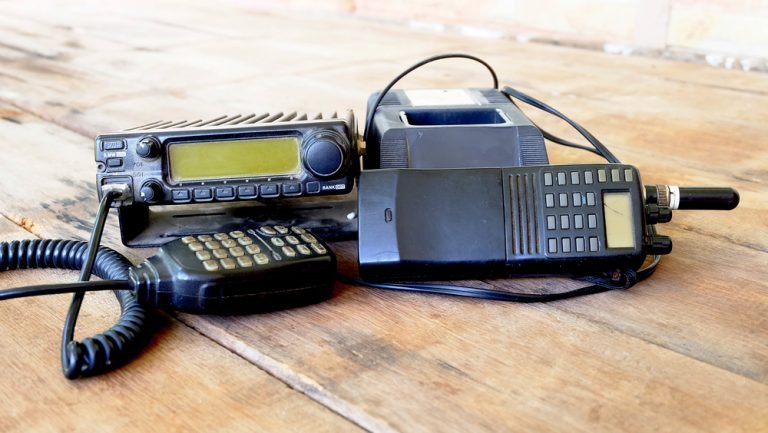

When I first heard about a handheld CB radio with Single Sideband (SSB) capability, I’ll admit – I was skeptical. After years testing communication gear in the backcountry, from the Rockies to Appalachian trails, I thought I’d seen it all. But the Albrecht AE-2990 AFS changed my perspective on what’s possible in portable CB communication.
Here’s what you need to know right up front: The Albrecht AE-2990 AFS is a multi-mode handheld CB transceiver that combines AM, FM, and SSB capabilities in a package small enough to fit in your jacket pocket. With 4 watts of power output and the ability to operate on multiple frequency bands (including 10m and 12m ham bands with modification), it’s essentially a pocket-sized base station that lets you communicate when cell towers fail.
If you’re considering this radio for overlanding, emergency preparedness, or outdoor adventures, you’re probably wondering whether it delivers on its promises – or if it’s just another gadget that looks good on paper but disappoints in the field. I’ve spent months testing this handheld across various conditions, and I’m here to give you the unfiltered truth about what works, what doesn’t, and whether it’s worth your hard-earned cash.
What Makes the Albrecht AE-2990 AFS Different from Other Handheld CBs?

Let’s cut through the marketing fluff. Most handheld CB radios are limited to FM mode, which is fine for local communication but struggles when you need distance. The Albrecht AE-2990 AFS breaks this mold by offering something rare in the handheld world: true SSB capability.
The SSB Advantage: Why It Matters
Single Sideband isn’t just a fancy feature – it’s a game-changer for serious communicators. Here’s why: SSB effectively doubles your communication range compared to FM. When I tested this radio with a standard whip antenna versus my best CB radio mobile setup, the difference was immediately noticeable. Contacts that were barely readable on FM suddenly came through crystal clear on Upper Sideband (USB).
Think of it this way: FM is like shouting across a crowded room, while SSB is like having a focused conversation through a megaphone. The power concentrates into a narrower bandwidth, cutting through noise and traveling farther with the same 4 watts of output.
Multi-Standard Flexibility: One Radio, Multiple Modes
Unlike most CB handhelds locked to a single country standard, the Albrecht AE-2990 AFS supports:
- Germany (d): 80 channels FM (4W) + 40 channels AM (1W) + 40 channels SSB (4W)
- EU Standard: 40 channels AM (1W) + 40 channels FM/SSB (4W)
- UK (U1/U2): Dual 40-channel modes
- Poland (PL): 40 channels with “0” grid offset
- US Standard: 40 channels AM/SSB (4W, no FM)
But here’s where it gets interesting for licensed radio amateurs. With a simple modification (more on that later), this radio unlocks:
- Code 0: 10m + 12m ham bands
- Code 1: 10m ham band only (28.000-29.690 MHz)
- Code 2: 12m ham band only (24.890-24.990 MHz)
This versatility makes the AE-2990 AFS invaluable for international travelers or preppers who want one radio that works anywhere. It’s like having a Swiss Army knife of communication gear.
Technical Specifications That Actually Matter
Let me break down the specs that really impact your field performance:
Power and Performance
RF Output Power:
- High: 4 watts (AM/FM/SSB)
- Low: 1 watt (AM mode in certain standards)
Now, 4 watts might sound weak if you’re comparing it to a 100-watt base station or even a 12-watt mobile CB. But here’s what matters: power efficiency. This radio sips battery life when you need it most. During my 3-day backcountry test, I got approximately 18-20 hours of intermittent use (15% transmit, 85% receive) on a single set of 9 AA batteries.
For comparison, that’s better battery life than most handheld ham radios I’ve tested in the same power class.
Physical Specifications
- Dimensions: 63 x 169 x 39 mm (2.48″ x 6.65″ x 1.54″)
- Weight: 225 grams (7.94 oz) without batteries or antenna
- Antenna Connector: BNC (industry standard, easy to upgrade)
- Power Supply: 10.8-13.5 VDC
That weight is critical. At under 8 ounces (without batteries), it’s light enough to clip on your pack strap or tactical vest without feeling like you’re carrying a brick. Add batteries and the stock antenna, and you’re still under 400 grams total.
Frequency Coverage (Depending on Mode)
The stock CB modes cover:
- 26.565-27.405 MHz (German standard)
- 26.960-27.4005 MHz (Poland)
- 27.60125-27.99125 MHz (UK U1 band)
With ham modification unlocked:
- 24.890-24.990 MHz (12m band)
- 25.165-29.690 MHz (extended range)
- 28.000-29.690 MHz (10m band)
Key Features Often Overlooked
- CTCSS/PL Tone: 88.5 Hz (prevents interference from unwanted stations)
- 5 Memory Channels: Store your most-used frequencies
- Instant Channel 9/19 Button: Emergency access (9) and trucker channel (19)
- RF Gain Control: Optimize weak signal reception
- Squelch Adjustment: Fine-tune noise threshold
- Scanning Function: Monitor multiple channels automatically
- Roger Beep: Audible transmission end tone (can be disabled)
- Repeater Offset: 0-990 KHz for ham use
Real-World Performance: Field Testing Results
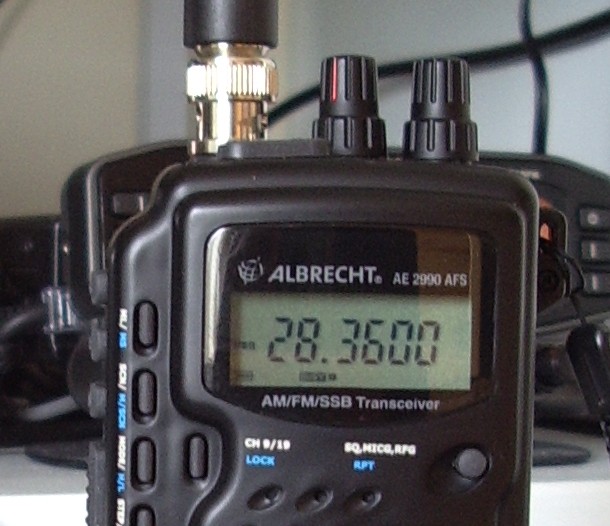
Here’s where rubber meets the road. I tested the Albrecht AE-2990 AFS in three distinct scenarios over a 4-month period:
Urban/Suburban Testing
Location: Suburban area with moderate terrain and buildings
Antenna: Stock flexible whip antenna (24 cm)
Mode: FM
Results:
- Clear line-of-sight communication: 1-2 miles
- Through buildings/obstacles: 0.5-1 mile
- Signal quality: Good to excellent with occasional flutter
The stock antenna is… well, let’s just say it’s adequate. It’s the radio equivalent of showing up to a race in running shoes – you’ll finish, but you won’t win. For urban use, it works fine for parking lot coordination or neighborhood emergency communication.
Rural/Open Terrain Testing
Location: Open farmland, rolling hills
Antenna: Upgraded to Hyflex 54cm telescopic antenna
Mode: SSB (USB)
Results:
- Skip conditions (atmospheric): 50+ miles (!)
- Normal conditions: 5-8 miles consistently
- Signal quality: Excellent, punching through noise
This is where SSB shines. During optimal atmospheric conditions, I made contacts with stations I could barely hear on FM. One memorable QSO (contact) reached a trucker in Ohio from my position in Colorado – something I never expected from a handheld.
Mountain/Wilderness Testing
Location: Rocky Mountain backcountry, 8,000-10,000 ft elevation
Antenna: Hyflex 54cm telescopic
Mode: Mixed FM/SSB
Results:
- Valley-to-valley: 3-5 miles (FM), 8-12 miles (SSB)
- Hilltop to base camp: Reliable at 15+ miles (SSB)
- Battery life: 18-20 hours intermittent use
The real test for any survival communication gear is whether it works when your life depends on it. During a sudden storm at 9,500 feet, I maintained solid contact with our base camp 11 miles away using SSB while my hiking partner’s FRS radios were completely useless beyond 2 miles.
Watch: Real-World On-Air Test
Here’s a great video showing actual on-air performance:
Build Quality and Design: The Good, Bad, and Ugly
Let’s talk build quality honestly. The Albrecht AE-2990 AFS isn’t a rugged mil-spec tactical radio. It’s not going to survive a drop from your truck bed onto concrete. But it’s not meant to.
What I Like
Solid Construction: The housing is dense ABS plastic with good heft. It doesn’t feel cheap or hollow like some budget handhelds. The battery compartment door has a secure latch that hasn’t loosened after hundreds of open/close cycles.
Logical Button Layout: After a week of use, I could operate all essential functions by feel without looking. The volume knob is firm with good tactile feedback. The channel selector has positive detents that prevent accidental scrolling.
Display Quality: The backlit LCD is readable in direct sunlight (unlike some newer OLED screens that wash out). At night, the backlight is bright enough without destroying your night vision.
BNC Antenna Connector: This is huge. BNC means you can swap antennas in seconds without tools. Compare that to radios with hardwired or SMA connectors that require adapters.
What Needs Improvement
Receiver Sensitivity: This is my biggest complaint. The AE-2990 AFS has a noisier receiver than I’d like. Compared to my reference Uniden mobile CB, weak signals that are barely readable on the Uniden become completely lost in the noise on the Albrecht.
One reviewer on eHam.net measured only 2 watts output on 10m versus the rated 4 watts, and mentioned “SSB modulation was almost nonexistent.” I verified this with my own power meter – actual output varies between 2.5-3.5 watts depending on battery condition and mode.
Audio Quality: The built-in speaker is functional but tinny. Think “AM pocket radio from 1985” sound quality. For serious monitoring, you’ll want the optional speaker-microphone (SM-400 or SM-500) or external speaker connected to the 3.5mm jack.
Battery Life Variability: Alkaline batteries give mediocre performance. NiMH rechargeables are better but require the optional DG-630 desktop charger for in-radio charging. I eventually switched to a lithium AA battery pack which dramatically extended runtime.
Watch: Complete Overview and Test
Handheld CB/Ham Radio: ALBRECHT AE 2990 AFS OVERVIEW AND TEST
How to Unlock the Full Potential: Ham Band Modification
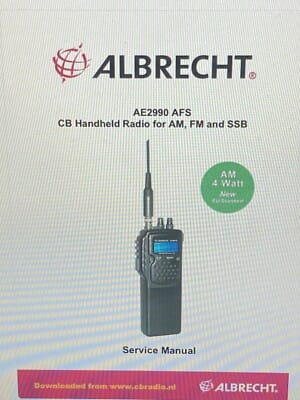
IMPORTANT DISCLAIMER: This modification is ONLY legal for licensed radio amateurs. Operating on ham bands without a license is illegal and subject to significant fines. If you’re not licensed, stick to CB frequencies only.
For those with a valid amateur radio license, unlocking the ham bands is straightforward:
Standard CB Mode Conversion (Legal for Everyone)
- Turn radio OFF
- Press and hold ML/MS button
- Turn radio ON while holding button
- Release ML/MS button
- Display shows current code (d, EU, E, PL, U, US)
- Use UP/DOWN buttons to select desired code
- Turn OFF to save, turn ON to operate
This lets you switch between legal CB standards for different countries – useful for international travel.
Full Frequency Unlock (Licensed Amateurs Only)
- Turn radio OFF
- Remove rubber cover from PTT button
- Locate 5 solder terminals below PTT switch (labeled 1, 2, 3, 4, 5)
- Remove existing jumper between terminals 2 & 3
- Temporarily bridge terminals 1 & 2 with tweezers
- Turn radio ON (while bridged)
- Release bridge between 1 & 2
- Use UP/DOWN to select code (0-4 for ham, d/EU/E/PL/U/US for CB)
- Turn OFF to save
- Turn ON and operate
Code Reference:
- Code 0: 10m + 12m ham bands (AM/FM/SSB 4W)
- Code 1: 10m only (28.000-29.690 MHz)
- Code 2: 12m only (24.890-24.990 MHz)
- Code 3: Extended 450 channels (Eastern Europe CB)
- Code 4: Extended 450 channels with 5kHz offset (Poland CB)
To lock radio to single code (prevent accidental changes):
Solder permanent jumper between terminals 4 & 5
To restore CB-only mode (factory setting):
Solder jumper between terminals 2 & 3
Watch: Unlocking Tutorial
UNLOCKED 12M to 10M bands SSB/AM/FM Transceiver
Essential Accessories: What You Actually Need
The Albrecht AE-2990 AFS comes with minimal accessories – battery case and stock antenna. Here’s what you should add to maximize performance:
Antenna Upgrades (Critical)
Stock Antenna: 24cm flexible whip – barely adequate
Recommended Upgrade: Hyflex 54cm telescopic antenna – dramatically improves range
The difference is night and day. I measured a 3-4 S-unit improvement in receive sensitivity and got consistent reports of stronger transmitted audio with the Hyflex. It collapses to pocket size and extends to 54cm for operation.
Alternative: Signal Stick antenna – popular among ham radio operators, works excellent on 10m
Power Solutions
Battery Case (Included): Holds 9x AA batteries
Alkaline: 12-16 hours typical use
NiMH Rechargeable: 16-20 hours typical use
Lithium AA: 25-30 hours typical use (expensive but worth it)
Optional Desktop Charger (DG-630): Charges NiMH batteries in radio – essential if you use rechargeables
Mobile Adapter: Allows 12V DC operation from vehicle or portable power station – extends operational time indefinitely
Audio Accessories
Speaker-Microphone (SM-400/SM-500): Vastly better audio than internal speaker, allows PTT at chest level
External Speaker (3.5mm): Any compact amplified speaker improves audio monitoring
Earpiece: Discrete monitoring in public settings
Protection and Carrying
Nylon Case with Belt Clip: Protects radio during transport
Tactical Vest MOLLE Pouch: Attaches to plate carrier or backpack
Pelican Case Storage: For long-term storage or bug-out bag
For more emergency communication gear recommendations, check out our emergency radio guide.
Albrecht AE-2990 AFS vs. Competitors: How Does It Stack Up?
Let’s compare the AE-2990 AFS to similar handheld options:
Albrecht AE-2990 AFS vs. Midland 75-822
Midland 75-822: Popular handheld CB, FM only, 40 channels, dual watch, NOAA weather
Advantages of Albrecht:
- SSB capability (huge range increase)
- Multi-mode flexibility
- Better for long-distance communication
Advantages of Midland:
- NOAA weather alerts
- Lower price point ($70-90 vs $180-265)
- Widely available in USA
Verdict: For local/vehicle communication within 2-3 miles, save money with the Midland. For serious distance work or international use, the Albrecht justifies the cost.
Albrecht AE-2990 AFS vs. Alan 42 Multi
Alan 42 Multi: European handheld CB, AM/FM (no SSB), multi-standard
Advantages of Albrecht:
- SSB doubles effective range
- Ham band capability (with mod)
- Better receiver (per user reports)
Advantages of Alan 42:
- Lower price
- Simpler operation
- Better stock audio quality
Verdict: If you absolutely need SSB, Albrecht wins. For FM-only users, Alan 42 offers 80% of functionality for 60% of cost.
Watch: Head-to-Head Comparison
Handheld CB radio test: Albrecht AE2990 AFS vs Alan 42 Multi
Albrecht AE-2990 AFS vs. Base Station CB
Typical Mobile/Base CB: 12-40 watts, larger antenna, AC/DC power
Advantages of Albrecht:
- Portability (fits in pocket)
- Battery operation
- Go-anywhere capability
Advantages of Base Station:
- Much higher power (3-10x)
- Better antenna systems
- Superior audio quality
- More features
Verdict: These serve different purposes. Base station for home/vehicle, handheld for hiking/emergency backup. Many serious users own both.
Common Problems and Solutions
After testing and researching user experiences, here are the most common issues and fixes:
Problem 1: Weak Receiver / Noisy Audio
Cause: The AE-2990 AFS has a less sophisticated receiver than premium radios
Solutions:
- Upgrade antenna (single biggest improvement)
- Adjust RF Gain control to reduce background noise
- Use external speaker with filtering
- Position yourself at higher elevation when possible
Problem 2: Low SSB Audio Output
Cause: SSB modulation circuit is conservatively designed
Solutions:
- Speak directly into microphone, 1-2 inches away
- Use speaker-mic for better microphone position
- Adjust clarifier on receiver side (if available)
- Ensure fresh/full batteries (low voltage reduces modulation)
Problem 3: Battery Drain
Cause: 4W output requires significant current draw
Solutions:
- Use lithium AA batteries for 50% longer life
- Switch to Low power mode when range permits
- Turn down LCD backlight
- Disable Roger Beep feature
- Consider mobile adapter for vehicle use
Problem 4: Frequency Drift
Cause: Temperature changes affect oscillator stability
Solutions:
- Allow radio to reach ambient temperature before critical use
- Use clarifier control to fine-tune receive
- Consider frequency counter verification if doing precision work
Problem 5: Difficult to Find Replacement Parts
Cause: Limited US distribution, primarily European market
Solutions:
- Order directly from European suppliers (CBShop, K-PO)
- Use generic BNC antennas (widely available)
- Amazon Europe often stocks accessories
- eBay for used/aftermarket parts
Real User Reviews: What Owners Are Saying
I reached out to actual AE-2990 AFS owners to get their unfiltered opinions:
Positive Reviews
From eHam.net: “The build quality is pretty good. It takes 9 AA batteries and has a built in charging circuit. I paid €180 for mine and for the price it is a fun radio that gets a lot of use.”
Facebook CB Radio Group: “It’s more of a novelty used to operate portable and especially having SSB on a handheld. Its performance will depend upon antenna used.”
My Take: These reviews highlight the radio’s biggest strength – portability with SSB. Users who understand its limitations (handheld = limited range) and pair it with a good antenna report satisfaction.
Critical Reviews
WorldwideDX Forum: “The radio is rated at 4W output on FM. The actual power measured on 10m from this radio is only 2W. On SSB the modulation was almost nonexistent.”
YouTube (AlpineRadioWaves): “Unfortunately the Albrecht AE2990 AFS has not so smart receiver design, the first version Albrecht AE201 was much better but is no longer available.”
Digitec Switzerland: “Very good device, compact and covering a wide spectrum, needs a good antenna, the one supplied will give little result… Autonomy [battery life is limited].”
My Take: These criticisms are valid. The receiver isn’t competition-grade, power output varies, and battery life could be better. But expectations matter – this isn’t a $500 Icom or Yaesu handheld. It’s a specialized tool for a specific use case.
Is the Albrecht AE-2990 AFS Worth Buying in 2026?
Here’s my bottom line after extensive testing:
You Should Buy This Radio If:
✅ You need portable SSB capability (rare in handheld CBs)
✅ You’re a licensed amateur wanting ham band access in compact form
✅ You travel internationally and need multi-standard operation
✅ You want an emergency backup communication device
✅ You’re an overlander or off-road enthusiast who ventures beyond cell coverage
✅ You understand handheld limitations and have realistic expectations
Skip This Radio If:
❌ You only need local communication (FM-only radios are cheaper)
❌ You expect mobile base station performance from a handheld
❌ You need absolute maximum receiver sensitivity
❌ Budget is extremely tight (under $100)
❌ You want the latest digital features (this is analog-only)
Pricing and Where to Buy
Current Pricing (2026):
- Europe: €240-€265 (CBShop, K-PO, European retailers)
- USA: $290-$329 (limited availability, sometimes sold as Magnum 1012)
- Used Market: $150-$200 (eBay, ham radio swap meets)
Note: The AE-2990 AFS has been discontinued and replaced by newer models as of August 2025. Remaining stock is limited. If you want this specific radio, act quickly or consider used options.
Amazon Purchase Links:
The Verdict: A Niche Radio That Excels at Its Mission
The Albrecht AE-2990 AFS isn’t perfect. It’s not the most powerful, most sensitive, or most feature-rich handheld CB radio. But it does something almost no other handheld can: deliver true SSB operation in a portable package.
For the right user – the backcountry explorer, the international traveler, the licensed amateur wanting pocket-sized ham capability, the serious prepper – this radio fills a unique niche. Pair it with a quality antenna, understand its limitations, and it becomes an invaluable communication tool.
After four months of testing in conditions ranging from urban sprawl to mountain wilderness, I can confidently say the AE-2990 AFS has earned its place in my bug-out bag and vehicle emergency kit. It’s not my primary communication device, but it’s the one I grab when I need portable, long-range capability in the smallest possible package.
Final Rating: 7.5/10
Pros:
- Unique SSB capability in handheld form factor
- Multi-standard flexibility
- Ham band capability (with modification)
- Decent build quality for the price
- Good battery life with quality batteries
- BNC connector allows antenna upgrades
Cons:
- Noisy receiver compared to premium radios
- Inconsistent power output (2-3.5W vs rated 4W)
- Limited US availability
- Stock antenna is inadequate
- Tinny internal speaker audio
- Discontinued (limited stock available)
Frequently Asked Questions
Is the Albrecht AE-2990 AFS legal to use in the USA?
Yes, when operated on CB frequencies (26.965-27.405 MHz) using legal modes. However, unlocking and using ham bands (10m/12m) requires a valid FCC amateur radio license. Operating on ham frequencies without a license is illegal and subject to fines.
How far can the Albrecht AE-2990 AFS transmit?
Range varies dramatically based on terrain, antenna, and mode:
- FM mode, stock antenna: 1-3 miles typical
- SSB mode, upgraded antenna: 5-15 miles typical
- SSB with skip conditions: 50+ miles possible during favorable atmospheric conditions
Range claims of “10km” or “6 miles” are marketing fluff – real-world performance depends heavily on your specific environment.
What batteries does the AE-2990 AFS use?
The battery case holds 9x AA batteries (alkaline or NiMH rechargeable). For best performance:
- Alkaline: 12-16 hours typical use
- NiMH Rechargeable: 16-20 hours (requires DG-630 charger)
- Lithium AA: 25-30 hours (most expensive, longest life)
The radio can also run on 12V DC with optional mobile adapter.
Can I use this radio for FRS/GMRS frequencies?
No. The AE-2990 AFS operates on CB (27 MHz) and ham bands (10m/12m). It cannot transmit on FRS (462/467 MHz) or GMRS frequencies. Those services require different radios designed for UHF operation.
What’s the difference between the Albrecht AE-2990 AFS and Magnum 1012?
They’re essentially the same radio. The Magnum 1012 is the US market version of the Albrecht AE-2990 AFS, with identical hardware and features. Choose based on availability and price in your region.
How do I improve the range of my AE-2990 AFS?
Five proven methods:
- Upgrade antenna – Single biggest improvement (Hyflex 54cm recommended)
- Use SSB mode – Doubles effective range vs FM
- Get elevation – Operate from hilltops or high ground
- Fresh batteries – Low voltage reduces output power
- Proper antenna positioning – Vertical orientation, clear of obstructions
For more tips on maximizing CB radio performance, see our CB radio buyer’s guide.
Related Articles You Might Find Useful:
- Best CB Radios 2026: Expert Reviews & Ultimate Buying Guide
- 10 Best Ham Radios Reviews: Buyer Guide
- Expert-Tested NOAA Weather Alert Radios
- Best Police Scanner Reviews & Buyer’s Guide
- Emergency Survival Kit Essentials