
Pepper gel vs pepper spray — pepper gel is the better choice for most women and everyday carry in 2026, delivering longer range (up to 18 feet vs 12 feet), virtually zero wind blowback, safer indoor use, and an intensifying potency effect when an attacker rubs it — at only $5–$10 more per canister. Standard pepper spray wins in one specific scenario: facing multiple attackers outdoors where wide-area coverage matters more than precision.
Key Takeaways
- Pepper gel and pepper spray contain the same active ingredient — oleoresin capsicum (OC) — and produce the same burning, vision impairment, and respiratory effects lasting 20–45 minutes — SABRE Red
- Pepper gel fires in a ballistic stream reaching up to 18 feet in most models vs 10–15 feet for standard spray — a critical extra standoff distance — SafeWise, 2026
- Gel’s thick, viscous formula resists wind blowback — aerosol spray, especially cone/fog patterns, can drift back into the user’s face in mild outdoor breeze
- Pepper gel does not atomize indoors — making it safe to deploy in stairwells, parking garages, hallways, and home settings without room saturation — Premier Body Armor
- Gel increases in potency when rubbed — the sticky formula spreads deeper into the attacker’s eyes when they instinctively try to wipe it off, an effect aerosol spray does not have — Mace Brand
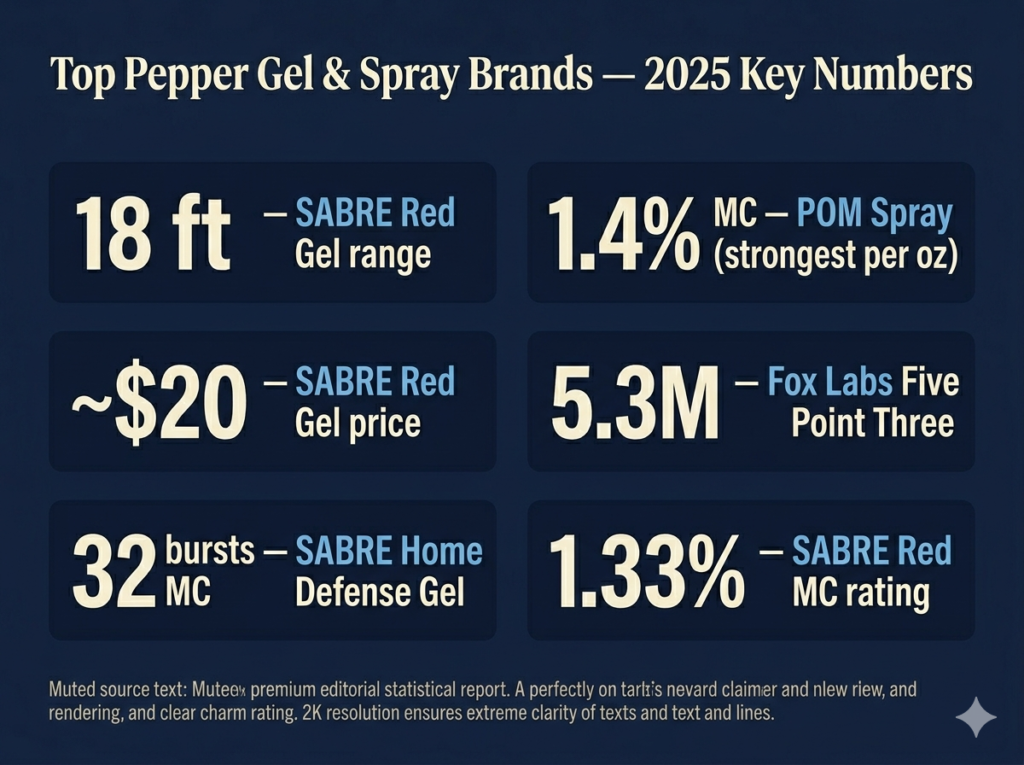
- SABRE Red Pepper Gel (~$20, 18 ft range, 1.33% MC) is the most widely recommended consumer gel; SABRE Crossfire extends to 20 feet for home defense — SafeWise top pick 2026
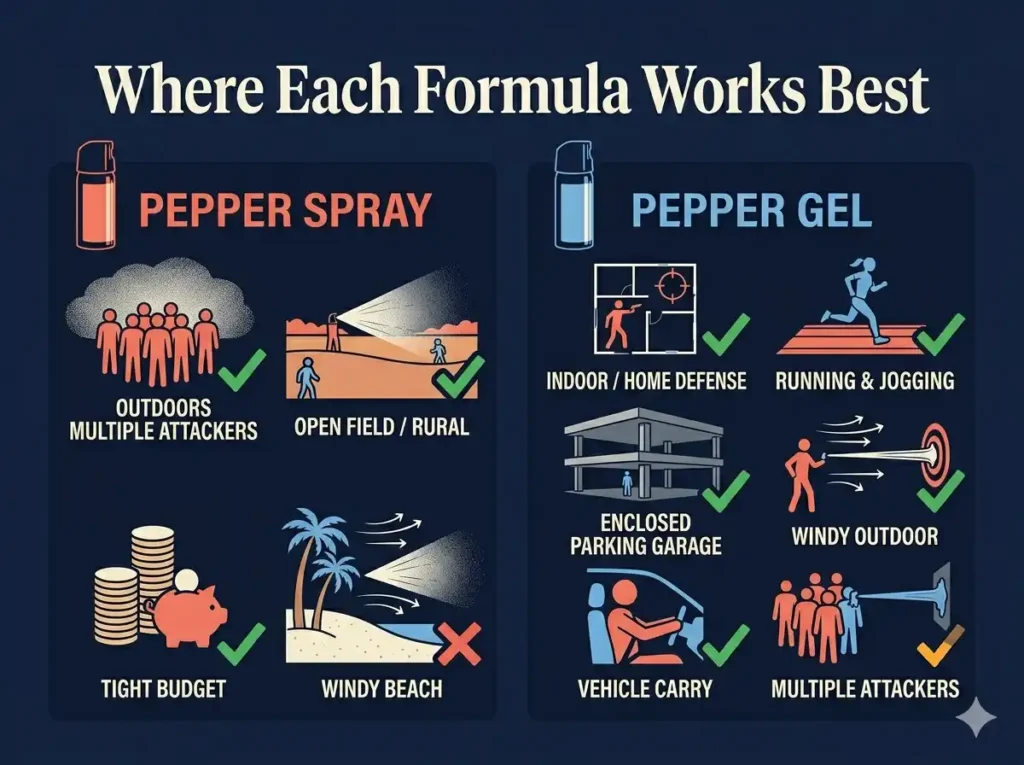
- Pepper spray retains one key edge: cone and fog patterns cover wider areas faster, making them better against multiple attackers outdoors — Premier Body Armor
What Is the Actual Difference Between Pepper Gel and Pepper Spray?
The chemistry inside the canister is identical. Both pepper gel and pepper spray are built on oleoresin capsicum (OC) — a concentrated extract from chili peppers in the genus Capsicum — suspended in a carrier liquid and pressurized for delivery. When it contacts an attacker’s eyes, skin, and airways, OC triggers intense burning, involuntary eye closure (blepharospasm), and respiratory distress that lasts 20–45 minutes. As SABRE explains, pepper gel is made the same way as pepper spray but dispensed as a thicker substance with a more targeted stream.
The single difference is the delivery medium. Traditional pepper spray suspends OC in a lightweight liquid that atomizes into a fine mist, cone, stream, or fog when released. Pepper gel suspends the same OC in a thick, viscous gel base — similar in consistency to hair gel — that fires as a coherent, ballistic stream rather than dispersing into airborne particles. That one physical difference produces a cascade of practical consequences that matter enormously in a real self-defense situation.

How Does Pepper Gel Compare to Pepper Spray? (Full Head-to-Head)
The table below covers every factor that matters in a real-world self-defense decision — not just marketing copy from manufacturers.
| Factor | Pepper Spray | Pepper Gel | Edge |
|---|---|---|---|
| Active Ingredient | Oleoresin capsicum (OC) | Oleoresin capsicum (OC) | Tie |
| Effective Range | 10–15 ft (stream); 6–10 ft (cone/fog) | Up to 18 ft (most models) | Gel |
| Wind Blowback Risk | High (cone/fog); moderate (stream) | Very low — ballistic stream resists drift | Gel |
| Indoor Safety | Poor — atomizes and saturates room air | Excellent — does not atomize | Gel |
| Accuracy Required | Low (cone/fog); moderate (stream) | Moderate — must aim at face/eyes | Spray |
| Multiple Attackers | Better — wide dispersal covers more area | Less effective — single targeted stream | Spray |
| Onset Speed | Faster — fine mist reaches eyes/airways quickly | Slightly slower — gel must contact and spread | Spray |
| Sticks to Attacker | No — mist can be partially wiped/blown off | Yes — forms adhesive blindfold on face | Gel |
| Potency When Rubbed | Decreases — wipes off | Increases — spreads deeper into eyes/skin | Gel |
| Bystander Risk | Higher — airborne particles can drift | Lower — contained stream, minimal drift | Gel |
| OC Concentration | 2–10% OC typical | 2–10% OC; gels tend toward higher end | Gel (slight) |
| Cost | $10–$25 (quality brands) | $15–$30 (quality brands) | Spray (slight) |
| Availability | Widely available everywhere | Widely available; more SKUs in spray | Spray (slight) |
| Best Use: Outdoors | Moderate (wind risk with cone/fog) | Excellent — wind-resistant stream | Gel |
| Best Use: Indoors | Poor (room saturation risk) | Excellent — recommended choice | Gel |
| Best Use: Running/Jogging | Poor — blowback at pace | Excellent — SABRE Runner Gel designed for this | Gel |
Why Does Gel’s Blowback Resistance Matter So Much?
Blowback is the single most under-discussed risk in civilian pepper spray use — and it’s the reason law enforcement trainers increasingly recommend gel for untrained civilian carriers. When you deploy a cone or fog aerosol spray outdoors, the atomized particles are light enough to be carried by even a 5–10 mph breeze. That’s a typical parking lot on a moderately windy evening. The result: the spray can partially reverse and contact your own eyes, temporarily impairing the person trying to escape. That scenario is more dangerous than not spraying at all.
Premier Body Armor’s comparison guide makes the point directly: “Aerosolized particles are light enough to drift on even a mild breeze, so you can expose yourself to them, or bystanders could be affected. Gel’s viscous formula means that it stays in a coherent stream, and is less affected by wind than mist or fog-style spray.”
For women who walk to their cars at night, jog outdoors in the morning, or keep self-defense tools in their outdoor emergency kit, wind direction is not a variable you’ll have time to calculate during an incident. Gel eliminates that calculation.
What Makes Pepper Gel Better Indoors?
Indoor use is where the difference between gel and spray becomes most critical — and where the wrong choice can actively harm you and anyone else in the space.
When aerosol pepper spray is deployed inside a small room, stairwell, hallway, or vehicle, the atomized OC particles do not stay where you aimed them. They disperse through the air, saturating the enclosed space. In a 10×10 foot room, a single cone-pattern spray discharge can contaminate the entire air volume within seconds — affecting bystanders, children, pets, and yourself. Premier Body Armor’s guide notes: “In a small room, it can affect everyone, including bystanders, colleagues, and you.”
Pepper gel does not have this problem. Because the OC is suspended in a viscous gel rather than an atomizable liquid, it fires as a coherent stream and contacts only what it hits. It does not break into airborne particles that linger in the air. This makes gel the only recommended choice for home defense, office environments, vehicles, and any enclosed space. If you live in an apartment building where a hallway encounter is possible, or keep self-defense spray in your car, gel is the appropriate formula.
What Is the “Rubbing Effect” — and Why Is It a Serious Gel Advantage?
This is one of pepper gel’s most underappreciated tactical advantages and almost never discussed in mainstream self-defense guides. When gel contacts an attacker’s face, it adheres to the skin and forms a thick layer over the eyes. Mace Brand describes it as a “temporary blindfold” — the gel physically coats the eye area and creates sustained OC contact.
The critical follow-on: when an attacker instinctively tries to wipe their eyes (an immediate, nearly universal human response to eye irritation), they are not removing the gel. They are spreading it. The rubbing action drives the OC compound deeper into the cornea and surrounding tissue, intensifying the burning and vision impairment rather than reducing it. As Blingsting notes: “If the target tries to rub it off, it actually gets more potent.”
With aerosol pepper spray, the opposite is true. Spray that lands on the face can be partially wiped away with a sleeve or hand. The aerosol particles that don’t directly contact the eyes may dissipate without full effect. Gel eliminates both failure modes — it stays, and rubbing makes it worse for the attacker and better for you.
When Is Pepper Spray Still the Better Choice?
Gel is the better everyday carry for most women in most situations — but pepper spray retains meaningful advantages in specific scenarios, and being honest about them is more useful than a blanket recommendation.
Multiple attackers outdoors
If you are facing more than one attacker simultaneously in an outdoor environment, a cone or fog spray’s wide dispersal pattern lets you sweep across multiple targets with a single continuous burst. A gel stream requires individual, accurate shots at each attacker’s face. Premier Body Armor notes: “If you’re facing multiple threats, dealing with close-quarters encounters, or in environments where wide-area coverage is more important than pinpoint accuracy, spray is probably the better choice.” This is the one scenario where foam/fog spray’s lack of precision becomes an advantage rather than a liability.
Panic situations where accurate aim isn’t guaranteed
Under extreme acute stress, fine motor control degrades significantly. A cone-pattern spray that disperses across a 3–4 foot diameter at 8 feet requires almost no accuracy to contact the face. A gel stream requires a 4–6 inch accurate aim at the same distance. For people who have never trained with a defensive tool and want the lowest-skill-threshold option, a cone spray canister — kept at short range — remains a valid choice. The tradeoff is accepted: higher risk of self-contamination, but lower chance of a complete miss under panic.
Budget-constrained multiple-carry situations
If you are outfitting yourself and a family member, or replacing canisters for multiple locations (home, car, bag, gym locker), the $5–$10 per-canister premium on gel adds up. Quality stream-pattern sprays at $10–$15 per unit from SABRE or POM are legitimate options when the budget requires equipping multiple people.

Which Pepper Gel and Pepper Spray Brands Should You Actually Buy?
Not all products are equal. The critical metric is Major Capsaicinoids (MC%) — the actual concentration of the active incapacitating compounds — not the Scoville Heat Unit (SHU) figure used in most marketing materials. The Atomic Bear’s guide for women is direct: “Look for at least 1.0% Major Capsaicinoids. Ignore marketing claims about ‘18% OC’ or ‘5 million SHU’ — these numbers are misleading.”
SABRE Red Pepper Gel
~$2018-foot range, 1.33% MC, HPLC-tested for consistency, 35 bursts, keychain or belt-clip carry. SafeWise’s top overall pick for 2026. Inert practice canisters available.
SABRE Crossfire / Home Defense Gel
$25–$3520–25 foot range, 32 bursts (5× competition), wall-mountable, does not atomize indoors. Best choice for bedroom, front door, or vehicle.
SABRE Runner Pepper Gel
~$1817-foot gel range, reflective adjustable hand strap, compact. Designed to stay in hand during a run without blowback risk when running into wind.
POM Original Pepper Spray
~$151.4% MC (strongest per ounce), patented flip-top safety, ultra-compact. Best everyday carry spray for purse or pocket. Stream pattern.
Fox Labs Five Point Three
~$245.3 million SHU, 1.2% MC, UV dye for attacker ID, preferred by many law enforcement agencies. Available in spray and gel. For experienced carriers.
SABRE 3-in-1 Pepper Spray
Under $15OC + CS tear gas + UV dye, 35 bursts, 10-foot range. Named Concealed Carry Society’s #1 pick in 2026. Best all-round budget option for outdoor carry.
What Spray Pattern Should You Choose Inside Each Type?
This is the decision within the decision — and it’s one most buyers don’t realize they’re making when they grab the first canister they see.
| Pattern | Type | Range | Wind Resistance | Accuracy Needed | Best For |
|---|---|---|---|---|---|
| Cone / Fog | Spray | 6–10 ft | Poor | Very low | Close-range outdoors, multiple attackers. Do NOT use indoors. |
| Stream | Spray | 10–15 ft | Moderate | Moderate | Outdoor carry, jogging (if no gel available). Better indoors than cone. |
| Foam | Spray | 6–10 ft | Good | Moderate | Indoor/outdoor crossover. Sticks but less potent respiratory impact than gel. |
| Gel (ballistic stream) | Gel | 12–18 ft | Excellent | Moderate | All-purpose. Best for: indoor, running, windy outdoor, home defense, vehicles. |
| Gel (wide stream) | Gel | 8–12 ft | Good | Low-moderate | Indoor home defense, wide-pattern gel for less precise aiming. |
Does Pepper Gel Have Any Disadvantages You Should Know About?
Yes — three worth taking seriously before making your final choice.
Aim requirement. A gel stream is 1–2 inches wide at close range. In a panic, that requires intentional aim at the attacker’s face — specifically the eyes. Byrna’s comparison guide notes: “If you’re in a panic, that might be a bit tricky.” This is real. Practice deployment and target acquisition before carrying live gel, or the range and blowback advantages become irrelevant if you can’t connect under stress.
Slightly slower onset. Aerosol particles reach the eyes and airways faster than a gel stream because they become airborne. Prepared Hero notes: “Pepper spray works more quickly than gel and can reach multiple parts of the face quickly.” The difference is measured in seconds, not minutes — but in a fast-closing confrontation, the onset speed gap is worth knowing.
Less effective respiratory uptake. Because gel does not atomize, it delivers less OC directly into the attacker’s airway. The respiratory distress component of OC — coughing, gagging, breathing restriction — is reduced compared to a cone or fog spray deployed at close range. For attackers with high pain tolerance or substance impairment, this matters. The reduced respiratory impact of gel against intoxicated attackers is one of the few scenarios where a high-MC cone spray might outperform it.
Our Verdict: Pepper Gel vs Pepper Spray — Which Should You Get?
Get pepper gel if you are a woman carrying for everyday personal safety, running outdoors, commuting through parking structures, keeping defensive tools in your home or car, or if you have any concern about wind or indoor use. The extra $5–$10 is a negligible cost for the advantages in range, blowback resistance, indoor safety, and the rubbing-intensification effect. SABRE Red Pepper Gel (~$20) is the easiest first recommendation for almost anyone.
Get pepper spray (cone or fog pattern) if:
- You anticipate facing more than one attacker simultaneously outdoors
- You want the widest possible target margin for panic deployment and do not train regularly
- You are equipping multiple people on a tight budget and $5–$10 per unit matters
The honest answer for most people: carry gel as your primary defensive option, and understand that the only meaningful tradeoff is aim requirement under stress. Solve that with 30 minutes of practice with an inert practice canister. That investment is worth more than any choice between formulas.
Our Methodology
Why Trust The Outdoor Champ?
Frequently Asked Questions
Is pepper gel better than pepper spray?
What is the range of pepper gel vs pepper spray?
Can pepper gel be used indoors?
Does pepper gel work better in the wind?
Is pepper gel harder to aim than pepper spray?
What happens when an attacker rubs pepper gel?
What is the best pepper gel to buy?
How much does pepper gel cost compared to pepper spray?
More Self-Defense & Survival Gear at TheOutdoorChamp
Read our full guides on pepper spray vs taser, surviving outdoor threats, and building a complete personal safety kit.
Browse Survival Gear Guides →Continue Reading: Self-Defense Series

Charmaine van Vuuren is a seasoned professional hunter and safari guide turned outdoor gear expert, with over 15 years of experience leading big-game expeditions and wilderness adventures across Southern Africa. That same field-tested expertise now drives every review on TheOutdoorChamp — from hunting gear and survival tools to camping equipment, fishing tackle, and boating accessories. When she recommends a product, it’s because she’s used it in conditions where failure isn’t an option.