
Pepper spray vs taser for women’s self defense — pepper spray is the better everyday carry for most women in 2025, offering legal availability in all 50 states, a cost of $10–$30, and up to 45 minutes of incapacitation with no accuracy requirement — but a taser delivers stronger one-shot stopping power at up to 15 feet, making it the right upgrade for women who train regularly and live in states where it’s legal.
Key Takeaways
- Pepper spray is legal in all 50 U.S. states; tasers are banned for civilians in Hawaii, New York, and Rhode Island — The Home Security Superstore
- A standard OC pepper spray canister costs $10–$30; civilian TASER Pulse 2 and comparable models run $200–$450 — a 10–30× price gap
- Pepper spray impairs vision and breathing for 20–45 minutes; a civilian taser NMI window lasts 5 seconds — but 5 seconds of full muscle lock-up is often enough to escape
- In a 2020 survey, 45% of women aged 18–35 reported carrying pepper spray for personal safety — ZipDo Research
- The TASER 7CQ civilian model fires probes up to 12 feet with 85% of real-world deployments occurring at close range — Axon/TASER
- Surveys show 85% of self-defense users felt confident using pepper spray correctly after minimal training — ZipDo Research
- Tasers use neuromuscular incapacitation (NMI), which bypasses pain tolerance — making them more effective than pepper spray against attackers under the influence of drugs or alcohol
What Is Pepper Spray — and How Does It Work?
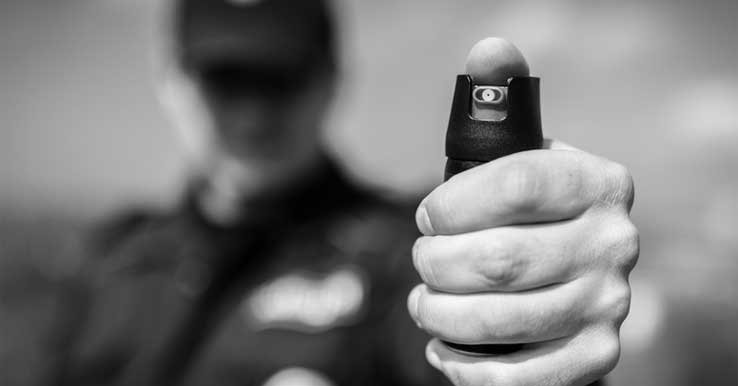
Pepper spray is a pressurized aerosol containing oleoresin capsicum (OC), an oily extract derived from hot peppers in the genus Capsicum. When sprayed at an attacker’s face, OC immediately stimulates pain receptors in the eyes, nose, and throat. The result is involuntary eye closure, intense burning sensation, and coughing or choking — effects that typically last 20 to 45 minutes, well beyond what’s needed to escape and contact emergency services.
Modern formulations come in stream, cone, gel, and foam patterns. Gel and foam reduce blowback risk (important in windy conditions outdoors), while stream delivers the longest range. For women walking to their cars at night or building a personal emergency kit, a keychain-sized canister weighing under one ounce is often the first non-lethal tool experts recommend.
The active potency measure that matters is Major Capsaicinoids (MC) percentage, not the Scoville Heat Unit (SHU) figure on the label — law enforcement trainers consistently point to 1–2% MC as the reliable civilian threshold. SABRE Red and Mace Brand are two of the most widely recommended brands in this category.
What Is a Taser — and How Does It Work?
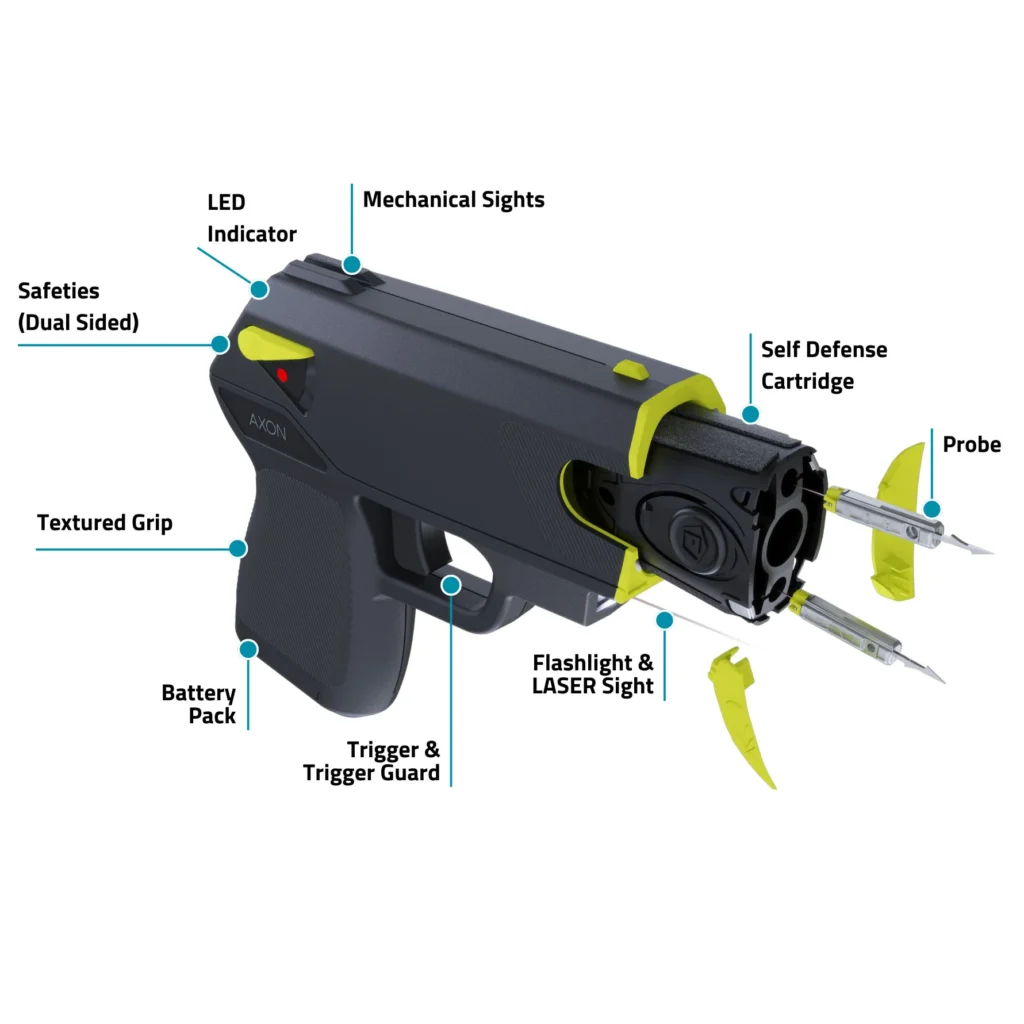
The word “taser” has become generic, but it’s technically an acronym originally coined by inventor Jack Cover (Tom A. Swift Electric Rifle). Today, Axon is the primary manufacturer of civilian taser devices sold under the TASER brand. Unlike contact stun guns, which require you to touch an attacker, a taser fires two barbed probes connected by thin copper wires — using compressed nitrogen as a propellant, similar to a small paintball marker.
When both probes contact the target, the device delivers a high-voltage, low-amperage electrical pulse that causes neuromuscular incapacitation (NMI): the attacker’s voluntary muscle control is disrupted, typically causing them to fall. Civilian models such as the TASER Pulse 2 deliver a 5-second NMI cycle. The TASER 7CQ offers a 12-foot range optimized for close quarters, while some models reach 15 feet. Axon’s devices are trusted by over 18,000 law enforcement agencies worldwide, which is the key EEAT credibility argument retailers make to civilian buyers.
The critical civilian limitation: most taser models carry a single cartridge. Miss your shot, and your next option is a contact drive-stun — which requires you to press the device against the attacker, eliminating the distance advantage entirely. Some newer models offer replaceable cartridges, but rapid reloading under stress is extremely difficult for untrained users.
How Does Pepper Spray Compare to a Taser? (Head-to-Head Table)
Below is a direct comparison across the factors that matter most for women’s everyday self-defense. This table covers the ground-level realities — not lab conditions.
| Factor | Pepper Spray | Taser / CEW | Edge |
|---|---|---|---|
| Cost | $10–$30 (canister) | $200–$450 (device + cartridges) | Pepper Spray |
| Effective Range | 8–12 feet (spray-pattern dependent) | 12–15 feet (probe deployment) | Taser |
| Incapacitation Duration | 20–45 minutes | 5 seconds (NMI cycle) | Pepper Spray |
| Ease of Carry | Under 1 oz, keychain or purse | 8+ oz, requires holster | Pepper Spray |
| Stopping Power (1-shot) | Moderate — pain-dependent | High — NMI bypasses pain tolerance | Taser |
| Multiple Attackers | Possible — spray can be swept | Limited — single cartridge fire | Pepper Spray |
| Legality (USA) | All 50 states (size restrictions vary) | Banned in HI, NY, RI; restricted elsewhere | Pepper Spray |
| Reliability in Wind/Weather | Reduced — can blow back toward user | Not affected by wind | Taser |
| Training Required | Minimal — aim at face, depress | Moderate — probe accuracy matters | Pepper Spray |
| Works on Drugged Attackers | Reduced — pain blunted | Yes — NMI is pain-independent | Taser |
| Fatality Risk | None under normal use | Very low; rare cardiac risk exists | Pepper Spray |
| Maintenance | Expiry date (2–4 years); replace canister | Battery maintenance; cartridge restock | Pepper Spray |
Which Situation Calls for Pepper Spray?
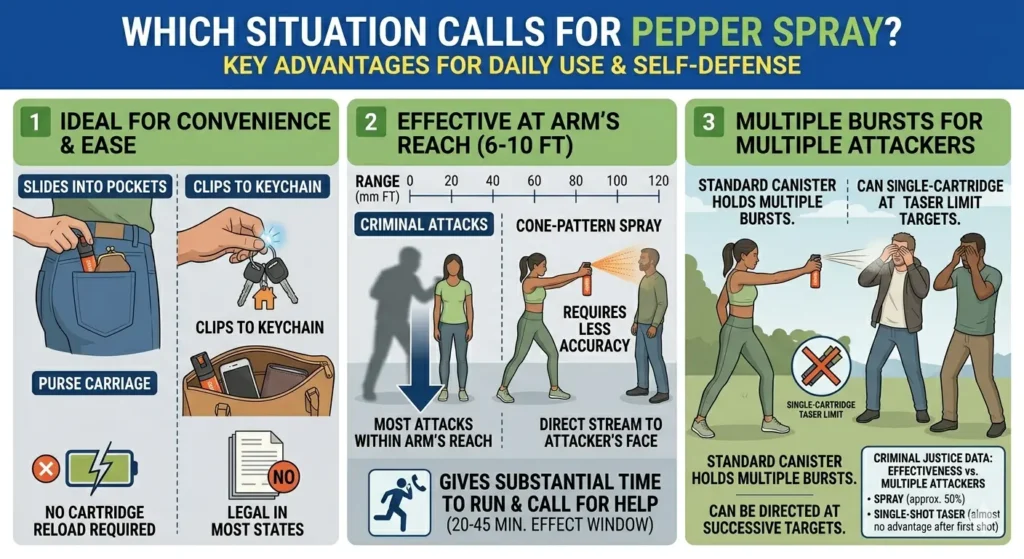
Pepper spray is the right tool when daily carry convenience is the priority. A canister fits in any pocket, clips to a keychain, or slides into a purse alongside your phone. There is no battery to charge, no cartridge to reload, and no legal paperwork required in most states.
It performs best at the distances most assaults happen — criminal justice research consistently shows that the vast majority of street attacks begin within arm’s reach or less. At 6 to 10 feet, a cone-pattern spray like SABRE Red requires no pinpoint accuracy: direct the stream at the attacker’s face, depress, and sweep if needed. The 20–45 minute effect window gives you substantial time to use your other emergency gear, run, and call for help.
Pepper spray is also the stronger choice when facing more than one attacker. Because a standard OC canister holds multiple bursts, it can be directed at successive targets — something a single-cartridge taser cannot do. Self-defense researchers note that effectiveness against multiple attackers drops to roughly 50% with spray, but a taser in that scenario offers almost no advantage at all once the cartridge is spent.
Which Situation Calls for a Taser?
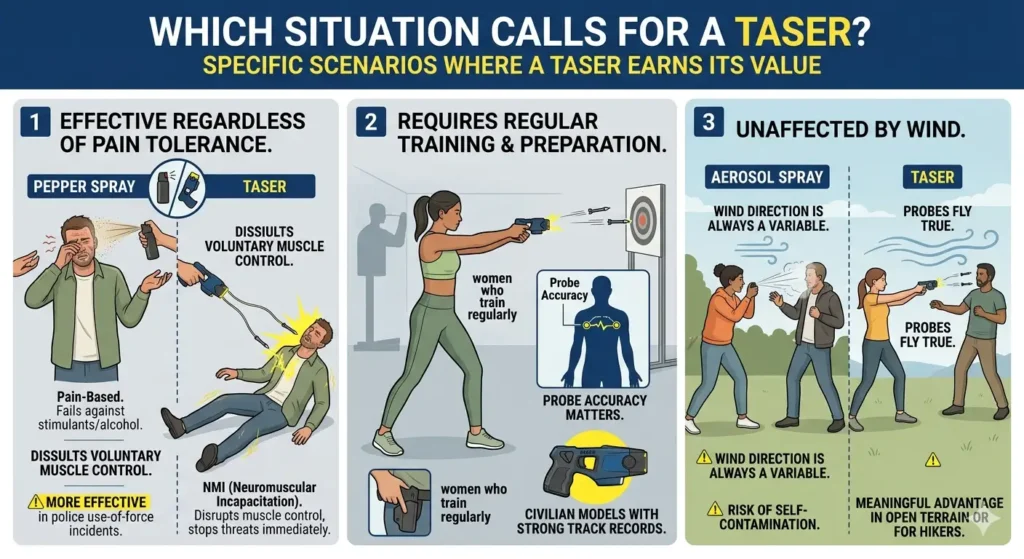
A taser earns its $200–$450 price tag in specific scenarios where pepper spray falls short. The most significant is attackers under the influence of stimulants or alcohol. Because NMI disrupts voluntary muscle control at a neurological level — rather than relying on pain — it can stop someone whose pain sensitivity is severely blunted. A 2017 National Institute of Justice review found tasers significantly more effective than OC spray in police use-of-force incidents, concluding that “once a Taser was used, that incident came to an end” in the overwhelming majority of cases.
Tasers also make sense for women who train regularly. Probe accuracy matters — both darts must contact the body to complete the electrical circuit and achieve NMI. Dry-fire practice and consistent holster carry habits dramatically improve deployment reliability. If you’re committed to that level of preparation, the TASER Pulse 2 or TASER 7CQ are the two civilian models with the strongest real-world performance track records.
Additionally, tasers are unaffected by wind — a meaningful advantage if you live in open terrain or frequently move between outdoor environments. For hikers and campers who regularly consult guides like those on TheOutdoorChamp, wind direction is always a variable with aerosol products.
What Does the Research Actually Say About Stopping Power?
The most authoritative comparison comes from the National Institute of Justice (NIJ), which analyzed use-of-force data from a large police department with over 2,000 sworn officers. The study found that taser use ended incidents with striking consistency, while OC spray showed more variable outcomes — particularly against resistant or intoxicated subjects.
However, it is critical to note that this research covers trained law enforcement officers deploying both tools under standard protocols — not untrained civilians under acute stress. A 2020 study published in Applied Ergonomics (ScienceDirect) specifically on civilian pepper spray users found that first-time users without experience struggled to deploy quickly under simulated stress — suggesting that consistent practice with whichever tool you choose matters far more than the tool itself.
The practical takeaway: a taser in trained hands outperforms pepper spray in stopping power. Pepper spray in untrained hands still outperforms a taser in untrained hands, because the margin for error with aerosol is wider.
Are There Legal Differences Women Should Know About?
Yes — and this is where pepper spray wins decisively for most women in the U.S. Pepper spray is legal in all 50 states, though individual states regulate canister size and set minimum age requirements (commonly 18). Some states restrict the OC concentration. California, for example, limits canisters to 2.5 oz. Always check your state’s specific statute before purchasing.
Tasers face far more significant legal barriers. Civilian ownership is outright banned in Hawaii, New York, and Rhode Island. Michigan restricts them to specific conditions. Several additional states permit tasers but require a permit or restrict where they can be carried (e.g., not on school grounds or government buildings). Unlike a pepper spray canister that can be tucked in a jacket pocket without much thought, carrying a taser demands legal homework specific to your state and city.
For women who travel frequently for work or outdoor recreation — a common profile among readers of TheOutdoorChamp’s survival gear guides — the cross-state portability of pepper spray is a practical advantage that’s easy to underestimate.
What Are the Risks and Limitations of Each Tool?
Neither weapon is foolproof under real-world conditions. Understanding the failure modes is as important as understanding the strengths.
Pepper Spray Limitations
Wind is the most common culprit. In open outdoor environments, a stream-pattern spray can be deflected, reduced in range, or — in worst cases — partially blown back toward the user. Gel and foam formulas were specifically developed to reduce this risk, but they require slightly more accurate aim because they don’t disperse in a cone. In tight enclosed spaces (a stairwell, elevator, or vehicle), aerosol can affect everyone present including the user — a consideration worth planning for.
Pepper spray also has reduced effectiveness against high-pain-tolerance or drug-intoxicated attackers. Because the mechanism is irritation of pain receptors, someone whose pain response is suppressed — by stimulants, adrenaline, or certain medications — may continue advancing even after being sprayed. This is the key scenario where a taser’s NMI advantage becomes decisive.
Taser Limitations
Probe accuracy is the central challenge. Both darts must complete an electrical circuit across the attacker’s body to achieve NMI. Thick winter clothing can reduce probe penetration. At very close range, the dart spread may be too narrow to span a sufficient muscle group. And if you miss — or only one dart connects — you have a drive-stun contact option, but that requires closing distance with your attacker, which eliminates the range advantage that justified the taser in the first place.
Cost and maintenance are ongoing concerns. Replacement cartridges run $20–$40 each. Battery maintenance matters — a dead battery at the wrong moment is catastrophic. And the upfront $200–$450 price point means many women simply don’t invest in one, carrying nothing instead, which is far worse than carrying an affordable pepper spray canister.
Our Verdict: Which Is Better for Women’s Self Defense?
For most women: pepper spray wins. It’s legal everywhere, costs $10–$30, weighs under an ounce, requires minimal training, and delivers a 45-minute incapacitation window that gives you ample time to escape and get help. The 85% confidence rate among trained users confirms it’s intuitive enough to use under stress with basic practice.
For women who train and can afford it: carry both. A keychain pepper spray as your first line and a TASER Pulse 2 or TASER 7CQ as your primary defense gives you layered protection for scenarios where one or the other falls short. Pepper spray handles multiple attackers and high-wind conditions; the taser handles the intoxicated single attacker at distance.
Never carry either without practicing deployment. The research is unambiguous: untrained users of both tools underperform significantly under acute stress. Buy a practice canister, run dry-fire taser drills, and know your local laws.
Our Methodology: How We Evaluated These Tools
Why Trust The Outdoor Champ?
Frequently Asked Questions
Is pepper spray or a taser better for women’s self defense?
Can pepper spray be used against multiple attackers?
Is a taser legal in all 50 states?
How long does pepper spray incapacitate an attacker?
What is the effective range of pepper spray vs a taser?
Does pepper spray work on attackers who are on drugs or alcohol?
Can I carry both pepper spray and a taser for self defense?
What pepper spray do experts recommend for women?
Gear Up for Real-World Safety
Explore TheOutdoorChamp’s full library of survival and safety gear reviews — tested by field practitioners in real conditions.
Browse Survival Gear Guides →
Similar Posts
Best Bushcraft Knives of 2026 | Expert-Tested Reviews & Ultimate Buying Guide
10 Best Bushcraft Knife 2026 – Expert Reviews & Buyer’s Guide What’s the one tool that separates successful wilderness adventurers from those who struggle? It’s not luck. It’s not expensive gear. It’s having the right bushcraft knife engineered to dominate any survival situation—from batoning firewood in freezing conditions to carving precision shelter stakes in tropical…
Suluk46 Yuka 240 Pull Saw: The Ultimate Ultralight Folding Saw for Backpacking and Bushcraft (2025 Review)
When you’re miles deep into the backcountry and need to process firewood or clear trail obstacles, carrying a bulky traditional saw just doesn’t make sense. That’s where the Suluk46 Yuka 240 Pull Saw comes in—a Canadian-engineered masterpiece that weighs just 6 ounces but cuts through wood like a dream. I’ve tested dozens of folding saws over the…
Best Super Bright Tactical Flashlight 2026: Expert-Tested Rankings with Real Data
10 Best Super Bright Tactical Flashlight 2026: Expert Rankings & Data When a police officer’s life depends on identifying a threat at 200 yards, or a search-and-rescue team needs to spot a hiker’s signal through fog, the difference between 1,000 lumens and 5,000 lumens isn’t just specs—it’s survival. The tactical flashlight market is drowning in…
Renovo MUV Series Review: The Ultimate Modular Water Filter System for Survivalists and Outdoor Enthusiasts
Renovo MUV Series Review: Survivalist, Eclipse & Nomad Water Filters Compared (2026) When I first stumbled upon the Renovo MUV water filter during a backpacking trip planning session, I thought I’d seen every water filtration system out there. But after three years of testing these modular beasts in everything from crystal-clear mountain streams to questionable…
Ham Radio License: Why You Need One, How to Get It, and Which Class Is Right for You
Ham Radio License Guide 2026: Types, Cost & How to Get One Key Facts at a Glance 3 license classes: Technician → General → Amateur Extra FCC exam fee: $35 | VEC session fee: ~$15 (varies) Technician study time: 10–30 hours Passing score: 74% on all three exams License valid: 10 years (renewable) Minimum age:…
Albrecht AE-2990 AFS Review: Is This Handheld SSB CB Radio Worth It in 2026?
When I first heard about a handheld CB radio with Single Sideband (SSB) capability, I’ll admit – I was skeptical. After years testing communication gear in the backcountry, from the Rockies to Appalachian trails, I thought I’d seen it all. But the Albrecht AE-2990 AFS changed my perspective on what’s possible in portable CB communication. Here’s what…