
- GET OUT — Move immediately to fresh air. Leave the room / area.
- DO NOT RUB — Keep hands away from your face. Rubbing makes it worse.
- REMOVE CONTACTS — Take out contact lenses immediately if wearing them.
- REMOVE CLOTHING — Cut off (don’t pull over face) contaminated clothing. Bag it.
- FLUSH EYES — Cool running water, inner corner outward, 15–20 minutes continuous.
- WASH SKIN — Unscented dish soap (Dawn) on dry skin → lather → rinse with cool water. Repeat 2–3×.
Accidentally sprayed yourself with pepper spray? The single most important rule: do not rub. Move to fresh air immediately, flush eyes with cool running water for 15–20 minutes, and wash skin with unscented dish soap — not lotion soap, not milk, not hot water. Most people feel significantly better within 30–60 minutes with proper decontamination. The burning is temporary; the mistakes you make in the first two minutes determine how long it lasts.
Key Takeaways
- Do NOT rub — capsaicin is oil-based; rubbing drives it deeper into eyes and skin rather than removing it — Mace Brand
- Flush eyes with cool running water for 15–20 minutes — tilt head to the side, pour from inner corner outward — Mace Brand OC First Aid Guide
- Wash skin with unscented dish soap (Dawn or similar) — dish soap is a degreaser that breaks down the oil-based OC compound — SABRE Red
- Milk does not work — a 2008 clinical study found no evidence milk outperformed plain water for pepper spray decontamination; at worst it introduces bacteria to your eyes — Medical News Today / 2008 clinical study
- Do not use hot water — heat reactivates capsaicin and intensifies burning; use cool or room-temperature water only — Survival Sullivan
- Peak symptoms occur within 5–20 minutes; most people recover significantly within 30–60 minutes; mild irritation can persist up to 24 hours — IERE.org Recovery Guide
- Call 911 immediately if you have asthma, COPD, difficulty breathing, chest pain, or symptoms don’t improve after 45–60 minutes — Poison Control / poison.org
- Poison Control is available 24/7, free, and confidential at 1-800-222-1222 — call them for any serious or unclear exposure — poison.org
Why Does Pepper Spray Burn So Much — and Why Can’t You Just Rinse It Off?
Before you can decontaminate effectively, you need to understand what you’re dealing with at a chemical level — because the properties of capsaicin explain exactly why most instinctive responses make things worse.
Pepper spray’s active compound is capsaicin — or more precisely, a mixture of capsaicinoids extracted from Capsicum peppers as oleoresin capsicum (OC). As Biology Insights explains, capsaicin is a non-polar, oil-based molecule — meaning it does not dissolve in or mix with water the way a water-soluble compound would. When capsaicin contacts your eyes, skin, or airways, it binds to a specific pain receptor called TRPV1 — the same receptor that normally responds to extreme heat. Your brain receives a signal that the tissue is being burned, triggering an intense, involuntary response: eyes slam shut, tears pour out, the airways contract, and mucus floods the nasal passages.
Here’s the crucial implication: because OC is oil-based, water alone does not remove it. Water and oil don’t mix. Rinsing your eyes with plain water will reduce the concentration of OC on the surface, but it won’t break the bond between capsaicin and your tissue. As Pepper Spray Store explains, “Since pepper spray is oil based, it simply won’t wash away with just water unless applied over an extended period of time — say 30 minutes or more.” This is why dish soap (a degreaser) is more effective than water alone for skin decontamination, and why prolonged flushing is necessary for eyes.
The second key fact: rubbing makes it dramatically worse. The mechanical action of rubbing drives capsaicin molecules deeper into the cornea and surrounding tissue, intensifying both the burning and the duration. Every second you spend rubbing is increasing recovery time.
What Are the Exact Symptoms of Accidental Pepper Spray Exposure?
Knowing what to expect helps you stay calm — and staying calm is one of the most effective things you can do, because panic causes rapid breathing which increases OC inhalation into the airways.
-
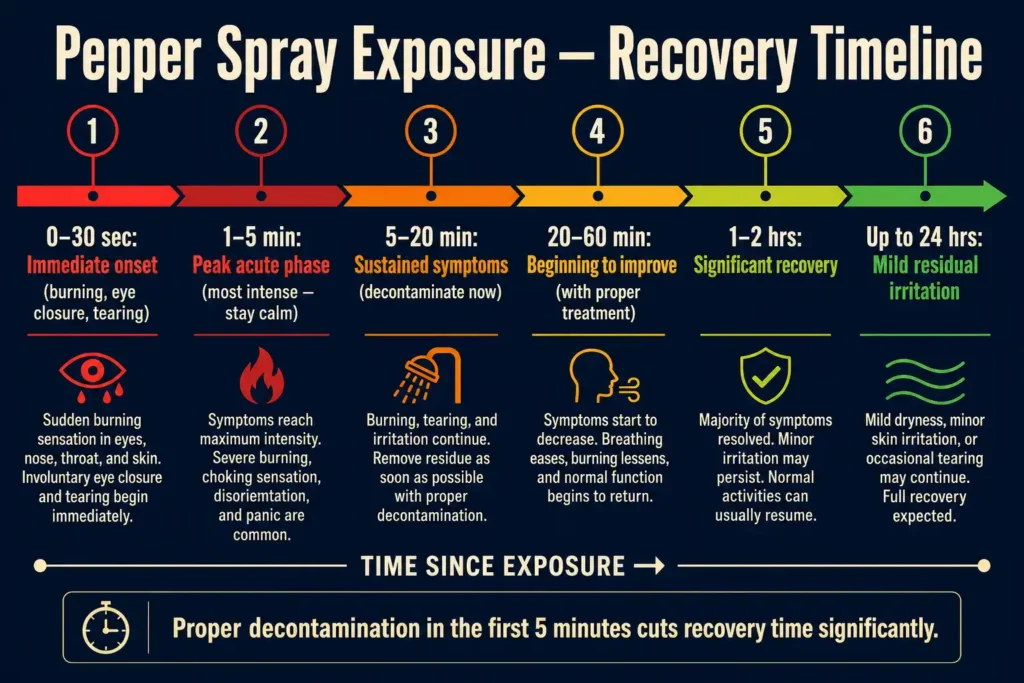
0–30 seconds
Immediate onset
Intense burning in the eyes, eyelids slam shut involuntarily (blepharospasm), profuse tearing, burning sensation on any exposed skin, coughing, and nasal flooding. Vision is significantly impaired or temporarily lost. If indoors, the surrounding air starts feeling thick and irritating.
-
1–5 minutes
Peak acute phase
Burning intensifies as OC penetrates deeper. Eyes are extremely painful. Skin feels like it is being scalded. Respiratory effects peak — coughing, choking sensation, difficulty breathing through the nose. Disorientation and panic are common. This is the most important window — stay calm and begin decontamination.
-
5–20 minutes
Sustained intense symptoms
Effects remain at or near peak intensity. Per UGuard’s exposure analysis, symptoms peak within 5–15 minutes. Proper decontamination begun in this window significantly reduces total recovery time.
-
20–60 minutes
Beginning to improve
IERE’s recovery guide notes that “most people experience the most intense effects for 30–60 minutes.” With good decontamination, symptoms noticeably reduce. Eyes begin to open. Breathing improves. Skin burning fades from acute to uncomfortable.
-
1–2 hours
Significant recovery
Most severe symptoms have resolved. Residual burning and eye irritation continue at lower intensity. Vision substantially returns. Respiratory effects largely resolved unless you have an underlying condition.
-
Up to 24 hours
Mild lingering effects
According to UGuard, “the eyes and skin remain irritated for up to 24 hours afterward.” Avoid makeup, skincare products, and contact lens reinsertion during this window. Complete recovery typically takes 1–2 days.
What Is the Step-by-Step Decontamination Process?
These steps are based on guidance from Mace Brand, SABRE Red, Poison Control, and medical literature. Follow them in order. Every step matters.
-
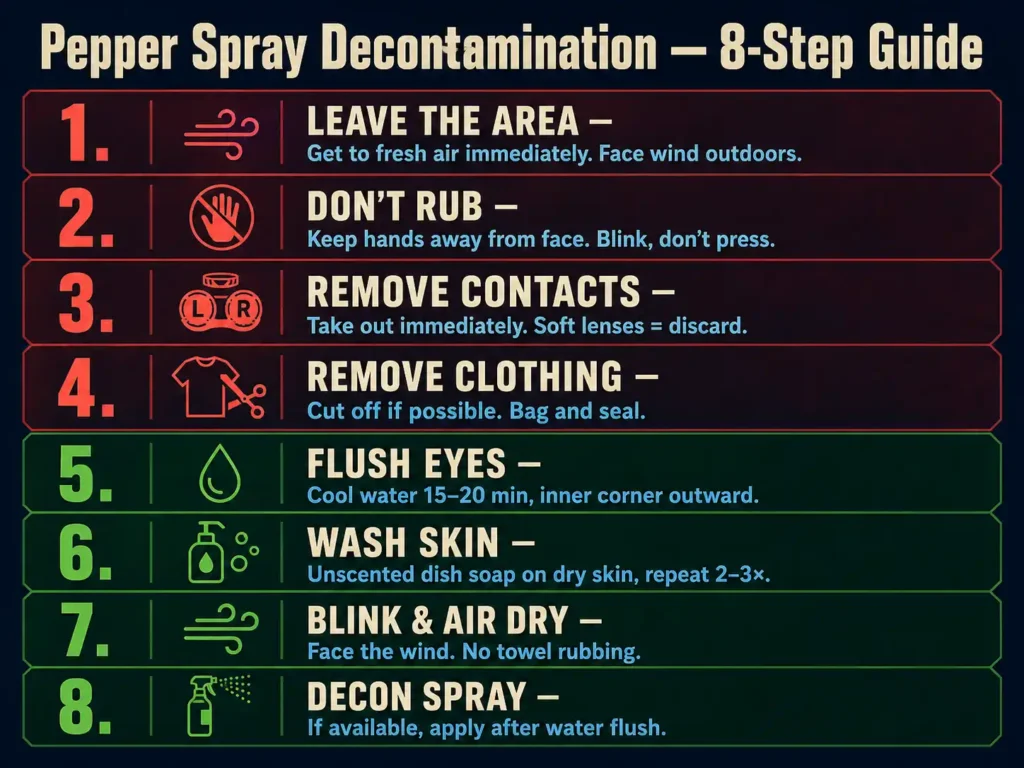
1
Leave the Contaminated Area Immediately
If you discharged indoors, get outside now. Pepper spray particles linger in the air. ZARC International’s exposure guide confirms: “The first thing you need to do is leave the contaminated area. Pepper spray particles linger in the air, so staying in the same space can make symptoms worse.” If outdoors, move to a position where the wind is at your back so airborne particles blow away from you, not toward you.
-
2
Do NOT Rub Your Eyes or Skin — At All
This is the most critical instruction and the one most people instinctively violate. The first-aid guide from Sharg confirms: “Do not rub your eyes or skin — rubbing drives capsaicin deeper.” Keep your hands away from your face entirely. Blink rapidly to encourage natural tear production, which helps flush the eye surface, but do not press, rub, or wipe with your hands or clothing until you have washed your hands thoroughly with soap first.
-
3
Remove Contact Lenses Immediately
Mace Brand’s decontamination guide is explicit: “Remove contact lenses immediately.” OC sticks to contact lens material and creates a sustained capsaicin reservoir directly against your cornea. Soft lenses should be discarded — they cannot be fully decontaminated. Hard lenses should be cleaned and soaked in lens solution for 24 hours before reinserting. Do not attempt to reinsert any lenses until eye symptoms have fully resolved.
-
4
Remove Contaminated Clothing — Cut It Off If Possible
Pulling a contaminated shirt over your face spreads OC directly to areas not yet exposed — particularly your eyes and airways. Medical News Today advises: “Cutting off clothing rather than pulling it over the head helps avoid further irritation to the eyes and skin.” Place contaminated clothing in a sealed plastic bag immediately. Do not leave it on a surface where others can contact it. Wash separately later in hot water.
-
5
Flush Eyes With Cool Running Water — 15 to 20 Minutes
This is the most important treatment step for eye exposure. Mace Brand’s eye care guide is specific about technique: tilt your head to the side (not back), hold your eyelids open with clean fingers if necessary, and pour cool water from the inner corner of the eye outward — this prevents spreading OC to the unaffected eye. Keep flushing for a full 15–20 minutes without stopping. A shower head on low pressure, a water bottle, or a sink faucet all work. Use cool water only — not hot. Hot water reactivates capsaicin and intensifies the burning. After flushing, artificial tears or saline solution can provide additional comfort.
-
6
Wash Skin With Unscented Dish Soap — Repeat 2–3 Times
Plain water alone won’t remove oil-based OC from skin. The most effective household degreaser is unscented dish soap — Dawn is the most commonly recommended brand. SABRE Red’s decontamination guide recommends applying dish soap to the affected area and working it in before adding water — this lets the soap break down the OC oil rather than just diluting it. Apply to dry or barely damp skin, work into a light lather, then rinse with cool water. Repeat 2–3 times. Avoid scented soaps, moisturizing soaps, lotions, or oil-based products — these trap capsaicin against the skin and prolong exposure.
-
7
Blink Rapidly and Air Dry — Do Not Towel Rub
After flushing and washing, blink rapidly to help carry residual particles away with tear flow. Pat — do not rub — the skin dry with a clean cloth if needed, then let air circulation finish the job. Stunster’s recovery guide advises: face the wind or a fan — moving air accelerates evaporation of any remaining surface OC and speeds symptom resolution. Stay calm and breathe slowly through your mouth.
-
8
Use a Decontamination Spray if Available
Commercial decontamination sprays — available from Mace Brand, SABRE, and similar manufacturers — are formulated to chemically neutralize OC residue more effectively than soap alone. Mace Brand recommends using a decontamination spray after thorough water flushing as a follow-up step. If you carry pepper spray regularly — especially for outdoor activities covered on TheOutdoorChamp — keeping a small decontamination spray in your kit is worth the $10–$15 cost.
How Do You Treat Each Body Area Differently?
Different body areas require slightly different approaches because of how capsaicin interacts with each type of tissue.
👁 Eyes
- Remove contacts first
- Tilt head to the affected side
- Cool water from inner corner → outward
- Flush 15–20 minutes continuously
- Blink rapidly — don’t hold eyes shut
- Follow with saline or artificial tears
- Do not use hot water — ever
- Avoid makeup for 24 hours after
🖐 Skin & Face
- Apply unscented dish soap to dry skin first
- Work into light lather with minimal water
- Rinse with cool water thoroughly
- Repeat 2–3 times total
- Do not use scented soap, lotion, or oils
- Pat dry — do not rub with towel
- Baking soda paste can help reduce residual burn
- Avoid hot showers for at least 1 hour
🫁 Airways & Breathing
- Move to fresh air — this is the treatment
- Breathe slowly through your mouth
- Do not try to breathe deeply and fast
- Face wind or a fan to increase ventilation
- Coughing is normal — don’t suppress it
- Call 911 if breathing becomes labored
- Asthma/COPD patients: seek medical help immediately
- Do not re-enter a contaminated indoor space
👕 Clothing & Gear
- Remove immediately — cut off if needed
- Seal in plastic bag to prevent re-contamination
- Wash separately from other laundry
- Hottest water the fabric tolerates
- Regular laundry detergent — repeat 2–3×
- Do not dry until smell is fully gone
- Air dry after final wash cycle
- Eyeglasses: wash frame with soap and water
Does Milk Actually Help With Pepper Spray Exposure?
This is one of the most persistent self-defense myths online, regularly shared in first-aid forums and spread by well-meaning but incorrect advice. The short answer: no, milk does not meaningfully help with pepper spray exposure.
The reasoning behind the milk claim is that dairy contains casein, a protein that can help break down capsaicin molecules (similar to how it can cool a spicy meal). Fightsense’s review of the evidence explains: “Many believe that milk helps with pepper spray burns because dairy contains casein, a protein that can break down capsaicin.” In theory, plausible. In practice, not supported by clinical evidence.
Medical News Today reviewed a 2008 clinical study that specifically compared milk, baby shampoo, antacids, and water for pepper spray decontamination and found “no evidence that they were more effective than water.” A randomized controlled trial also found no difference between baby shampoo and water alone. The casein in milk is simply not present in sufficient concentration to neutralize OC in the way a lab-grade degreaser would.
Survival Sullivan’s analysis is blunt: “No, milk doesn’t work for decontaminating pepper spray. Contrary to popular opinion, it does not neutralize oleoresin capsicum or effectively wash the chemical from eyes or skin. Milk might make things worse by binding the chemical to pores.” The cooling sensation people report from milk is real but temporary — it’s the temperature difference, not any chemical neutralization. Don’t waste time seeking out milk. Use cool water and dish soap.
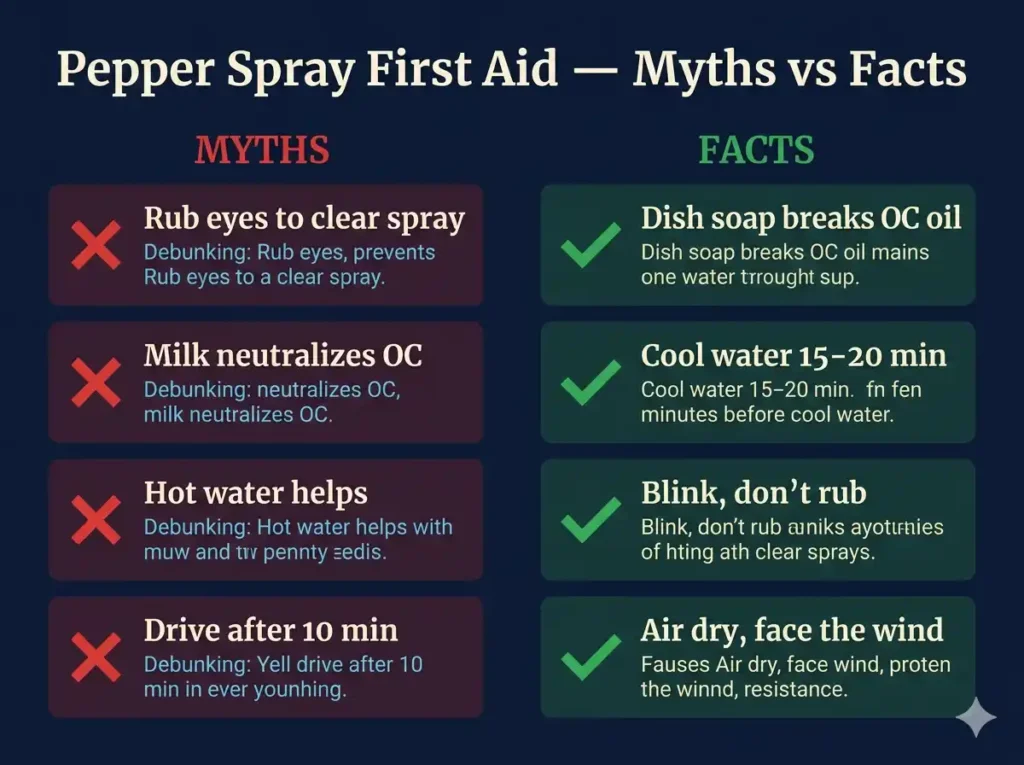
What Are the Myths vs. Facts About Pepper Spray First Aid?
| Claim | Verdict | The Reality |
|---|---|---|
| “Rub your eyes to clear the spray” | FALSE | Rubbing drives capsaicin deeper into tissue. Blink rapidly — never rub. |
| “Milk neutralizes pepper spray” | FALSE | 2008 clinical trial found no advantage over water. Milk can introduce bacteria and trap OC in pores. |
| “Hot water helps wash it off faster” | FALSE | Heat reactivates capsaicin. Use cool or room-temperature water only. |
| “Dish soap helps remove OC from skin” | TRUE | Dish soap is a degreaser that breaks the oil-based OC bond. Apply to dry skin first, then rinse with cool water. |
| “Pepper spray causes permanent eye damage” | RARELY | Temporary vision impairment is normal. Permanent damage is uncommon with proper decontamination. Medical attention needed for severe or prolonged eye pain. |
| “You can drive after 10 minutes” | FALSE | Do not drive until all eye symptoms have fully resolved — blepharospasm and tearing make driving dangerous. |
| “Baby shampoo works better than water” | MARGINAL | Baby shampoo (tear-free) is a mild surfactant that can help lift OC; however, the 2008 clinical trial found no statistically significant advantage over water alone. |
| “Baking soda paste reduces skin burn” | SOMEWHAT | Baking soda is alkaline and may partially neutralize capsaicin on skin. Safe to use as a follow-up after soap-and-water washing. Do not apply inside eyes. |
| “Saline solution is good for eye flushing” | TRUE | Saline is isotonic (same salt concentration as tears) and is one of the best options for prolonged eye flushing — better than tap water if available. |
| “You’ll fully recover in 20 minutes” | VARIES | Peak symptoms typically begin improving at 20–30 minutes; full recovery takes 1–2 days. OC concentration, proximity, and individual sensitivity all affect duration. |
What Should You Do If You Accidentally Discharge Pepper Spray Indoors?
An accidental indoor discharge is more complicated than outdoor blowback because the OC particles have nowhere to go — they contaminate the entire air volume of the room and can linger on surfaces for hours to days.
Immediate steps — first 5 minutes
Get everyone out immediately, including pets. Fightsense’s indoor discharge guide notes that pets exposed to pepper spray should be removed immediately and have their eyes and fur rinsed with cool water. Do not use your home’s HVAC system or central air conditioning — it will recirculate OC particles throughout the entire building. Open every window and exterior door you can reach, then leave and close the interior door to the affected room.
Ventilation — 30 to 60 minutes minimum
Set up fans pointing outward to push contaminated air through open windows. Run this for at least 30–60 minutes before re-entering even briefly. Fightsense’s surface contamination guide warns that “pepper spray residue can last from hours to months depending on the surface” — porous surfaces (carpet, upholstery, curtains) hold OC far longer than smooth surfaces.
Surface decontamination
Once the room has been thoroughly ventilated, Fightsense’s step-by-step guide recommends: clean hard surfaces (floors, walls, countertops) with dish soap and water, wiping down with a clean cloth and rinsing with fresh water. Vacuum soft furnishings — sofas, carpets, chairs — with a HEPA filter vacuum to capture OC particles rather than recirculate them. Wash all exposed textiles — curtains, pillowcases, towels — separately in hot water with detergent. Consider running an air purifier with a HEPA filter in the affected room for 24 hours.
What Is the Do and Don’t Summary for Pepper Spray Exposure?
✅ DO
- Get to fresh air immediately
- Blink rapidly to flush the eye surface
- Remove contact lenses right away
- Cut off contaminated clothing
- Flush eyes with cool water 15–20 min
- Use unscented dish soap on skin
- Repeat soap wash 2–3 times
- Air dry after flushing
- Breathe slowly through your mouth
- Call Poison Control (1-800-222-1222) if unsure
- Call 911 if breathing becomes labored
❌ DO NOT
- Rub your eyes or skin — ever
- Use hot water — it reactivates OC
- Pour milk on your eyes or face
- Pull contaminated shirt over your face
- Apply lotion, oils, or scented soap
- Stay in a contaminated indoor space
- Run the HVAC or central air
- Attempt to drive until fully recovered
- Reinsert contact lenses for 24 hours
- Apply creams, salves, or butter to skin
- Panic — slow breathing reduces OC intake
When Should You Seek Medical Attention?
For the vast majority of accidental pepper spray exposures, home decontamination is sufficient. Pepper spray is designed to be non-lethal and temporary. However, certain situations require immediate medical attention — and knowing which ones matters.
- You have asthma, COPD, or any chronic respiratory condition and are struggling to breathe — OC can trigger severe bronchospasm in people with reactive airways
- You experience chest pain or chest tightening at any point after exposure
- Breathing difficulty does not improve after moving to fresh air within 5–10 minutes
- Eye pain is severe or vision does not begin to partially return within 30 minutes of flushing
- Symptoms have not improved at all after 45–60 minutes of proper decontamination
- You develop hives, swelling beyond the spray area, rapid heartbeat, or other signs of an allergic reaction — anaphylaxis to capsaicin is rare but can be fatal
- A child, elderly person, or anyone with pre-existing health conditions was exposed — these groups are more vulnerable to respiratory complications
☎️ U.S. Poison Control Center
1-800-222-1222As Poison Control’s guide on pepper spray confirms: expert guidance is always free, confidential, and available 24 hours a day — online at webPOISONCONTROL.org or by phone. Call them for any exposure you’re unsure about, especially involving children or people with respiratory conditions.
How Do You Prevent Accidental Pepper Spray Discharge?
The best decontamination is the one you never need. Most accidental discharges fall into predictable, preventable categories.
- Practice with an inert canister first. ZARC’s training guide recommends inert training spray canisters — available from SABRE and Blingsting — to build muscle memory for safe handling and deployment without live OC. Twenty practice draws is more valuable than any product upgrade.
- Understand your specific safety mechanism. Most consumer canisters have a flip-top, twist-lock, or slide safety to prevent accidental discharge. Know exactly how yours works before you need it — and always engage the safety when returning the canister to your bag or holster.
- Store properly. Keep pepper spray away from children, in a dedicated holster or pouch rather than loose in a bag, and away from heat — car gloveboxes in summer can reach temperatures that compromise canisters and trigger accidental leaks.
- Never spray toward your own face. Practice grip and aim with an inert canister outdoors, always with the wind at your back, before carrying live spray.
- Consider pepper gel for indoor carry — gel does not atomize and dramatically reduces the severity of accidental indoor discharge consequences.
The Bottom Line: What To Do If You Accidentally Spray Yourself
The two rules that matter most: don’t rub, and start decontaminating immediately. Every second of rubbing increases recovery time. Every minute you delay flushing is more OC penetrating into tissue.
The correct sequence: get to fresh air → remove contacts → cut off contaminated clothing → flush eyes with cool water for 15–20 minutes → wash skin with unscented dish soap 2–3 times → blink and air dry → monitor for severe symptoms.
What won’t help: milk, hot water, lotions, oils, rubbing, or staying in the contaminated space.
What will help: cool water, dish soap, fresh air, time, and staying calm. Most people recover significantly within 30–60 minutes with proper treatment. Full recovery is expected within 1–2 days.
When to call for help: any breathing difficulty that doesn’t improve, any exposure involving asthma or COPD, or symptoms that don’t begin improving after 45–60 minutes. Poison Control is available at 1-800-222-1222, 24/7, free, and confidential.
Our Methodology
Why Trust The Outdoor Champ?
Frequently Asked Questions
What should I do immediately if I accidentally spray myself with pepper spray?
Does milk help with accidental pepper spray exposure?
How long does accidental pepper spray exposure last?
Why should you not rub your eyes after pepper spray exposure?
What is the best way to wash pepper spray off skin?
What should I do if I accidentally discharge pepper spray indoors?
When should you seek medical attention after pepper spray exposure?
Can you drive after accidentally being exposed to pepper spray?
More Self-Defense & Survival Gear at TheOutdoorChamp
Read our full guides on choosing the right pepper spray, pepper gel vs spray, and understanding your state’s carry laws.
Browse Self-Defense Guides →