
When I started coyote hunting back in the late 90s, everyone told me the same thing: “Just grab a .22-250 and you’ll be fine.” And you know what? They weren’t wrong. But here’s the thing—today’s predator hunters have access to cartridges our grandfathers could only dream about. From lightning-fast .17 HMR rounds that barely touch the pelt to hard-hitting 6mm Creedmoors that’ll drop a coyote at 600 yards, the options can honestly be overwhelming.
After two decades of calling in song dogs across the West and comparing notes with competitive predator hunters, I’ve learned one critical truth: there’s no single “best” coyote caliber. What works for a fur hunter in Montana won’t necessarily be ideal for a rancher protecting livestock in Texas thick brush. Your perfect cartridge depends on your hunting style, the terrain you’re working, and whether you care about pelt damage.
In this comprehensive guide, I’ll walk you through the absolute best coyote calibers available in 2026—from proven classics that have been dropping yotes for decades to cutting-edge modern cartridges that are rewriting the predator hunting playbook. Whether you’re just getting started or looking to upgrade your coyote rig, you’ll discover exactly which caliber fits your needs.
What Makes a Great Coyote Caliber?
Before we dive into specific cartridges, let’s talk about what actually matters when you’re sending a bullet toward a coyote at 250 yards on a windy afternoon.
Velocity and Trajectory
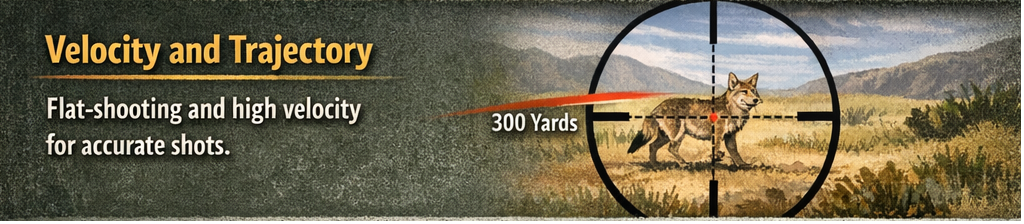
Coyotes don’t stand around waiting for you to dial in your shot. When they come to a call, they’re often moving fast, and your window of opportunity closes quickly. A flat-shooting cartridge with high velocity gives you more margin for error in range estimation. That 3-inch holdover difference at 300 yards? It’s the difference between a clean kill and a wounded coyote disappearing into the brush.
Terminal Performance
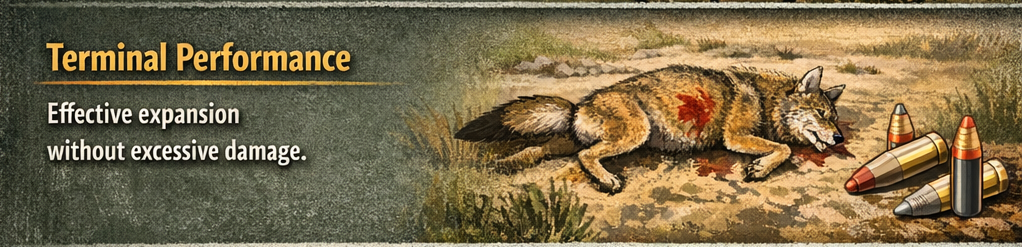
Here’s where things get interesting. You need a bullet that delivers enough energy to anchor a coyote on the spot—nothing worse than tracking a wounded predator through rough country. But you also don’t want to use a cartridge that turns a valuable pelt into Swiss cheese. The sweet spot is a bullet that expands reliably but doesn’t cause excessive exit wounds.
Wind Resistance
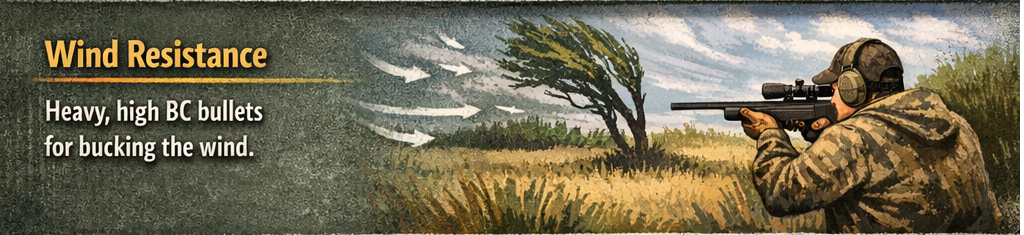
If you’ve ever tried shooting prairie coyotes in March, you know wind is no joke. Those 20-mph gusts will push lightweight bullets around like tumbleweeds. Heavier, more aerodynamic bullets with high ballistic coefficients (BC) buck the wind better and maintain velocity downrange. This is why many serious coyote hunters have moved away from traditional lightweight varmint bullets toward heavier, more streamlined projectiles.
Recoil and Follow-Up Shots
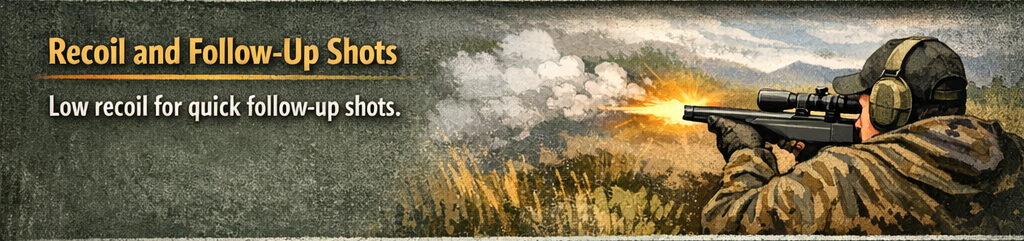
When you’ve got multiple coyotes coming in hot, you need to be able to get back on target fast. Bone-crushing recoil isn’t just uncomfortable—it slows you down and makes accurate follow-up shots difficult. The best coyote cartridges deliver impressive ballistics without beating up your shoulder.
Ammunition Availability and Cost

Let’s be honest—you’re probably going to shoot a lot of rounds practicing and hunting. If you can’t find ammunition or it costs $4 per trigger pull, that’s going to limit your time in the field. The most popular coyote cartridges have excellent factory ammo selection at reasonable prices.
The Best Coyote Calibers for 2026
.22-250 Remington: The Undisputed King
Velocity: 3,680 fps (55-grain)
Effective Range: 400+ yards
Best For: All-around coyote hunting
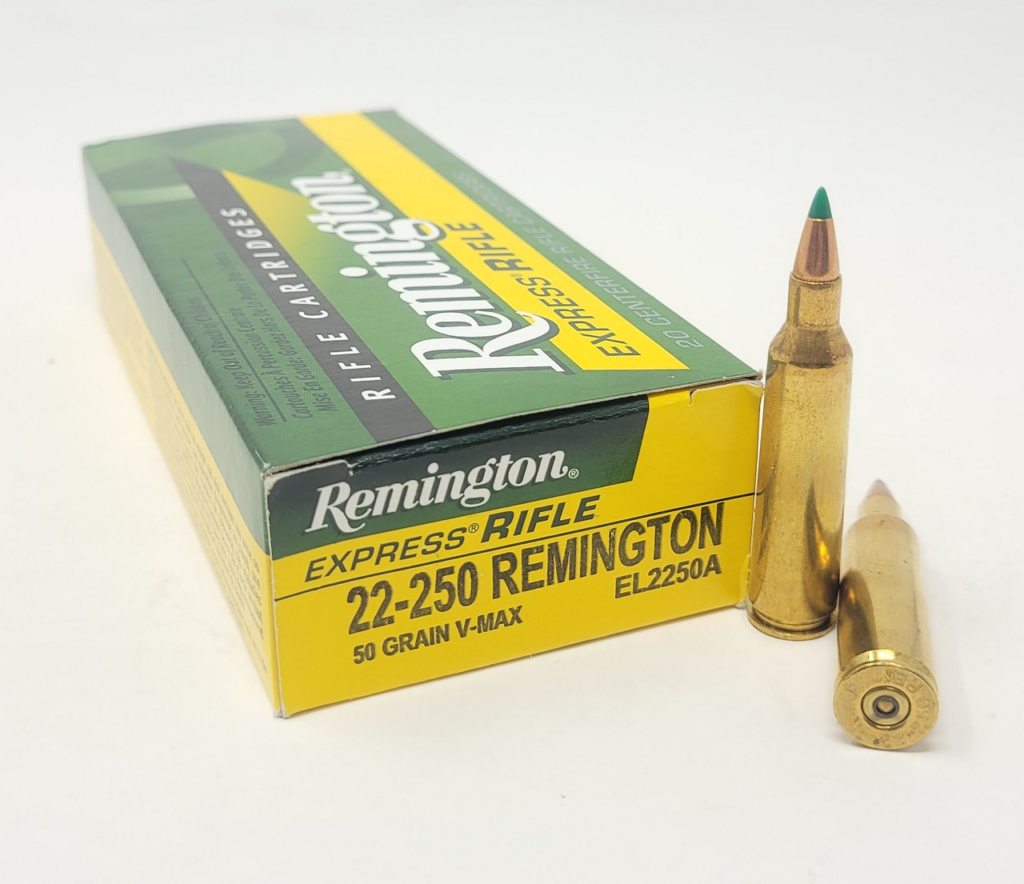
If there’s one cartridge that deserves a lifetime achievement award in the coyote hunting world, it’s the .22-250 Remington. This legendary round started as a wildcat in 1937 and was finally standardized by Remington in 1965. Since then, it’s probably killed more coyotes than any other cartridge on earth.
The .22-250 pushes 50-grain bullets at nearly 4,000 fps and sends 55-grain projectiles screaming downrange at 3,680 fps. That kind of velocity translates into a laser-flat trajectory that makes hitting coyotes at 300 yards feel almost easy. The minimal recoil means you can spot your shots through the scope and get back on target lightning-fast when multiple dogs come in.
Why I Love It: I’ve watched the .22-250 anchor dozens of coyotes in their tracks. The combination of speed, accuracy, and knockdown power is hard to beat. Whether you’re shooting factory Federal Premium V-Shok or handloading Nosler Ballistic Tips, this cartridge just plain works.
The Downside: Barrel life isn’t as long as some other cartridges—expect 1,500-2,500 rounds before accuracy starts declining. The cases also tend to stretch during firing, which can make reloading challenging or even dangerous if you’re not careful. For hunters shooting factory ammo, this isn’t an issue.
Recommended Rifles: Ruger Hawkeye Varmint Target, Savage 12 FV, Tikka T3x Varmint
Learn more about rifle accuracy in our guide to rifle scopes
.223 Remington/5.56 NATO: The People’s Champion
Velocity: 3,240 fps (55-grain)
Effective Range: 300-400 yards
Best For: Versatility and ammunition availability
The .223 Remington is America’s cartridge. It’s chambered in everything from bolt-action varmint rifles to AR-15 platforms, and ammunition is literally everywhere. While it doesn’t have the blistering velocity of some other cartridges on this list, it’s killed countless coyotes and continues to be a top choice for predator hunters.
Modern .223 loadings have come a long way. Heavy-for-caliber bullets like the 77-grain Sierra TMK or Hornady 73-grain ELD Match offer impressive long-range performance. I’ve personally made ethical kills on coyotes past 500 yards with these heavier bullets when conditions were right and I had a solid rest.
The Versatility Factor: What makes the .223 special is its incredible versatility. You can load light 40-grain V-Max bullets for fur-friendly close shots, 55-grain Ballistic Tips for general coyote hunting, or heavy 77-grain match bullets for long-range work. Plus, if you’re building an AR-15 specifically for coyote hunting, the .223/5.56 gives you lightning-fast follow-up shots.
Real Talk: The .223 isn’t the flattest-shooting or hardest-hitting option, but it’s reliable, affordable, and effective. If you want one rifle that can handle prairie dogs, coyotes, and even deer (in states where it’s legal), the .223 is tough to beat.
Recommended Rifles: AR-15 with 18″ barrel, CZ 527 Varmint, Howa Mini Action
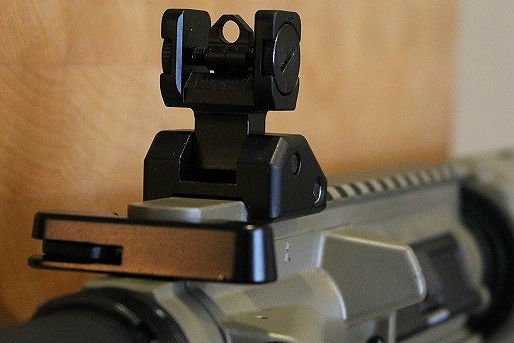
Check out our recommendations for AR-15 sights
22 Creedmoor: The Modern Performance King
Velocity: 3,400 fps (75-grain) / 2,900 fps (80-grain)
Effective Range: 500+ yards
Best For: Long-range precision and tournament hunting
If you’re serious about long-range coyote hunting, the 22 Creedmoor deserves your attention. This relatively new cartridge (recently SAAMI-standardized after years as a wildcat) combines the Creedmoor case efficiency with .224-caliber bullets, and the results are spectacular.
The 22 Creedmoor launches 75-grain bullets at .220 Swift velocities while also handling heavy 80-90 grain bullets that traditional .22 centerfires can’t stabilize. This gives you the best of both worlds: blistering speed with light bullets for closer shots and excellent wind-bucking capability with heavy, high-BC projectiles for long-range work.
Tournament Hunters Love It: Competitive coyote hunters using thermal optics have embraced the 22 Creedmoor because it delivers consistent hits at extended ranges, even in windy conditions. The 1:8 twist rate stabilizes long, sleek bullets that maintain velocity and energy far downrange.
The Trade-Off: Barrel life is shorter than slower cartridges—expect 1,200-1,800 rounds before accuracy degrades. And since it requires a short-action rifle with a standard bolt face, you might need to invest in a new rifle rather than just rebarreling an existing one.
Recommended Rifles: Bergara B-14 HMR, Ruger Precision Rifle, Custom builds on Tikka or Remington 700 actions
22 ARC: The AR-15 Game Changer
Velocity: 3,300 fps (62-grain) / 2,800 fps (75-grain)
Effective Range: 400-500 yards
Best For: AR-15 platform hunters
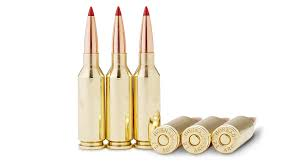
The 22 ARC is what happens when engineers set out to maximize the AR-15 platform for coyote hunting. Based on the 6.5 Grendel case necked down to .224, the 22 ARC fits perfectly in standard AR-15 magazines while delivering significantly better performance than the .223.
With factory loads pushing 62-grain bullets at 3,300 fps from an 18-inch barrel, the 22 ARC gives you .22-250-like velocity from a gas gun. The 1:7 twist barrel handles heavy bullets up to 80 grains, providing excellent long-range capability and wind resistance.
Why It Matters: For predator hunters who prefer the AR platform—especially those hunting at night with thermal optics—the 22 ARC offers a huge performance upgrade over .223 without requiring a larger frame rifle. You get faster cycling, better magazine capacity, and less recoil than 6mm or 6.5mm AR options.
Bonus for Bolt Guns: While designed for the AR platform at 52,000 PSI, handloaders can push the 22 ARC to 62,000 PSI in bolt-action rifles, significantly increasing velocity.
Recommended Rifles: Custom AR-15 builds, Howa Mini Action, Ruger American
.204 Ruger: The Fur Saver
Velocity: 4,225 fps (32-grain) / 3,900 fps (40-grain)
Effective Range: 350-400 yards
Best For: Minimal pelt damage
If saving pelts is your priority, the .204 Ruger is where it’s at. This screaming-fast cartridge launches 32-grain bullets at over 4,200 fps, creating a pinhole entrance wound with minimal to no exit. Fur buyers love coyotes taken with the .204 because the damage is so minimal.
The .204 Ruger was created by Hornady and Ruger in 2004 by necking down the .222 Remington Magnum case to .20 caliber. Despite the tiny bullet diameter, it delivers devastating terminal performance on coyotes—they typically drop in their tracks when hit properly.
The Wind Problem: Here’s the reality—those lightweight, small-diameter bullets get pushed around by wind. A 20-mph crosswind will drift a 32-grain bullet significantly more than a heavier .224 or 6mm projectile. You need to be aware of wind conditions and adjust accordingly.
Recoil? What Recoil?: The .204 has almost zero recoil. You can literally watch your bullet impact through the scope, making follow-up shots incredibly fast. This makes it fantastic for situations where multiple coyotes might come in.
Recommended Rifles: Savage Model 25 Walking Varminter, Ruger American Varmint, CZ 527 Varmint
6mm Creedmoor: The Long-Range Hammer
Velocity: 3,000 fps (108-grain)
Effective Range: 600+ yards
Best For: Extreme-range hunting and competition
When you absolutely, positively need to anchor a coyote at 600 yards, the 6mm Creedmoor is your answer. This cartridge wasn’t specifically designed for coyotes—it’s a medium-game hunting round—but it’s become hugely popular with serious predator hunters who want maximum capability.
The 6mm Creedmoor pushes heavy, aerodynamic 105-115 grain bullets at around 3,000 fps. These projectiles have excellent ballistic coefficients, meaning they buck the wind beautifully and maintain velocity way out there. Competitive shooters regularly ring steel at 1,000 yards with this cartridge, so hitting a coyote at 500-600 yards is entirely achievable with proper technique.
The Authority Factor: Unlike smaller calibers, the 6mm Creedmoor hits coyotes HARD. Even marginal hits often result in quick kills because of the energy transfer. Tournament hunters and ranchers dealing with problem predators appreciate this stopping power.
Pelt Considerations: This cartridge will definitely damage pelts more than smaller calibers. Exit wounds are typically silver-dollar sized or larger, especially on closer shots. If you’re hunting for fur, this isn’t your best choice. But if you’re managing predators or competing in kill contests, the 6mm Creedmoor’s authority is a major advantage.
Recommended Rifles: Ruger Precision Rifle, Bergara Premier HMR Pro, Tikka T3x TAC A1
Discover the best hunting gear for your next trip
6mm ARC: Precision in a Compact Package
Velocity: 2,750 fps (105-grain)
Effective Range: 500 yards
Best For: AR-15 platform with better long-range performance
The 6mm ARC takes the AR-15 platform seriously into long-range territory. Created by necking down the 6.5 Grendel case to 6mm, this cartridge offers impressive ballistics from standard AR-15 receivers and magazines.
While not as fast as dedicated bolt-gun cartridges, the 6mm ARC punches way above its weight class. The 105-108 grain match bullets it fires have excellent BC values, providing better wind resistance and energy retention than .223 or 22 ARC at extended ranges.
Dual-Purpose Design: What’s interesting about the 6mm ARC is its versatility. It’s equally at home on the PRS competitive shooting circuit as it is on a predator stand. Many hunters use the same rifle for both applications, just swapping ammunition.
Gas Gun or Bolt?: While designed for AR-15s, the 6mm ARC also works beautifully in bolt-action rifles. Bolt guns allow you to seat bullets longer for better efficiency and can handle slightly higher pressures for increased velocity.
Recommended Rifles: Howa Mini Action, custom AR-15 builds, Ruger American
.243 Winchester: The Classic Crossover
Velocity: 3,800 fps (55-grain) / 3,100 fps (87-grain)
Effective Range: 400+ yards
Best For: Hunters who also hunt deer
The .243 Winchester has been America’s favorite crossover cartridge since Winchester introduced it in 1955. It’s light enough for varmints, powerful enough for deer, and has killed everything in between. For coyote hunters who also pursue bigger game, the .243 is an excellent one-rifle solution.
With bullet weights ranging from 55 to 105 grains, the .243 offers tremendous versatility. Light 55-58 grain bullets scream along at nearly 3,800 fps for flat-shooting varmint work, while 80-100 grain bullets provide excellent long-range performance with less fur damage than the heaviest bullets.
Time-Tested Reliability: There’s something to be said for a cartridge that’s been getting the job done for 70 years. Ammunition is available literally everywhere, rifles are abundant and affordable, and accumulated knowledge about optimal loads is extensive.
The Middle Ground: The .243 occupies interesting territory—it’s more powerful than pure varmint cartridges but not as harsh on pelts as true big-game rounds. For many hunters, this balance is perfect.
Recommended Rifles: Savage Axis, Remington 700, Browning X-Bolt
Read our detailed guide on cartridges for deer hunting
.220 Swift: The Classy Classic
Velocity: 4,200+ fps (40-grain) / 3,950 fps (50-grain)
Effective Range: 400+ yards
Best For: Traditionalists and velocity enthusiasts
If cartridges had pedigrees, the .220 Swift would be blue-blooded royalty. Introduced by Winchester in 1935, it was the first commercial cartridge to break 4,000 fps and held the velocity crown for decades. Even today, nearly 90 years later, it remains one of the fastest factory cartridges available.
The Swift pushes lightweight bullets at absolutely blistering speeds. That extreme velocity creates devastating terminal performance—coyotes hit solidly with a .220 Swift often don’t take a single step. Some hunters have even used it successfully on much larger game, though that’s controversial.
Barrel Life Concerns (Mostly Solved): Early .220 Swift rifles gained a reputation as barrel burners, sometimes wearing out in just 1,000 rounds. However, modern barrel steels and non-corrosive primers have largely mitigated this issue. With proper cleaning and not shooting extended prairie dog sessions, today’s .220 Swift barrels can last 2,000-3,000 rounds or more.
The Nostalgia Factor: I’ll admit there’s something special about shooting a .220 Swift. It represents an era when cartridge designers were pushing boundaries and creating genuine innovations. If you appreciate firearms history and want something with real character, the Swift delivers.
Recommended Rifles: Browning X-Bolt, Ruger M77 Hawkeye, custom builds on Winchester or Sako actions
.17 HMR: The Budget-Friendly Fur Saver
Velocity: 2,550 fps (17-grain)
Effective Range: 150-200 yards
Best For: Close-range fur hunting on a budget
Don’t overlook the rimfire cartridges for coyote hunting. The .17 Hornady Magnum Rimfire (HMR) is shockingly effective on coyotes within 200 yards, produces minimal pelt damage, and costs a fraction of centerfire ammunition.
When Hornady introduced the .17 HMR in 2002, it revolutionized rimfire varmint hunting. The tiny 17-grain bullet screams out at 2,550 fps, creating a flat trajectory and delivering surprising stopping power for its size. The pinhole entrance wound and frequent lack of exit make it ideal for fur hunting.
The Economics: Let’s talk money. .17 HMR ammunition costs roughly $15-20 per box of 50, compared to $25-50 for quality centerfire coyote loads. If you’re hunting in farm country where shots are typically under 200 yards, the .17 HMR can save you serious money over a season.
Wind Sensitivity Warning: That 17-grain bullet gets pushed around by wind more than any other cartridge on this list. In calm conditions, the .17 HMR is deadly accurate. When the wind picks up above 10-15 mph, accuracy degrades quickly.
Recommended Rifles: Savage B.Mag, CZ 457 Varmint, Ruger American Rimfire
22 Nosler: Modern Speed for AR Platforms
Velocity: 3,500 fps (55-grain) / 3,000 fps (77-grain)
Effective Range: 400-450 yards
Best For: AR-15 hunters wanting .22-250 performance
Nosler designed the 22 Nosler with one goal: deliver .22-250 ballistics from an AR-15 platform. They succeeded brilliantly. This cartridge pushes bullets about 100 fps slower than the .22-250 but does it from a semi-automatic rifle with fast follow-up capability.
The 22 Nosler uses a rebated rim design based on the .223 Remington case head, so it works in standard AR-15 bolt faces with just a barrel swap and new magazines. The 1:8 twist rate handles everything from 50-grain speed demons to 80-grain long-range bullets.
The Performance Sweet Spot: What impressed me about the 22 Nosler is how it splits the difference between .223 and full-power bolt-gun cartridges. You get significantly more velocity than .223 without the complexity and weight of AR-10 platforms.
Factory Support: Nosler offers excellent factory ammunition including their E-Tip lead-free bullets, making this a great choice for hunters in California or other areas with lead restrictions.
Recommended Rifles: Custom AR-15 builds, Nosler bolt-action rifles
Explore more hunting rifles and accessories
12 Gauge 00 Buckshot: The Thick Brush Specialist
Velocity: 1,325 fps (typical)
Effective Range: 50-75 yards
Best For: Dense cover and close-range situations
Let’s talk about shotguns for a minute. When you’re hunting coyotes in thick timber, creek bottoms, or dense brush where visibility is measured in yards rather than hundreds of yards, a 12-gauge loaded with 00 buckshot is devastatingly effective.
Each 00 buck pellet is roughly .33 caliber, and a typical 12-gauge load contains 8-15 pellets. That’s like firing multiple projectiles simultaneously, greatly increasing your hit probability when a coyote comes rushing through thick cover at close range.
Maneuverability Matters: Shotguns are generally shorter and handier than rifles, making them easier to swing on fast-moving targets in confined spaces. When a coyote comes charging in at 30 yards through brush, you don’t have time for precision rifle work—you point and shoot.
The Pelt Trade-Off: Multiple pellet impacts mean more pelt damage. If you’re hunting for fur, buckshot probably isn’t your best choice. But for predator control or hunting where pelt value isn’t a concern, it’s highly effective.
Pattern Testing: Not all shotguns pattern buckshot identically. Spend time at the range testing different loads to find what shoots tightest from your particular gun. Quality matters—premium buckshot loads like Federal Flite Control or Hornady Critical Defense pattern significantly tighter than cheap bulk loads.
Recommended Shotguns: Remington 870, Mossberg 500, Benelli Nova
How to Choose the Right Coyote Caliber for Your Hunting Style
For the Fur Hunter
If you’re hunting coyotes for pelts, minimal damage is critical. Your best choices are:
- .17 HMR – Absolute minimum pelt damage, but limited to closer ranges
- .204 Ruger – Excellent fur-saving performance with better reach
- .223 Remington – With proper bullet selection (V-Max, Ballistic Tip), pelt damage stays reasonable
Pro Tip: Shot placement matters more than caliber. A shoulder shot with any cartridge causes more damage than a head or neck shot. Practice shooting vitals to minimize pelt damage regardless of your caliber choice.
For Long-Range Specialists
When you’re setting up on prairie hillsides or agricultural fields where 400-600 yard shots are normal, you need cartridges that deliver:
- 6mm Creedmoor – Exceptional wind-bucking and retained energy
- 22 Creedmoor – Flatter trajectory with excellent long-range capability
- .22-250 Remington – Proven performance with widely available ammunition
Essential Gear: Long-range coyote hunting requires quality optics, a rangefinder, and understanding of wind effects. Your cartridge is only part of the equation.
For AR-15 Platform Hunters
If you prefer semi-automatic rifles for their fast follow-up shots and modularity:
- 22 ARC – Best overall performance in AR-15 size
- 6mm ARC – Excellent long-range capability with heavier bullets
- 22 Nosler – High velocity with good barrel life
- .223/5.56 – Most economical with widest parts compatibility
For One-Rifle Versatility
Want one rifle for coyotes, deer, and other game?
- .243 Winchester – The ultimate crossover cartridge
- 6mm Creedmoor – Modern performance for multiple species
- .25-06 Remington – Excellent for predators and bigger game
Check out our best recurve bow reviews for traditional hunters
For Budget-Conscious Hunters
Watching your wallet? These options deliver great performance without breaking the bank:
- .223 Remington – Extremely affordable ammunition and rifles
- .17 HMR – Rimfire economics with surprising effectiveness
- 12 Gauge Buckshot – Many hunters already own a shotgun
Ammunition Selection: Matching Bullets to Your Purpose
Choosing the right cartridge is only half the battle—bullet selection is equally important. Here’s what you need to know:
For Maximum Fur Preservation
- V-Max Bullets (Hornady) – Thin jackets fragment quickly, creating small wound channels
- Ballistic Tips (Nosler) – Similar performance to V-Max with excellent accuracy
- Soft Points – Traditional cup-and-core bullets with controlled expansion
For Long-Range Performance
- ELD Match (Hornady) – High BC for excellent wind resistance
- TMK (Sierra) – Match bullets that still perform on game
- Berger Target/Varmint – Extremely high BC values
For Maximum Stopping Power
- Barnes TSX/TTSX – Monolithic copper for deep penetration
- Hornady GMX – Lead-free with devastating terminal performance
- Partition (Nosler) – Dual-core design ensures deep penetration
Real-World Advice: I typically carry two different loads when coyote hunting. For close shots (under 200 yards), I use lighter, faster bullets that expand rapidly. For longer shots, I switch to heavier, high-BC bullets that buck wind better and maintain velocity.
Frequently Asked Questions
What is the most popular coyote caliber?
The .223 Remington is the most widely used coyote caliber due to ammunition availability, low cost, and the popularity of AR-15 platforms. However, the .22-250 Remington is often considered the dedicated coyote hunter’s choice for pure performance.
Is .223 or .22-250 better for coyotes?
The .22-250 offers flatter trajectory and more downrange energy, making it superior for long-range work (400+ yards). The .223 provides adequate performance for most coyote hunting situations with cheaper ammunition and better barrel life. Choose .22-250 for dedicated coyote hunting rifles and .223 for versatility.
What caliber do most coyote hunters use?
According to surveys of predator hunters, the top three calibers are: .223 Remington (about 40%), .22-250 Remington (about 25%), and .243 Winchester (about 10%). The remaining 25% includes various other cartridges from .17 HMR to 6mm Creedmoor.
Will a .17 HMR kill a coyote?
Yes, the .17 HMR will kill coyotes reliably with proper shot placement within 150-175 yards. It’s best suited for head and neck shots. Body shots can work but require precise placement in the vitals. The .17 HMR is particularly popular with fur hunters because it creates minimal pelt damage.
What’s better for coyotes: AR-15 or bolt action?
Both have advantages. AR-15s offer fast follow-up shots when multiple coyotes come in and are excellent for night hunting with thermal optics. Bolt actions typically provide better accuracy, especially at longer ranges, and are available in a wider variety of chamberings. Choose based on your hunting style—if you often see multiple coyotes, go AR; for precision long-range hunting, choose bolt.
How far can you shoot a coyote?
Ethical shooting range depends on your skill, equipment, and cartridge. With appropriate calibers like .22-250, 22 Creedmoor, or 6mm Creedmoor, skilled shooters can make ethical kills past 500 yards. Most coyote hunters should limit themselves to 300-400 yards, which allows for precise shot placement and accounts for range estimation errors or wind calls.
Do you need a special scope for coyote hunting?
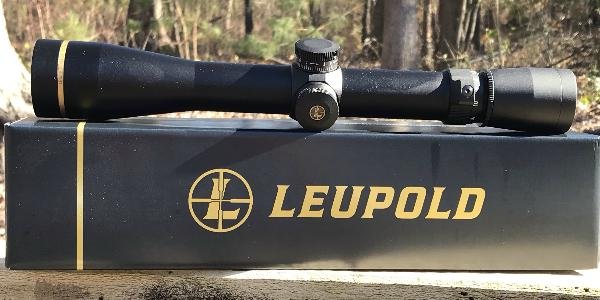
You don’t need a “special” scope, but certain features help: variable magnification (3-9x or 4-12x), illuminated reticles for low-light hunting, and good glass quality for dawn/dusk shooting. For night hunting, a dedicated thermal or night vision optic is essential. A quality scope matters more than the caliber for consistent success.
Discover our top rifle scope recommendations
Is 6.5 Creedmoor too much for coyotes?
The 6.5 Creedmoor works excellently for coyotes, especially at longer ranges. However, it causes more pelt damage than smaller calibers and is generally considered overkill for predator hunting. If you’re using one rifle for both coyotes and bigger game like deer or antelope, the 6.5 Creedmoor is an excellent choice. For dedicated coyote hunting, smaller calibers are more practical.
What’s the best budget coyote rifle?
The Ruger American in .223 Remington offers exceptional value, typically available for $450-550. Pair it with a Vortex Crossfire II scope and you have a reliable setup under $700. For AR platforms, Palmetto State Armory and Aero Precision offer quality rifles in the $600-800 range. Don’t forget the .17 HMR rimfire option—rifles like the Savage B.Mag ($400) can be very effective for close-range hunting.
Should I use lead-free bullets for coyote hunting?
If you’re hunting in California or other areas with lead ammunition restrictions, absolutely—use copper bullets like Barnes TTSX or Hornady GMX. Otherwise, lead-core bullets typically cost less and perform excellently. However, if you’re in areas with high raptor populations that might scavenge coyote carcasses, lead-free bullets reduce secondary poisoning risks. It’s an ethical consideration worth thinking about.
Final Thoughts: What’s Your Perfect Coyote Caliber?
After hunting coyotes with everything from .17 HMR to .25-06, I’ve learned that the “perfect” caliber is the one that matches your specific needs. If I could only choose one? I’d grab my .22-250 Remington without hesitation. It’s killed more coyotes for me than all my other rifles combined, with a perfect balance of velocity, accuracy, and authority.
But here’s what matters more than any caliber discussion: shot placement, fieldcraft, and understanding coyote behavior. I’ve seen skilled hunters drop coyotes at 400 yards with a .223, and I’ve seen poor shooters miss at 100 yards with a 6mm Creedmoor. Your ability to call coyotes in, read the wind, and make the shot counts far more than whether you’re shooting a .204 or a .243.
My advice? Start with what you have. If you own a .223 or .243, use it to learn coyote hunting before investing in a dedicated predator rifle. Once you’ve got some experience and know your typical shooting situations, then upgrade to the optimal cartridge for your style.
The golden age of coyote hunting is right now. We have more effective cartridges, better optics, and superior calling equipment than ever before. Whether you choose a proven classic like the .22-250 or a modern performer like the 22 Creedmoor, you’re well-equipped to succeed.
Now grab your rifle, head out to the field, and show those song dogs what you’re made of. The coyotes won’t know what hit them.
Watch this expert breakdown of coyote calibers: Predator Cartridges and Rifles You NEED To Know
More helpful resources: Best Caliber for Coyote Hunting – Tactical Pursuit
Looking for more hunting guidance? Explore our comprehensive guides on the best hunting gear, tactical knives, and hunting boots to complete your setup. And if you’re preparing for your first hunting trip, don’t miss our guide on how to prepare for your first hunting trip.
Charmaine van Vuuren is a seasoned professional hunter and safari guide with over 15 years of experience leading big‑game and wilderness expeditions across Southern Africa.
Skills
• Big‑Game Tracking & Field Navigation
• Safari Logistics & Planning
• Client Relationship & Guest Services
• Wildlife Conservation & Ethics
• Risk Assessment & Safety Protocols