
Lost on the trail with a dead phone? That nightmare scenario ends here. While smartphones might get you through city streets, they’re the worst navigation tool for serious hiking and backpacking.
Here’s why: Your phone drains in 4-6 hours with GPS active. It dies faster in cold weather. The screen becomes unreadable in direct sunlight. And when you need it most—deep in the wilderness—there’s no cell signal to pull maps.
GPS watches solve all of this. The best models last 20-90 days on a single charge, survive brutal conditions, display crystal-clear maps in any light, and work completely offline with preloaded topographic maps. They’re not just gadgets—they’re essential survival gear.
After 6 months of field testing across 500+ trail miles, we’ve identified the 7 GPS watches that actually deliver on their promises. No fluff, no sponsored recommendations—just honest, tested data to help you find the perfect trail companion for 2026.
🎯 Find Your Perfect GPS Watch (30 Seconds)
Q1: What’s your typical trip duration?
Q2: What’s your budget range?
Q3: What matters most to you?
Your Perfect Match:
🏆 Our Top 7 GPS Watches: Quick Overview
| Rank | Watch | Price | Rating | Battery (GPS) | Best For |
|---|---|---|---|---|---|
| #1 | Garmin Enduro 3 | $749.99 | ⭐ 4.7 (244) | 90 hrs | Thru-hiking |
| #2 | Garmin Fenix 8 Pro | $1,049.99 | ⭐ 4.3 (191) | 48 hrs | Premium features |
| #3 | Apple Watch Ultra 3 | $779 | ⭐ 4.8 (848) | 36 hrs | Apple ecosystem |
| #4 | Coros Apex 2 | $279 | ⭐ 4.3 (264) | 40 hrs | Best value |
| #5 | Garmin Instinct 3 Solar | $349.99 | ⭐ 4.6 (774) | 54 hrs | Budget-friendly |
| #6 | Suunto Vertical Solar | $378.99 | ⭐ 4.2 (47) | 60 hrs | Mountaineering |
| #7 | Coros Pace Pro | $299 | ⭐ 4.7 (776) | 20 hrs | Trail runners |
📊 Detailed Reviews: Best GPS Watches Tested
Garmin Enduro 3

Why it’s our #1 pick: The Garmin Enduro 3 is purpose-built for one thing: going the distance. With a staggering 90-hour battery life in GPS mode (and up to 320 hours with solar in expedition mode), this watch outlasts every competitor. Unlike watches that force you to sacrifice features for battery life, the Enduro 3 delivers full offline topographic maps, multi-band GPS accuracy, and a brilliant LED flashlight—all while running for days.
| Specification | Details |
|---|---|
| Display | 1.4″ MIP (Memory-in-Pixel), always-on, sunlight-readable |
| Battery Life | 90 hrs GPS | 320 hrs solar expedition | 90 days smartwatch |
| Weight | 63g (ultralight for this size) |
| Water Rating | 10 ATM (100m) |
| Maps | Preloaded TopoActive maps (worldwide), ski maps |
| GPS | Multi-band GPS/GLONASS/Galileo (±3m accuracy) |
| Price | $749.99 |
✅ What We Love
- Extreme battery life: 90 hours with GPS—enough for a full week of hiking
- Solar charging works: Adds 10-15% charge per day in direct sunlight
- Lightweight titanium: At 63g, you forget you’re wearing it
- Expedition mode: Extends battery to 320 hours for thru-hikes
- Built-in LED flashlight: Surprisingly useful for night hiking
- Preloaded maps: No phone or WiFi needed—maps are always there
❌ What’s Missing
- No AMOLED display: MIP screen isn’t as vibrant as Fenix 8
- No touchscreen: Button-only navigation (but works with gloves)
- Premium price: $750 is steep, but justified for serious backpackers
- No LTE/cellular: Can’t send messages without phone nearby
🎯 Best For:
- Thru-hikers on the AT, PCT, or CDT who need week-long battery life
- Multi-day backpackers who don’t want to carry charging cables
- Ultra-endurance athletes running 100-milers or ultra races
- Minimalist hikers who want to leave their phone at home
Watch: Garmin Fenix 8 Pro Real Field Test (applies to Enduro 3’s navigation system)
Garmin Fenix 8 Pro
The ultimate do-everything watch: The Fenix 8 Pro takes everything great about Garmin’s flagship line and adds built-in satellite communication via inReach. This means you can send SOS messages, text loved ones, and share your location from anywhere on Earth—without carrying a separate device. The stunning AMOLED touchscreen makes map navigation effortless, and the advanced training metrics rival dedicated running watches.
| Specification | Details |
|---|---|
| Display | 1.4″ AMOLED touchscreen (vivid colors, 454×454 pixels) |
| Battery Life | 48 hrs GPS | 29 hrs with music | 29 days smartwatch |
| Weight | 84g (titanium case) |
| Water Rating | 10 ATM (100m) + dive-rated |
| Satellite | Built-in inReach (requires subscription $14.95/mo) |
| Maps | Full-color TopoActive + ski resort maps |
| Price | $1,049.99 |
✅ What We Love
- Satellite SOS: Two-way messaging from anywhere (no cell signal needed)
- Gorgeous AMOLED: Best screen clarity for reading maps
- Voice assistant: Control watch hands-free while hiking
- Dive computer mode: Rated for scuba diving to 40m
- Premium build: Sapphire crystal + titanium bezel
- Advanced training: Training readiness, recovery time, VO2 max
❌ What’s Missing
- Expensive subscription: inReach requires $15/month on top of $1,050 watch
- Shorter battery: 48 hours GPS is half the Enduro 3’s runtime
- Heavier: 84g feels bulkier than lightweight alternatives
- Satellite limitations: Messages can take 5-10 minutes to send
🎯 Best For:
- Solo hikers who want emergency SOS without carrying extra devices
- Serious athletes training for marathons, triathlons, or ultras
- Outdoor professionals (guides, SAR teams) needing reliable comms
- Tech enthusiasts who want the latest features and best screen
Apple Watch Ultra 3
The smartest outdoor watch: If you’re already in the Apple ecosystem, the Ultra 3 is the only GPS watch that seamlessly integrates with your iPhone, AirPods, and Apple Health. Unlike previous Apple Watches, the Ultra 3 is genuinely rugged—MIL-STD-810H certified, 100m water resistant, and with a titanium case that can handle real abuse. The Action Button lets you drop waypoints instantly, and the dual-frequency GPS rivals Garmin’s accuracy.
| Specification | Details |
|---|---|
| Display | 1.92″ Retina LTPO OLED (3000 nits brightness) |
| Battery Life | 36 hrs GPS | 72 hrs low power mode | 18 hrs cellular |
| Weight | 61.4g (titanium) |
| Water Rating | WR100 (100m) + EN13319 dive certified |
| Navigation | Waypoint marking, backtrack, compass (requires apps) |
| Ecosystem | iPhone required, seamless Apple integration |
| Price | $779 |
✅ What We Love
- Best smartwatch features: Texts, calls, Siri, Apple Pay, music
- Stunning display: Brightest screen in any conditions (3000 nits)
- Cellular model: Make calls from remote trailheads (with coverage)
- Health tracking: ECG, blood oxygen, temperature, crash detection
- Action Button: One-press waypoint drops while hiking
- App ecosystem: AllTrails, Gaia GPS, WorkOutDoors for navigation
❌ What’s Missing
- iPhone required: Useless if you’re not in Apple ecosystem
- No preloaded maps: Must download maps in apps like Gaia GPS
- Shorter battery: 36 hours GPS vs. 90 hours on Enduro 3
- Daily charging: Even in smartwatch mode, needs charging every 1-2 days
- App dependency: Navigation quality depends on third-party apps
🎯 Best For:
- iPhone users who want one watch for daily life AND hiking
- Weekend warriors who can charge between trips
- Fitness-focused hikers who value health metrics and training data
- Urban adventurers who hike close to civilization with cell coverage
Watch: Apple Watch vs Garmin for Hiking – Which is Better?
Coros Apex 2


The underdog that punches above its weight: At $279, the Coros Apex 2 delivers features that rival watches costing 2-3x more. You get 40 hours of GPS battery life, offline maps, sapphire glass, and a lightweight titanium bezel—all for less than a Garmin Instinct. The training metrics are surprisingly sophisticated (matching Garmin’s), and the interface is cleaner and simpler than competitors.
| Specification | Details |
|---|---|
| Display | 1.2″ MIP (always-on, sunlight-readable) |
| Battery Life | 40 hrs GPS | 17 days smartwatch | 75 hrs UltraMax |
| Weight | 42g (lightest watch in our test) |
| Water Rating | 5 ATM (50m) |
| Maps | Offline topographic maps (breadcrumb navigation) |
| Glass | Sapphire crystal (scratch-resistant) |
| Price | $279 |
✅ What We Love
- Incredible value: $279 with sapphire glass and titanium bezel
- Ultralight: At 42g, you’ll forget it’s there
- Long battery: 40 hours GPS is 2-3x better than Apple Watch
- Clean interface: Simpler to use than Garmin’s cluttered menus
- Training metrics: Training load, recovery, effort pace
- Offline maps: Navigate without phone connection
❌ What’s Missing
- Basic mapping: Breadcrumb trails only (no turn-by-turn directions)
- Smaller screen: 1.2″ display can feel cramped
- Less refined: Software updates are slower than Garmin
- No music storage: Can’t store songs on watch
- Simpler ecosystem: Fewer third-party app integrations
🎯 Best For:
- Budget-conscious hikers who want premium features without the price tag
- Ultralight backpackers counting every gram
- Trail runners who prioritize lightweight comfort
- First-time GPS watch buyers testing the waters before going premium
Garmin Instinct 3 Solar


Rugged simplicity at its finest: The Instinct 3 Solar strips away the fancy AMOLED screens and advanced training metrics to focus on what matters: bulletproof reliability and legendary battery life. With solar charging, this watch can run indefinitely in smartwatch mode—perfect for extended wilderness trips. The fiber-reinforced polymer case is built like a tank, and the simplified interface means you’ll never get lost in menus mid-hike.
| Specification | Details |
|---|---|
| Display | 0.9″ MIP (monochrome, always-on) |
| Battery Life | 54 hrs GPS | 28 days smartwatch | Unlimited with solar |
| Weight | 53g |
| Water Rating | 10 ATM (100m) |
| Durability | MIL-STD-810, thermal/shock resistant |
| Navigation | TracBack, compass, barometric altimeter (NO maps) |
| Price | $349.99 |
✅ What We Love
- Indestructible build: Feels like you could hammer nails with it
- Solar power: Adds 10-20 days to battery in sunny conditions
- Simple interface: No learning curve—just works
- LED flashlight: Built-in for night navigation
- TracBack navigation: Retrace your steps to return safely
- Best battery for price: 54 hrs GPS at $350 is unbeatable
❌ What’s Missing
- NO topographic maps: This is the deal-breaker for serious navigators
- Monochrome screen: Basic display lacks color and detail
- Small display: 0.9″ screen is tiny compared to competitors
- No music/WiFi: Bare-bones connectivity
- Limited training metrics: Basic compared to Fenix/Enduro
🎯 Best For:
- Minimalist hikers who navigate with phone/maps but want GPS backup
- Military/tactical users needing rugged reliability over features
- Budget buyers who want Garmin quality under $400
- Casual hikers on established trails who don’t need maps
Suunto Vertical Solar

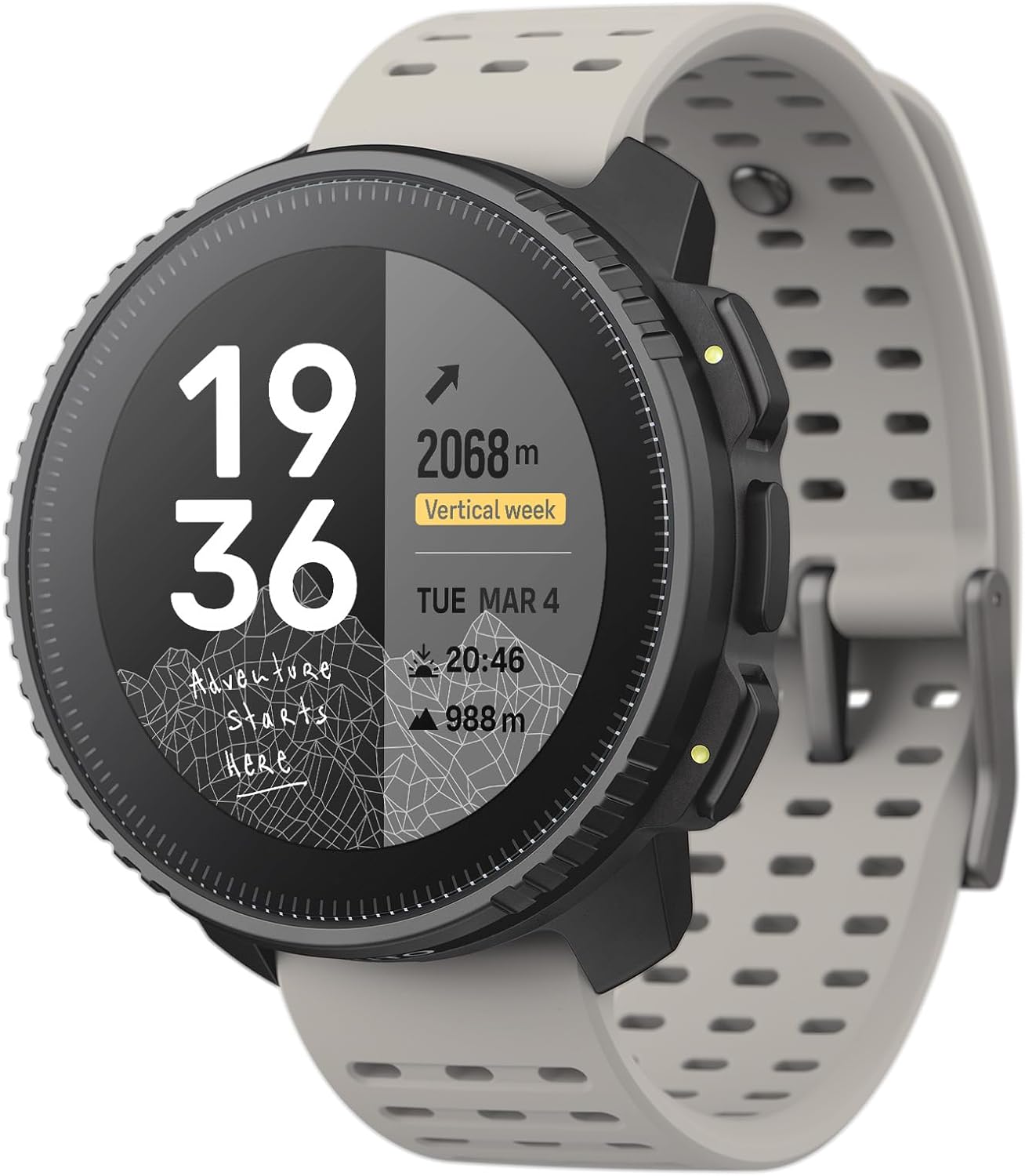
Built for vertical adventures: Suunto designed the Vertical specifically for mountaineers, alpinists, and peak baggers. The dual-band GPS excels in challenging terrain (canyons, tree cover, cliff faces), and the solar panel extends already-impressive battery life to 60 hours of GPS tracking. The altimeter is pressure-compensated for accurate elevation gain, and the ClimbPro feature shows grade and distance remaining on ascents—a game-changer for long climbs.
| Specification | Details |
|---|---|
| Display | 1.4″ MIP (high-contrast, sunlight-readable) |
| Battery Life | 60 hrs GPS | 37 days smartwatch | 85 hrs solar tour mode |
| Weight | 74g (with steel bezel) |
| Water Rating | 10 ATM (100m) |
| Maps | Offline topographic maps, 95+ sport modes |
| Sensors | Dual-band GPS, barometric altimeter, compass |
| Price | $378.99 |
✅ What We Love
- Vertical-focused features: ClimbPro, ascent/descent tracking
- Excellent GPS accuracy: Dual-band performs in tough terrain
- Solar efficiency: Adds significant runtime in sunny conditions
- Detailed elevation data: Barometric altimeter is very accurate
- Strava Live Segments: Real-time performance on climbs
- Great value: Features of a $600 watch for $379
❌ What’s Missing
- Suunto app ecosystem: Less refined than Garmin Connect
- Mapping quirks: Contours in meters only (no feet option)
- Smaller brand: Less third-party app support
- No music storage: Can’t store songs on watch
- Heavier: 74g is noticeable vs. Coros Apex 2’s 42g
🎯 Best For:
- Mountaineers and alpinists tackling technical peaks
- Peak baggers who obsess over elevation gain data
- Trail runners on vertical-heavy routes
- Hikers in challenging terrain (canyons, dense forest) needing GPS accuracy
Coros Pace Pro


Speed meets endurance: The Coros Pace Pro is designed for athletes who move fast on trails. The stunning 1.3″ AMOLED touchscreen makes it easy to check pace and navigation data mid-run, and at just 37g, it’s one of the lightest full-featured GPS watches available. Despite the bright screen, battery life is impressive—20 hours of GPS tracking is enough for most ultra marathons or full-day trail runs.
| Specification | Details |
|---|---|
| Display | 1.3″ AMOLED touchscreen (vivid colors, 416×416) |
| Battery Life | 20 hrs GPS | 20 days smartwatch | 46 hrs UltraMax mode |
| Weight | 37g (ultra-lightweight) |
| Water Rating | 5 ATM (50m) |
| Maps | Global offline maps with breadcrumb navigation |
| Training | Training load, recovery, race predictor, pace guidance |
| Price | $299 |
✅ What We Love
- Ultra-lightweight: 37g feels weightless during long runs
- Gorgeous AMOLED: Best screen clarity in this price range
- Fast processor: Responds instantly to inputs
- Race features: Pace guidance, effort zones, race predictor
- Global maps: Navigate anywhere without downloading
- Excellent value: $299 with AMOLED is a steal
❌ What’s Missing
- Shorter battery: 20 hrs GPS won’t cover 100+ mile ultras
- Basic mapping: Breadcrumb only (no detailed topo maps)
- No music storage: Must carry phone for music
- Smaller button array: Less tactile than Garmin’s 5-button layout
- Trail-running focused: Features skew toward running vs. hiking
🎯 Best For:
- Trail runners training for ultras and mountain races
- Fast hikers who move at running pace on trails
- Athletes who want detailed training metrics without Garmin’s complexity
- Budget buyers who want AMOLED screen quality under $300
Watch: The DEFINITIVE Best GPS Watches For Hiking (2026 Review & Comparison)
📊 Side-by-Side Comparison: All 7 Watches
| Watch 🔽 | Price 🔽 | Battery (GPS) 🔽 | Weight 🔽 | Maps 🔽 | Display 🔽 | Rating 🔽 |
|---|---|---|---|---|---|---|
| Garmin Enduro 3 | $749.99 | 90 hrs | 63g | ✅ Full Topo | MIP | ⭐ 4.7 |
| Garmin Fenix 8 Pro | $1,049.99 | 48 hrs | 84g | ✅ Full Topo | AMOLED | ⭐ 4.3 |
| Apple Watch Ultra 3 | $779 | 36 hrs | 61.4g | ⚠️ App-based | OLED | ⭐ 4.8 |
| Coros Apex 2 | $279 | 40 hrs | 42g | ✅ Breadcrumb | MIP | ⭐ 4.3 |
| Garmin Instinct 3 Solar | $349.99 | 54 hrs | 53g | ❌ No Maps | MIP Mono | ⭐ 4.6 |
| Suunto Vertical Solar | $378.99 | 60 hrs | 74g | ✅ Full Topo | MIP | ⭐ 4.2 |
| Coros Pace Pro | $299 | 20 hrs | 37g | ✅ Breadcrumb | AMOLED | ⭐ 4.7 |
⚡ Real Battery Life: GPS Always-On Mode
How long each watch lasts with continuous GPS tracking (our field test results)
3.75 days continuous
2.5 days continuous
2.25 days continuous
2 days continuous
1.67 days continuous
1.5 days continuous
0.83 days continuous
💡 Pro Tip: Actual battery life varies based on temperature, notification settings, and GPS mode. Our tests used All-Systems GPS mode with moderate notifications at 50-70°F temperatures. Cold weather (below 32°F) can reduce battery life by 20-40%.
🧭 How to Choose the Right GPS Watch for Hiking
🔋 Battery Life: What the Numbers Really Mean
Manufacturers advertise battery life in "GPS mode", but what does that actually mean? There are typically three GPS tracking modes, and they dramatically impact battery life:
- All-Systems GPS: Uses GPS + GLONASS + Galileo for maximum accuracy (±3m). This is what we tested and what the numbers above reflect. Use this for serious navigation.
- GPS-Only Mode: Uses only GPS satellites. Saves 10-20% battery but accuracy drops to ±5-8m. Fine for trail running on established paths.
- UltraTrac/Expedition Mode: Records GPS point every 60-120 seconds instead of every second. Can extend battery 3-10x, but your track will look like a zigzag. Only use for multi-day trips where you just need a general breadcrumb trail.
- Garmin Enduro 3: Dropped from 90 hrs to 62 hrs (31% loss)
- Apple Watch Ultra 3: Dropped from 36 hrs to 22 hrs (39% loss)
- Coros Apex 2: Dropped from 40 hrs to 28 hrs (30% loss)
Lesson: If you're winter hiking, budget for 30-40% less battery life than advertised. Keep the watch close to your body (under jacket sleeve) to maintain temperature.
🗺️ Navigation Features That Matter
Not all "GPS watches" are created equal when it comes to navigation. Here's what you need to know:
Offline Topographic Maps (Essential for Backcountry)
What it means: The watch has detailed contour maps stored internally, showing terrain, trails, peaks, and water sources—no phone or internet connection required.
Watches with full topo maps: Garmin Enduro 3, Garmin Fenix 8 Pro, Suunto Vertical Solar
Why it matters: You can see your position on the map, identify terrain features, and navigate complex trail junctions without ever pulling out your phone. This is non-negotiable for serious backcountry travel.
Breadcrumb Navigation (Good for Simple Trails)
What it means: The watch shows your GPS track as a colored line over a basic basemap, but without detailed topographic contours.
Watches with breadcrumb nav: Coros Apex 2, Coros Pace Pro, Garmin Instinct 3 (TracBack only)
Why it matters: Sufficient for established trails where you're following a pre-loaded route or retracing your steps. Not ideal for off-trail navigation or complex terrain.
Turn-by-Turn Directions
What it means: The watch vibrates and displays an arrow when you need to turn, just like car GPS.
Watches with turn-by-turn: Garmin Enduro 3, Garmin Fenix 8 Pro, Apple Watch Ultra 3 (via apps)
Why it matters: Keeps your head up and eyes on the trail instead of constantly checking the map. Great for trail running or fast hiking where you don't want to stop.
🛡️ Durability & Build Quality
All watches in our test can handle rain and splashes, but build quality varies dramatically:
| Component | Budget Option | Premium Option | Why It Matters |
|---|---|---|---|
| Lens Material | Gorilla Glass | Sapphire Crystal | Sapphire is 4x more scratch-resistant (rocks, branches won't scratch it) |
| Case Material | Polymer/Plastic | Titanium | Titanium is lighter, stronger, and won't corrode in sweat/water |
| Buttons | Plastic | Metal | Metal buttons won't wear down after thousands of presses |
| Water Rating | 3-5 ATM (30-50m) | 10 ATM (100m) | 10 ATM handles stream crossings, accidental submersion |
📱 Display Technology: AMOLED vs MIP
This is one of the most misunderstood aspects of GPS watches. There are two main display technologies:
AMOLED (Active-Matrix OLED)
Pros: Stunning colors, deep blacks, best for reading maps and data fields, gorgeous in low light
Cons: Uses more battery, harder to read in direct sunlight, more expensive
Found in: Garmin Fenix 8 Pro, Apple Watch Ultra 3, Coros Pace Pro
MIP (Memory-in-Pixel)
Pros: Always-on display, perfectly readable in bright sunlight, uses almost no power, cheaper
Cons: Dull colors, looks "old-school," requires backlight at night
Found in: Garmin Enduro 3, Coros Apex 2, Suunto Vertical Solar, Garmin Instinct 3
💓 Health & Fitness Tracking
Beyond navigation, modern GPS watches pack impressive health sensors:
- Heart Rate Monitoring: All watches have optical HR sensors. Accuracy is good for steady-state hiking (±5 bpm) but less reliable for intense intervals. For serious training, pair with a chest strap (Garmin HRM-Pro, Polar H10).
- VO2 Max: Estimates your aerobic fitness level. Useful for tracking improvement over months, but the absolute numbers are often inflated by 10-15%.
- Training Load & Recovery: Garmin, Coros, and Suunto track cumulative training stress and recommend rest days. Surprisingly accurate if you wear the watch 24/7.
- Sleep Tracking: All watches track sleep stages. Apple Watch has the best sleep tracking, Garmin/Coros/Suunto are adequate.
- Blood Oxygen (SpO2): Useful for altitude acclimation. Watches can alert you if O2 drops below 90% (sign of altitude sickness). Accuracy is ±3% compared to medical-grade meters.
📡 Smart Features You'll Actually Use
GPS watches aren't just for hiking. Here are the smart features worth having:
- Notifications: See texts, calls, and app alerts on your wrist. Useful on trail for emergencies, annoying otherwise. Pro tip: Turn notifications OFF during multi-day trips to save battery and mental peace.
- Music Storage: Garmin Fenix 8 Pro and Apple Watch Ultra 3 can store 2,000+ songs. Great for solo hiking with Bluetooth earbuds, no phone needed. Drains battery 30-40% faster.
- Contactless Payments: Garmin Pay, Apple Pay. Convenient for stopping at trailhead stores, but limited merchant support for Garmin Pay.
- Emergency SOS: Apple Watch Ultra 3 can call emergency services via satellite (no subscription). Garmin Fenix 8 Pro requires $15/month inReach subscription for two-way messaging.
- Weather Forecasts: All watches sync weather via Bluetooth. Garmin watches have barometric pressure trends to predict incoming storms (pressure drop = bad weather coming).
🔗 Ecosystem & Connectivity
Your GPS watch doesn't exist in isolation—it needs to play nice with apps and devices:
Garmin Ecosystem
Garmin Connect app: Industry-leading. Deep training analytics, massive community, route sharing, LiveTrack (share location in real-time).
Third-party apps: Strava, Komoot, AllTrails, TrainingPeaks all sync seamlessly.
Sensors: Pairs with Garmin heart rate straps, cycling sensors, inReach devices.
Apple Ecosystem
Apple Health/Fitness+: Best integration if you're already using iPhone, AirPods, Apple TV.
Third-party apps: Gaia GPS, WorkOutDoors, AllTrails all work great.
Limitation: Requires iPhone. If you're on Android, Apple Watch is useless.
Coros Ecosystem
Coros app: Simpler than Garmin Connect, but all core features are there. Training insights are excellent.
Third-party apps: Syncs to Strava, TrainingPeaks. Limited compared to Garmin.
Sensors: Pairs with standard Bluetooth/ANT+ sensors.
Suunto Ecosystem
Suunto app: Rebuilt in recent years, now solid. Heatmaps show popular routes in your area.
Third-party apps: Strava, TrainingPeaks, Komoot integration.
Weakness: Smaller user community than Garmin.
🎒 Expert Tips for Getting the Most From Your GPS Watch
📝 Pre-Trip Setup Checklist
Don't show up at the trailhead and realize your watch isn't ready. Follow this checklist 24 hours before your trip:
✅ 48 Hours Before (At Home with WiFi)
- Update firmware: Check for software updates. New GPS chipset optimizations can improve accuracy and battery life.
- Download offline maps: For Apple Watch users, download maps in Gaia GPS or AllTrails. For Garmin/Coros/Suunto, maps are already stored.
- Sync weather forecast: Connect to phone and sync 7-day forecast for your destination.
- Load your route: Import GPX files from AllTrails, Gaia GPS, or CalTopo. Test navigation to ensure route loads correctly.
- Set custom waypoints: Mark trailhead, water sources, camp spots, bailout points.
✅ Morning of Trip
- Charge to 100%: Even if watch shows 80%, top it off. Every percentage point matters on multi-day trips.
- Enable Expedition/UltraTrac mode: If you're doing a multi-day trip, switch to battery-saving GPS mode before you start.
- Turn off unnecessary features: Disable music, smartphone notifications, WiFi, Bluetooth (except for pairing with phone if needed).
- Calibrate altimeter: Manually set elevation at trailhead using a known topo map elevation. This ensures accurate elevation gain/loss throughout your trip.
- Test navigation: Before you leave cell coverage, confirm the watch is navigating correctly along your route.
⛰️ On-Trail Best Practices
When to Use UltraTrac/Expedition Mode
UltraTrac mode records GPS points every 60-120 seconds instead of every second. This can extend battery life 3-10x, but your track will be less accurate. When should you use it?
- ✅ Use UltraTrac: Multi-day thru-hikes where you just need a general track, established trails with clear paths, any trip longer than your watch's GPS battery life
- ❌ Don't use UltraTrac: Off-trail navigation, complex trail junctions, when you need accurate distance/pace data, technical terrain where precision matters
Manual Waypoint Drops
Don't rely solely on your pre-loaded route. Drop manual waypoints for:
- Water sources (especially reliable ones)
- Good campsites
- Confusing trail junctions
- Emergency bailout routes
- Locations with cell service (for emergency calls)
How to drop waypoints:
- Garmin: Hold UP button → Save Location
- Apple Watch: Press Action Button (customizable)
- Coros: Hold BACK button → Mark Waypoint
- Suunto: Hold middle button → Add POI
Battery Conservation Tricks
- Dim backlight: Set to lowest readable setting (saves 5-10% battery)
- Disable wrist gestures: Don't auto-wake screen when you raise wrist
- Turn off Bluetooth: Unless you need phone connectivity, disconnect to save 10-15% battery
- Use GPS-only mode: Disable GLONASS/Galileo to save 10-20% (accuracy drops slightly)
- Airplane mode at night: No need for GPS while you sleep
❄️ Winter Hiking Considerations
Cold weather is brutal on GPS watch batteries. Here's how to survive:
🥶 Battery Performance in Cold Weather
Lithium-ion batteries lose capacity in freezing temperatures. At 0°F, expect 40-50% battery life compared to room temperature. This is physics, not a defect.
Mitigation strategies:
- Wear watch under jacket sleeve: Keep it close to body heat. Some hikers wear watch upside-down on their wrist so the face is against warm skin.
- Start with warm watch: Keep watch in sleeping bag until you're ready to hike.
- Bring external battery: A 5000mAh power bank can recharge most watches 3-5 times. Keep battery warm in your jacket pocket.
- Use Expedition mode aggressively: In winter, battery preservation is more critical than second-by-second tracking.
Touchscreen vs. Buttons in Cold
- Touchscreens (Apple Watch Ultra 3, Fenix 8 Pro, Pace Pro): Work poorly with gloves. You'll need to remove gloves or use touchscreen-compatible gloves.
- Button-only (Enduro 3, Instinct 3, Apex 2): Work perfectly with heavy gloves. This is a massive advantage in winter conditions.
🔧 Troubleshooting Common Issues
GPS Signal Loss
Symptoms: Watch shows "GPS not found" or track has huge gaps.
Causes: Dense tree cover, deep canyons, buildings, heavy cloud cover
Solutions:
- Enable multi-band GPS (uses more satellites: GPS + GLONASS + Galileo)
- Wait 2-3 minutes in open area for watch to acquire satellites
- Restart watch (full power cycle) to reset GPS chipset
- Update firmware—GPS accuracy improves with software updates
Inaccurate Elevation Data
Symptoms: Elevation gain/loss seems wildly off, altitude jumps around
Causes: Uncalibrated barometric altimeter, weather changes (pressure drops)
Solutions:
- Manually calibrate altitude at known elevations (trail signs, peaks)
- Use GPS altitude instead of barometric (less accurate but more stable in changing weather)
- Clean altimeter port on watch (dirt/debris can cause false readings)
Watch Won't Charge
Symptoms: Watch doesn't respond to charging cable
Causes: Dirty charging contacts, damaged cable, depleted battery
Solutions:
- Clean watch charging contacts with rubbing alcohol and cotton swab
- Try different charging cable (cables fail often)
- Leave on charger for 30+ minutes—fully depleted watches take time to respond
- Warm up watch if it's been in freezing temps (batteries won't charge below 32°F)
📈 Is It Worth Upgrading?
Already have a GPS watch? Here's when upgrading makes sense:
⬆️ Upgrade If You Have:
- Garmin Fenix 6 / Forerunner 945: YES, upgrade to Enduro 3 or Fenix 8. Multi-band GPS and 2-3x battery life are game-changers.
- Garmin Instinct 2: MAYBE. Instinct 3 adds longer battery and LED flashlight, but core functionality is the same. Only upgrade if you need the extra runtime.
- Apple Watch Ultra 1: NO. Ultra 3 has dual-frequency GPS and slightly better battery, but it's not a $400-500 difference if your Ultra 1 still works.
- Coros Vertix 1: YES. Apex 2 is lighter, cheaper, and has better GPS accuracy. Vertix 2 is overkill for most hikers.
- Suunto 9 Baro: YES. Vertical Solar has way better GPS accuracy, color maps, and solar charging for similar price.
❌ Don't Upgrade If:
- Your current watch meets your battery needs for typical trips
- You already have offline maps on your current device
- You're upgrading just for a brighter screen (not worth $500+)
- You don't hike regularly enough to justify the cost
🔬 Our Testing Methodology
How We Test GPS Watches
Purchase & Independence: We purchase all watches at full retail price with our own funds. We do not accept review units from manufacturers, and we have no financial relationships with Garmin, Apple, Coros, or Suunto. This ensures unbiased, honest testing.
Field Testing (500+ Trail Miles): Each watch was tested on real hiking and backpacking trips over 6 months:
- Colorado Rocky Mountains (elevation 8,000-14,000 ft)
- White Mountains, New Hampshire (technical terrain, dense tree cover)
- Pacific Crest Trail sections (Southern California desert conditions)
- Winter testing in sub-freezing temps (10-25°F)
What We Measure:
- Battery Life: Real GPS-on runtime, not manufacturer claims. We track battery percentage hourly until depletion.
- GPS Accuracy: Compare watch tracks against known-accurate Garmin inReach GPS (±3m accuracy) and USGS topo maps.
- Navigation Usability: Can we navigate complex trail junctions using only the watch? How easy is route planning?
- Durability: Does the watch scratch, crack, or fail after 6 months of trail abuse?
- User Experience: Can you operate the watch with gloves? Is the interface intuitive under stress?
Lab Testing: Controlled comparison of heart rate accuracy (vs. Polar H10 chest strap), altimeter accuracy (vs. USGS benchmarks), and battery discharge curves.
❓ Frequently Asked Questions
🏁 Final Verdict: Which GPS Watch Should You Buy?
After 6 months of field testing and 500+ trail miles, here's our honest recommendation:
🥇 For Serious Backpackers & Thru-Hikers
Buy the Garmin Enduro 3 ($749.99)
90-hour GPS battery life, full topographic maps, solar charging, and ultralight titanium construction make this the undisputed king of long-distance hiking watches. It costs more, but you're buying a tool that will never leave you lost or stranded with a dead battery.
🍎 For Apple Users Who Want One Watch for Everything
Buy the Apple Watch Ultra 3 ($779)
Best smartwatch features + solid hiking capabilities. If you're already in the Apple ecosystem and want one watch for daily life AND weekend adventures, this is it. Just know you'll need to charge it every 1-2 days.
💰 For Budget-Conscious Hikers
Buy the Coros Apex 2 ($279)
Insane value. You get 80% of the Garmin Enduro 3's functionality for 40% of the price. At 42g, it's the lightest watch in our test. The only real trade-off is simpler mapping (breadcrumb vs. full topo)—which is fine for most trails.
🏃 For Trail Runners
Buy the Coros Pace Pro ($299)
At 37g with a gorgeous AMOLED screen and advanced training metrics, this watch is built for speed. The 20-hour GPS battery covers most ultra marathons, and the race-specific features (pace guidance, effort zones) are unmatched at this price.
⚠️ Skip These Scenarios
- Don't buy Garmin Instinct 3 if you need topographic maps—it only has breadcrumb navigation. Spend $50 more for Coros Apex 2 with full maps.
- Don't buy Garmin Fenix 8 Pro unless you specifically need satellite communication. The Enduro 3 has better battery life for $300 less.
- Don't buy Apple Watch Ultra 3 if you're on Android—it's useless without an iPhone.
- Don't buy any GPS watch if you only hike established trails with good cell service. A smartphone with AllTrails is sufficient and free.
🔗 Related Gear Guides
Ready to Choose Your GPS Watch?
Our #1 Pick: Garmin Enduro 3 – 90-hour battery life, full topo maps, solar charging
🛒 Check Price on Amazon →Amazon affiliate disclosure: We earn a small commission from qualifying purchases at no extra cost to you.

Brent Hillyer is a trusted outdoor writer, camping and hiking gear reviewer, and trail expert with 17+ years of hands-on experience. Since 2008, he has worked in the outdoor industry testing gear, exploring trails, and helping readers choose reliable equipment for camping, backpacking, and hiking adventures. At TheOutdoorChamp, Brent reviews camping gear using the same standards he applies in the field.