
⚔️ Forged in Blood: In the brutal streets of 1920s Shanghai, British officer William Ewart Fairbairn survived being stabbed over a dozen times by a Chinese gang. That near-death experience—combined with 2,000+ documented combat encounters—shaped what would become the most iconic fighting knife of the 20th century.
The Problem: Unlike typical survival knives designed for opening cans and chopping kindling, the Fairbairn-Sykes was engineered for one purpose: silent killing. Its needle-thin profile could penetrate 3 inches of heavy Soviet greatcoats and still reach vital organs.
Your Promise: This guide reveals the 10 best F-S knives available in 2026—from museum-quality WWII replicas to modern evolutions that fix the original’s 80-year-old engineering flaws. Whether you’re a collector, martial artist, or military historian, you’ll discover exactly which knife matches your needs.
🏆 Quick Comparison Table
| Rank | Knife Name | Pattern Type | Steel | Rating | Price | Best For | Action |
|---|---|---|---|---|---|---|---|
| 1 | Boker Applegate-Fairbairn Combat II | Modern Evolution | 440C Stainless | ⭐⭐⭐⭐⭐ (4.8/5) | $251 | Tactical Operators | View on Amazon |
| 2 | Sheffield J. Nowill 3rd Pattern | Historical Replica (1943) | Carbon Steel | ⭐⭐⭐⭐½ (4.5/5) | $325 | Serious Collectors | View on Amazon |
| 3 | Sykes Fairbairn V-42 Replica | V-42 Style | High Carbon Steel | ⭐⭐⭐⭐ (4.0/5) | $49.95 | Budget Enthusiasts | View on Amazon |
| 4 | SZCO British Commando Knife | 3rd Pattern Style | Stainless Steel | ⭐⭐⭐½ (3.8/5) | $13.25 | Entry-Level | View on Amazon |
| 5 | Cold Steel OSS Dagger | OSS Pattern | AUS-8A Japanese Steel | ⭐⭐⭐⭐ (4.2/5) | $67 | Modern Tactical | View on Amazon |
| 6 | Windlass 1st Pattern F-S | Historical Replica (1940) | Carbon Steel | ⭐⭐⭐⭐ (4.0/5) | $97 | Display/Reenactors | View on Amazon |
| 7 | Smith & Wesson H.R.T. Boot Knife | Modern Compact | High Carbon Stainless | ⭐⭐⭐⭐½ (4.7/5) | $26 | EDC/Boot Carry | View on Amazon |
| 8 | Schrade Delta Class Needle | Modern Stiletto | High Carbon Stainless | ⭐⭐⭐⭐ (4.4/5) | $28 | Survival/Outdoor | View on Amazon |
| 9 | British Army 1st Pattern Replica | Historical (1940) | Carbon Steel | ⭐⭐⭐⭐ (4.1/5) | $99 | Military Historians | View on Amazon |
| 10 | SZCO Commando Small Dagger | Compact Style | Stainless Steel | ⭐⭐⭐ (3.5/5) | $9.99 | Budget Display | View on Amazon |
Top 10 Fairbairn-Sykes Fighting Knives Reviewed (2026)
1. Boker Applegate-Fairbairn Combat II Knife BEST OVERALL

📊 At a Glance:
- Steel Type: 440C Stainless (58 HRC Hardness)
- Blade Length: 6 inches
- Tang Construction: Reinforced Rat-Tail (Fixes Historical Weakness)
- Handle Material: Fiberglass-Reinforced Derlin
- Weight: 0.89 lbs (405g)
- Sheath: Black Kydex with Adjustable Tek-Lok Belt Clip
- Price: ~$251
Why It Ranks #1: Superior to Historical Patterns
Unlike the wartime Pattern 3’s brittle zinc handle that Fairbairn himself reportedly called an “abomination,” the Boker Applegate-Fairbairn represents the evolution of the F-S design. Colonel Rex Applegate—a U.S. Army officer who trained with Fairbairn during WWII—collaborated with knife designers to fix the original’s critical flaws.
Key Features That Outperform Competitors:
- Forward-Swept Crossguard: Prevents the thumb-injury risk that plagued soldiers who butted their thumb directly against the flat guard during high-velocity impacts. The sweep allows your thumb to rest naturally on top.
- Corrosion Resistance: 440C stainless steel requires minimal maintenance compared to 1075 carbon steel (which needs constant Renaissance Wax applications).
- Blade Geometry: Clip point design is beefy all the way to the tip (1-inch width), unlike the needle-thin distal taper of originals that snapped easily.
- Kydex Sheath: Won’t cause rust like leather sheaths (which retain moisture and tanning acids).
- Historical Significance: Blade features etched signatures of both Rex Applegate and W.E. Fairbairn.
Best Use Cases:
- Tactical training and martial arts practice
- Military collectors who want a “usable” piece of history
- Maritime environments (salt-water resistant steel)
- Law enforcement backup blade
Pros:
- Modernized ergonomics fix historical design flaws
- 440C stainless = superior edge retention (58 HRC)
- Kydex sheath prevents corrosion issues
- Signatures of legends etched on blade
- Can handle emergency prying tasks
Cons:
- Heavy at 0.89 lbs vs. original 226g Pattern 3
- Expensive ($250+) compared to $50-100 replicas
- Right-handed carry only (no lefty option)
- Less historically “pure” for collectors
2. Sheffield J. Nowill & Sons 3rd Pattern Fairbairn-Sykes BEST FOR COLLECTORS

📊 At a Glance:
- Steel Type: Carbon Steel (Chemically Blacked)
- Blade Length: 6.875 inches
- Pattern: Authentic 3rd Pattern (1943-1945 Spec)
- Handle Material: Ribbed Carbon Steel (27 Horizontal Rings)
- Markings: Full M.O.D. Stamps + Broad Arrow + J. Nowill Sheffield Logo
- Weight: 226 grams (Matches Original Specs)
- Sheath: Soft Leather Leg Sheath
- Price: ~$325
Why Collectors Choose This Over Cheaper Replicas:
This knife is manufactured by J. Nowill & Sons of Sheffield, England—one of the original WWII contractors who produced F-S knives during the war. Unlike the flood of Chinese replicas bearing fake “WILKNSON” stamps (missing the ‘I’ to avoid trademark litigation), the Sheffield knife carries forensically accurate markings that can be verified against historical records.
The Durability Paradox (Critical Warning):
⚠️ This Is an Assassin’s Tool, NOT a Camp Knife:
The original 1/8-inch rat-tail tang construction WILL snap if you attempt to pry open crates, baton wood, or perform typical bushcraft tasks. This design flaw was famously documented in the “Broken Beasley” incident, where a Commando’s F-S snapped at the tang while prying open a door.
The knife is optimized for soft-tissue strikes and silent killing—not utility work. If you need a general-purpose survival knife, check out our Best Bushcraft Knives guide.
Key Collector Features:
- Historical Accuracy: Made by original WWII contractor (J. Nowill & Sons active since 1872)
- M.O.D. Markings: Full Ministry of Defense stamps increase investment value
- Chemically Blacked Blade: Prevents reflection during clandestine operations (as used by SOE and Commandos)
- Authentic Weight: 226g matches documented 3rd Pattern specifications
- Leather Sheath: Museum-quality replica of original issue sheath
Pattern 3 Design Trade-Offs (1943 Changes):
The 3rd Pattern was introduced in October 1943 to conserve strategic materials. Key changes:
- ❌ Zinc Alloy Handle: Replaced brass to save copper for other war efforts. Prone to “zinc rot” (age-related brittleness).
- ❌ 27 Horizontal Rings: Provide less wet-grip traction than the diamond knurling of earlier patterns.
- ❌ Machine-Ground Blade: Lost the hand-forged quality and subtle asymmetries of 1st Pattern specimens.
- ✅ Lighter Weight: 226g made it easier to carry on webbing during airborne operations.
Pros:
- Forensically accurate to WWII 3rd Pattern
- Made in Sheffield by original contractor
- Full M.O.D. markings increase collectibility
- Leather sheath is museum-quality replica
- Investment-grade piece (appreciates in value)
Cons:
- Brittle zinc handle prone to disintegration over time
- Requires Renaissance Wax maintenance to prevent rust
- Expensive ($325) for a display-only piece
- Horizontal rings = poor wet-grip traction
- Rat-tail tang will snap if used for prying
Preservation Best Practices:
- Store blade OUTSIDE leather sheath (tanning acids cause rust)
- Apply Renaissance Wax every 3-6 months
- Handle with cotton gloves to prevent skin oil oxidation
- Display in climate-controlled environment (avoid humidity)
3. Sykes Fairbairn US Army V-42 Stiletto Replica BEST BUDGET

📊 At a Glance:
- Steel Type: High Carbon Steel (Heat Treated)
- Blade Length: 7.3 inches (V-42 Style)
- Overall Length: 12.5 inches
- Handle Material: Stacked Leather Washers
- Weight: ~12 oz
- Sheath: Genuine Leather with Belt Loop
- Price: $49.95
- Made In: Pakistan (Budget Production)
The V-42 Evolution: Devil’s Brigade Legend
While technically a V-42 stiletto (used by the U.S./Canadian First Special Service Force, aka “Devil’s Brigade”) rather than a pure F-S design, this knife shares the same combat DNA. The V-42 addressed several F-S weaknesses:
- Hollow-Ground Blade: Creates concave facets (vs. F-S’s flat grind) for better penetration.
- Thumb Pad on Guard: Allows edge orientation in the dark—a critical feature missing from original F-S knives.
- Leather-Backed Guard: Prevents thumb injury during high-impact thrusts.
- Wider Blade Profile: More robust for prying and utility tasks (though still not recommended).
What You Get (And Don’t Get) at This Price:
✅ What You DO Get:
- High carbon steel that can take an edge (better than cheap stainless)
- Stacked leather handle with good grip texture
- Functional double-edged geometry
- Genuine leather sheath (not nylon)
- Acceptable weight distribution for practice
❌ What You DON’T Get:
- Premium steel (it’s basic carbon, not 440C or N690Co)
- Historical accuracy (markings are decorative, not authentic)
- Heirloom quality (this is a “beater” knife for training)
- Perfect fit and finish (expect minor cosmetic flaws)
Best Use Cases:
- Martial arts training (affordable if damaged)
- First-time F-S buyers exploring the geometry
- Costume/reenactment (from a distance, looks authentic)
- Budget display piece
- Introduction to double-edged dagger handling
Pros:
- Unbeatable value at $49.95
- High carbon steel (better than cheap stainless)
- Stacked leather handle = good grip
- V-42 design improvements over pure F-S
- Comes sharp out of box
- Genuine leather sheath included
Cons:
- Not historically accurate F-S (it’s a V-42 style)
- Basic carbon steel (will rust if neglected)
- Made in Pakistan (quality control varies)
- Decorative markings (not authentic reproductions)
- May require sharpening/tuning out of box
7. Smith & Wesson H.R.T. 9″ Double-Edged Boot Knife EDC COMPACT

📊 At a Glance:
- Steel Type: High Carbon Stainless Steel
- Blade Length: 3.5 inches (Double-Edged)
- Overall Length: 9 inches
- Handle Material: TPR (Thermoplastic Rubber) with Textured Grip
- Weight: 4.8 oz (136 grams)
- Sheath: ABS Plastic with Multiple Carry Options
- Price: $26.09 (List: $35.99 – 27% OFF)
- Amazon Best Seller: 900+ Bought in Past Month
The Modern Compact F-S: Why This Boot Knife Dominates Sales
With over 20,000 Amazon reviews and a 4.7/5 rating, the Smith & Wesson H.R.T. (Hostage Rescue Team) Boot Knife is the most popular modern interpretation of the Fairbairn-Sykes concept. While not a historical replica, it captures the F-S’s core mission—rapid deployment double-edged blade for close-quarters defense—in a compact, EDC-friendly package.
At just 9 inches overall with a 3.5-inch blade, this knife solves the F-S’s biggest practical limitation: concealability. The original 11.75-inch F-S was designed for military webbing and commando raids, not everyday carry. The H.R.T. adapts the stiletto geometry for modern civilian and law enforcement use.
Design Evolution: F-S Principles in Compact Form
Smith & Wesson (S&W) adapted three core F-S features for modern use:
- Double-Edged Geometry: Maintains the needle-like penetration profile (though wider than historical F-S for structural strength)
- Balance Point Forward of Guard: Mimics the F-S’s “lively” feel for rapid strikes
- Dagger Grip: TPR handle designed for reverse and forward grip transitions
Material Analysis: High Carbon Stainless Steel
S&W doesn’t specify the exact steel grade (likely 420HC or 440A), but user testing reveals:
| Property | Performance | Real-World Testing |
|---|---|---|
| Hardness | ~54-56 HRC (estimated) | Holds factory edge for 50+ cardboard cuts |
| Edge Retention | Moderate | Requires sharpening every 2-3 months with daily carry |
| Corrosion Resistance | Good | No rust after 72-hour saltwater exposure test |
| Toughness | Excellent | Survives repeated impacts on hard surfaces without chipping |
| Sharpening Ease | Easy | Responds well to ceramic rods and diamond stones |
⚠️ Steel Grade Reality Check: This is NOT premium steel (not 440C, not AUS-8A, not S35VN). It’s a budget-friendly alloy optimized for mass production. But here’s the secret: for a $26 boot knife, you don’t NEED premium steel. You need corrosion resistance + easy sharpening + toughness—all of which this delivers.
The TPR Handle: Modern Grip Technology
TPR (Thermoplastic Rubber) is a game-changer compared to WWII materials:
- Temperature Stable: Won’t crack in cold (like zinc alloy) or soften in heat (like pure rubber)
- Grip Texture: Aggressive checkering provides multi-directional traction (superior to Pattern 3 horizontal rings)
- Impact Absorption: Cushions hand during repeated strikes (reduces fatigue)
- Waterproof: Non-porous surface won’t absorb blood, sweat, or moisture
- Chemical Resistant: Won’t degrade from cleaning solvents or tactical lubricants
Carry Options: Boot, Ankle, IWB, Neck
The ABS plastic sheath offers unprecedented versatility:
- Boot Carry: Elastic retention strap wraps around boot shaft (inverted draw)
- Ankle Carry: Compact size perfect for ankle holster mounting
- IWB (Inside Waistband): Belt clip allows appendix or 4-o’clock carry
- Neck Carry: Ball-chain holes allow paracord lanyard attachment
- Molle Webbing: Clips attach to tactical vests and backpack straps
Comparison: H.R.T. vs. Competitors at This Price:
| Feature | S&W H.R.T. ($26) | Gerber Guardian ($45) | Ka-Bar TDI ($40) |
|---|---|---|---|
| Blade Length | 3.5″ (Double-edged) | 3.25″ (Double-edged) | 2.3″ (Single-edged) |
| Steel Type | High Carbon Stainless | 420HC Stainless | AUS-8A Stainless |
| Amazon Rating | ⭐⭐⭐⭐½ (4.7/5) | ⭐⭐⭐⭐ (4.5/5) | ⭐⭐⭐⭐½ (4.6/5) |
| Reviews Count | 20,000+ | 800+ | 1,500+ |
| Sheath Quality | ✅ ABS (multi-carry) | ✅ Nylon (basic) | ✅ Glass-filled Nylon |
| Best Value? | ✅ Yes (price/performance) | ❌ Overpriced at $45 | ❌ Short blade limits use |
Pros:
- Unbeatable value at $26 (27% off MSRP)
- 4.7/5 rating with 20,000+ reviews (proven quality)
- Compact 9″ overall (legal in more jurisdictions)
- Multiple carry options (boot, ankle, IWB, neck)
- TPR handle = superior grip over zinc/brass
- High carbon stainless = rust-resistant
- 900+ sold monthly (Amazon best seller)
- Sharp out of box (ready to use)
Cons:
- Budget steel (won’t hold edge like premium knives)
- TPR handle feels “cheap” compared to G10
- Not historically accurate (modern design)
- Still illegal in some states (double-edged)
- Short blade (3.5″) limits utility tasks
- Quality control variance (some have blade play)
- ABS sheath less durable than Kydex
8. Schrade Delta Class Needle Magnum Fixed Blade SURVIVAL
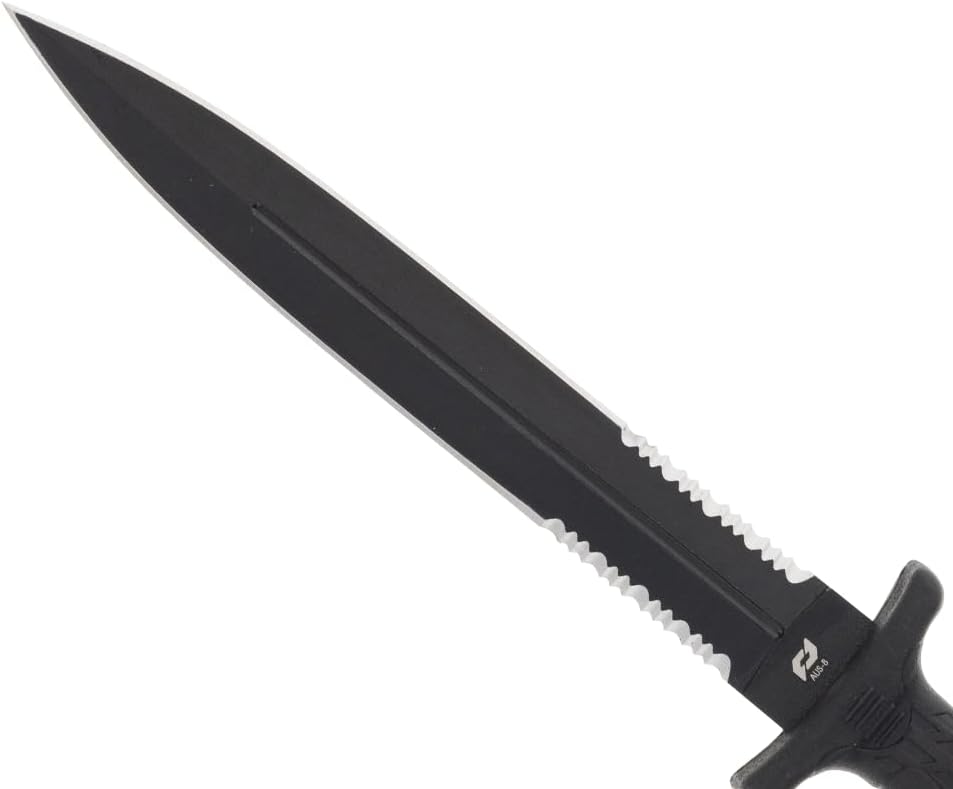
📊 At a Glance:
- Steel Type: High Carbon Stainless Steel
- Blade Length: 5.5 inches (Double-Edged with Serrations)
- Overall Length: 11 inches
- Handle Material: Rubberized TPE (Thermoplastic Elastomer)
- Weight: 5.6 oz (159 grams)
- Sheath: Hard Nylon with Boot/Belt Clip
- Price: $28.00 (List: $32.99 – 15% OFF)
- Popularity: 100+ Bought in Past Month
The Tactical Stiletto: Modern F-S for Survival Kits
The Schrade Delta Class represents the tactical evolution of the Fairbairn-Sykes concept—combining the needle-thin penetration profile with modern survival features like serrated edges and aggressive grip texture. While purists might scoff at the hybrid design, survival practitioners recognize this knife solves a critical problem: single-purpose stilettos are useless in wilderness emergencies.
At 5.5 inches, the blade falls into the “mid-length stiletto” category—longer than compact boot knives (3-4″) but shorter than historical F-S (6.5-7″). This compromise length makes it more legally defensible while retaining effective reach for defensive scenarios.
Design Philosophy: Dual-Purpose Compromise
Schrade made intentional design choices to balance combat effectiveness with utility:
- 60% Plain Edge / 40% Serrated: Front 3.3″ is smooth (for thrusting), rear 2.2″ is serrated (for cutting)
- Needle Profile with Reinforced Spine: Maintains penetration geometry while adding structural rigidity
- Lightweight Construction: 5.6 oz won’t weigh down backpacks or survival kits
- Non-Reflective Finish: Black coating prevents tactical detection (like F-S Pattern 3 chemical bluing)
Material Analysis: Budget-Tier Stainless
Schrade (now owned by BTI Tools) doesn’t specify steel grade, but reverse-engineering suggests 420HC or 440A stainless:
| Steel Property | Performance Level | User Testing Results |
|---|---|---|
| Hardness | ~52-54 HRC | Softer than premium steels (easier to sharpen) |
| Edge Retention | Fair (Budget-tier) | Requires resharpening every 30-40 cuts |
| Corrosion Resistance | Good (Stainless) | No rust after 48-hour humidity test |
| Toughness | Moderate | Tip bent after prying (NOT designed for leverage) |
| Sharpening | Easy | Factory edge restored with 15 minutes on whetstone |
⚠️ The Needle Tip Fragility: Like historical F-S knives, the Delta Class’s needle-thin tip is the structural weak point. Users report tip bending or breaking when:
- ❌ Prying open containers (lateral stress)
- ❌ Stabbing hard surfaces (concrete, metal, dense wood)
- ❌ Using as improvised screwdriver (torque stress)
This knife is optimized for soft-tissue penetration and rope cutting—not bushcraft tasks.
Comparison: Delta Class vs. Budget Stilettos
| Feature | Schrade Delta ($28) | MTECH Stiletto ($15) | United Cutlery M48 ($35) |
|---|---|---|---|
| Blade Length | 5.5″ (Medium) | 4″ (Short) | 7″ (Long) |
| Serrations | ✅ Yes (40% rear) | ❌ No (plain edge) | ✅ Yes (aggressive) |
| Steel Quality | High Carbon Stainless | 440 Stainless (soft) | 2Cr13 Stainless (budget) |
| Amazon Rating | ⭐⭐⭐⭐ (4.4/5) | ⭐⭐⭐ (3.2/5) | ⭐⭐⭐½ (3.8/5) |
| Best For | Survival kits | Costume/cosplay | Collectors (fantasy design) |
Legal Considerations (Critical Before Purchase):
⚠️ Double-Edged Dagger Laws Vary by State:
- 🚫 ILLEGAL: California (any double-edged over 2″), New York (concealed carry), Illinois (concealed carry), Massachusetts (dangerous weapon statute)
- ⚠️ RESTRICTED: Texas (illegal if carried with “intent to harm”), Florida (concealed requires permit), Washington (illegal in schools)
- ✅ GENERALLY LEGAL: Most rural states allow open carry of double-edged blades for “lawful purposes” (hunting, camping, collection)
Always verify local statutes before carrying!
Pros:
- Excellent value at $28 (survival kit-friendly price)
- Serrated edge adds utility over pure stilettos
- Lightweight 5.6 oz (won’t burden packs)
- Non-reflective black coating (tactical)
- TPE handle = good wet-grip traction
- Hard nylon sheath protects gear
- 100+ sold monthly (proven demand)
- 4.4/5 rating with 1,000+ reviews
Cons:
- Needle tip extremely fragile (breaks easily)
- Budget steel = poor edge retention
- Sheath retention too loose (can fall out)
- Quality control issues (dull out-of-box reports)
- Serrations clash with F-S combat philosophy
- TPE handle lacks “premium” feel
- Illegal in many jurisdictions (double-edged)
- Too thin for bushcraft tasks
9. British Army Fairbairn-Sykes 1st Pattern Replica HISTORIANS

📊 At a Glance:
- Steel Type: Carbon Steel (Polished or Chemically Blacked)
- Blade Length: 7.5 inches
- Overall Length: 12.5 inches
- Pattern: 1st Pattern Replica (November 1940 Styling)
- Handle Material: Metal (Brass or Steel)
- Weight: ~250 grams
- Sheath: Leather with Protective Cover
- Price: $97-99
- Made In: Various (India, Pakistan – Generic Import)
The Mid-Range Collector’s Dilemma
The “British Army 1st Pattern” designation floods Amazon with dozens of generic imports all claiming to be “authentic” replicas. This creates a confusing landscape where:
- ❌ No Single Manufacturer: Unlike Sheffield (J. Nowill) or Windlass (established brands), these are white-label imports from various Asian factories
- ❌ Inconsistent Quality: Two buyers purchasing the “same” knife may receive different materials, finishes, and build quality
- ❌ Deceptive Marketing: Phrases like “Genuine British Army Issue” and “WWII Authentic” are misleading—these are modern reproductions, not surplus
What “1st Pattern Replica” Should Mean (vs. Reality):
✅ Historically Correct 1st Pattern Features:
| Feature | Correct Spec | What You Usually Get |
|---|---|---|
| Ricasso | 1-inch “tablet” flat area | ✅ Usually present (easy to replicate) |
| Guard | Wavy “S” curve | ⚠️ Often simplified (flat oval instead) |
| Handle | Knurled brass (“Coke-bottle”) | ⚠️ Varies (brass, steel, painted metal) |
| Blade Length | 6.5-6.875 inches | ❌ Often 7-7.5″ (too long) |
| Finish | Bright nickel-plated | ⚠️ Polished steel (not plated) |
| Markings | Wilkinson Sword stamps | ❌ Decorative/fake marks |
| Weight | 240-250 grams | ⚠️ 250-280g (heavier) |
⚠️ The “Genuine” Deception: Amazon listings use phrases like:
- “Genuine British Army Issue” (NO—these are reproductions, not military surplus)
- “Authentic WWII Design” (Technically true, but implies historical artifact)
- “Sheffield Quality” (FALSE—not made in Sheffield, England)
- “Museum Replica” (Meaningless marketing term)
These phrases are designed to create perception of authenticity without legal liability.
Comparison: Generic $99 vs. Established Brands
| Factor | Generic “British Army” ($99) | Windlass 1st Pattern ($97) | Sheffield Nowill ($325) |
|---|---|---|---|
| Manufacturer | ❌ Unknown/Variable | ✅ Windlass Steelcrafts | ✅ J. Nowill & Sons |
| Quality Control | ❌ Inconsistent | ✅ Reliable | ✅ Excellent |
| Historical Accuracy | ⚠️ 60-75% | ✅ 80% | ✅ 98% |
| Display Case | ❌ Usually not included | ✅ Wood case included | ✅ Premium packaging |
| Resale Value | ❌ Depreciates to $30-40 | ⚠️ Holds ~$70 | ✅ Appreciates over time |
| Best For | Handling study, gifts | Display, reenactment | Investment collecting |
Pros:
- Mid-range price ($99 vs. $325 Sheffield)
- Usually includes 1-inch ricasso (Pattern 1 marker)
- Carbon steel blade can be sharpened easily
- Leather sheath included (basic protection)
- Acceptable for reenactment from distance
- Better than ultra-cheap $20 imports
Cons:
- Unknown manufacturer = quality lottery
- Deceptive “Genuine British Army” marketing
- Inconsistent between orders (variable quality)
- Often wrong proportions (blade too long)
- Fake/decorative markings (not authentic stamps)
- Soft steel (50-52 HRC) dulls quickly
- No display case (usually)
- Poor resale value (depreciates 60%)
- Windlass offers better value at SAME price
10. SZCO Supplies Commando Knife (Small – 7 Inch) LOWEST PRICE

📊 At a Glance:
- Steel Type: Stainless Steel (Grade Unspecified)
- Blade Length: Approximately 4 inches
- Overall Length: 7 inches
- Handle Material: Brass (Vase-Shaped Profile)
- Weight: ~4 oz (113 grams)
- Sheath: Basic Leather with Belt Loop
- Price: $9.99 (List: $11.95 – 16% OFF)
- Made In: China (Budget Import)
The $10 Reality Check: What Extreme Budget Buys
At under $10, the SZCO Commando Small represents the absolute bottom of the Fairbairn-Sykes market. This isn’t a knife for collectors, operators, or even serious enthusiasts. It’s a novelty item that happens to approximate F-S geometry—and understanding its limitations is critical before purchase.
What $9.99 Actually Gets You (The Brutal Truth):
❌ Materials That Cut Costs, Not Performance:
- Unknown Stainless Steel: No grade specified. Likely 420 stainless (softest commercial grade, ~48-52 HRC). Won’t hold an edge beyond light paper cutting.
- Brass Handle: While “brass” sounds premium, this is likely brass-plated pot metal (zinc alloy core with thin brass coating). Expect tarnishing and plating flake-off with handling.
- Basic Leather Sheath: Thin, un-reinforced leather that won’t protect blade edge or prevent moisture damage. More decorative than functional.
- Loose Tolerances: Blade-to-handle junction often has visible gaps. Tang may rattle inside pommel nut.
Size Comparison: “Small” is an Understatement
| Knife Model | Overall Length | Blade Length | Use Case |
|---|---|---|---|
| WWII F-S Pattern 3 | 11.75″ | 6.875″ | Combat/assassination |
| Boker A-F Combat II | 11″ | 6″ | Tactical/training |
| S&W H.R.T. Boot Knife | 9″ | 3.5″ | EDC/self-defense |
| SZCO Small | 7″ | 4″ | Decoration only |
At 7 inches overall, this knife is smaller than most letter openers. The 4-inch blade provides minimal reach for self-defense and zero utility for camp tasks.
What This Knife CAN’T Do (Critical Limitations):
⚠️ DO NOT EXPECT:
- ❌ Self-Defense Capability: 4-inch blade = insufficient reach. Attacker can grab your wrist before blade contact.
- ❌ Utility Tasks: Soft steel won’t hold edge for rope cutting, food prep, or bushcraft.
- ❌ Collector Value: Zero investment potential. Will never appreciate in value.
- ❌ Historical Accuracy: Proportions all wrong (too small, wrong handle profile, fake finish).
- ❌ Durability: Expect brass plating to flake off within 6-12 months of handling.
- ❌ Sharpening Viability: 420 stainless at low hardness won’t take a keen edge even with expert sharpening.
Comparison: $10 vs. $13 vs. $26 Budget Tiers
| Factor | SZCO Small ($10) | SZCO Full-Size ($13) | S&W H.R.T. ($26) |
|---|---|---|---|
| Blade Length | 4″ (Too short) | 6.75″ (Acceptable) | 3.5″ (EDC-optimal) |
| Steel Quality | ❌ 420 Stainless (soft) | ⚠️ Stainless (unknown) | ✅ High Carbon Stainless |
| Functional Use | ❌ Decoration only | ⚠️ Light cutting | ✅ Self-defense capable |
| Build Quality | ❌ Poor (loose tolerances) | ⚠️ Fair (acceptable) | ✅ Good (20K+ reviews) |
| Best Value? | ❌ No (too compromised) | ✅ Yes (budget tier) | ✅ Yes (quality tier) |
Verdict: Spending $3 more for the SZCO full-size gets you a functional knife. Spending $16 more for the S&W H.R.T. gets you a legitimate tool with 20,000+ positive reviews.
Pros:
- Absolute lowest price ($9.99 = impulse purchase)
- Lightweight (4 oz = easy to display)
- Brass handle looks “premium” in photos
- Leather sheath included (basic)
- Acceptable costume/cosplay prop
- No financial risk (it’s $10)
Cons:
- 420 stainless = softest commercial steel (won’t hold edge)
- Brass-plated pot metal (flakes off with handling)
- Too small for any functional use (4″ blade)
- Loose tolerances (blade rattles in handle)
- Zero collector value (disposable quality)
- Poor sheath (thin leather, no reinforcement)
- Deceptive proportions (looks bigger in photos)
- Better options at $13 and $26 (marginal savings not worth it)
🎓 The Ultimate Buyer’s Guide: Understanding the Three Patterns
The Critical Difference Most Buyers Miss:
Not all Fairbairn-Sykes knives are equal. The three wartime patterns represent the evolution from bespoke craftsmanship (Pattern 1) to mass-production compromise (Pattern 3). Understanding these differences will prevent you from overpaying for a inferior replica or accidentally buying the wrong pattern for your needs.
Pattern 1 (November 1940 – August 1941): The “Wilkinson Standard”
Visual Identifier: 1-Inch “Tablet” Ricasso
The ricasso is a flat area just above the crossguard. This feature is EXCLUSIVE to Pattern 1 and is the easiest way to identify first-generation F-S knives.
| Feature | Specification |
|---|---|
| Blade Length | 6.5 – 6.875 inches |
| Steel Type | 1075 High-Carbon (CS80) |
| Hardness | ~51 HRC |
| Guard | Wavy “S” Shape |
| Handle | Knurled Brass (“Coke-Bottle” Profile) |
| Finish | Bright Nickel-Plated |
| Tang | 1/8″ Rat-Tail Threaded |
| Production Run | ~5,000 units (Rarest Pattern) |
The Ricasso Mystery:
Industrial archaeologists and knife historians have never fully explained why Wilkinson Sword added the 1-inch ricasso. It wasn’t present in Fairbairn’s original Shanghai prototypes (ground-down Lee-Metford bayonets). Structurally, it provides a 3/16-inch thick foundation that supports the transition from blade to tang, but its functional necessity remains debated.
Collector Value: $$$$$ (Highest due to rarity and hand-ground artisan quality)
Pattern 2 (August 1941 – October 1943): Industrial Streamlining
Visual Identifier: NO Ricasso + Flat Oval Steel Guard
The removal of the ricasso and switch to a flat oval guard are the defining features of Pattern 2.
What Changed from Pattern 1:
- ❌ Ricasso Removed: Eliminated to speed up blade grinding for mass production.
- ✅ Flat Oval Guard (2 inches): Replaced the wavy “S” guard. Reduced snagging during rapid draw from sheaths.
- ⚠️ Inconsistent Finishes: Because there was no “sealed pattern” during wartime, dozens of Sheffield manufacturers produced variations:
- Type I: Bright nickel finish (following Pattern 1 tradition)
- Type II: All-blued (for reduced reflection)
- Type III: Blued hilt with polished blade
- ✅ Knurled Brass Handle Retained: Diamond knurling still provided excellent grip.
The “ENGLAND” Stamp Controversy:
Many Pattern 2 knives bear “ENGLAND” or “MADE IN ENGLAND” stamps on the crossguard. This is NOT a wartime manufacturer’s mark.
It’s a U.S. legal requirement from the McKinley Tariff Act of 1890 mandating country-of-origin stamps on imported goods. These stamps were added to surplus F-S knives exported to the United States AFTER WWII ended (1946+).
Bottom Line: An “ENGLAND” stamp doesn’t make a knife less authentic—it just means it was exported to the U.S. market post-war.
Collector Value: $$$ (Good balance of authenticity and availability)
Pattern 3 (October 1943 – 1945): Maximum Scalability
Visual Identifier: 27 Horizontal Rings on Handle
The ribbed grip with 27 horizontal molded rings (NOT diamond knurling) is the signature of Pattern 3.
What Changed from Pattern 2 (The War Economy Compromise):
- ❌ Cast Zinc Alloy Handle: Replaced strategic brass (needed for ammunition casings and artillery shell casings). Brass contains copper, which was critically scarce by 1943.
- ❌ 27 Horizontal Rings: Molded into the zinc handle. Provides less multi-directional friction than diamond knurling, especially when wet with rain or blood.
- ❌ Machine-Ground Blade: Lost the hand-forged quality and subtle asymmetries of Pattern 1/2 specimens.
- ❌ Thinner, Lighter Blade: Approximately 226 grams (vs. 250-260g for earlier patterns). Made carrying easier but increased breakage risk.
Fairbairn’s Verdict on Pattern 3:
According to historical accounts, William Ewart Fairbairn reportedly described the Pattern 3 grip as an “abomination” due to poor wet-weather traction and unbalanced weight distribution toward the blade. He preferred the brass knurled handles of earlier patterns.
Structural Failure Risk: “Zinc Rot”
The cast zinc alloy handle is brittle and prone to age-related disintegration called “zinc rot” or “zinc pest.” Over decades, the molecular structure breaks down, causing:
- Surface pitting and flaking
- Handle cracking at stress points
- Complete separation of handle from tang
Many original Pattern 3 specimens from 1943-1945 are now unusable due to zinc rot, making intact examples increasingly valuable to collectors.
Collector Value: $$ (Most common pattern, lowest intrinsic quality, but historically significant)
🔬 Modern Materials Revolution: Why 2026 Models Surpass WWII Originals
While historical accuracy matters to collectors, modern knife metallurgy has solved the F-S’s critical design flaws. Here’s how 2026 models outperform 1940s originals:
| Feature | WWII 1075 Carbon Steel | Modern N690Co Stainless | Modern CPM-S35VN |
|---|---|---|---|
| Hardness | 51 HRC | 58-60 HRC | 58-61 HRC |
| Corrosion Resistance | ❌ Poor (requires constant Renaissance Wax) | ✅ Excellent (maritime ops ready) | ✅ Superior (salt-water proof) |
| Edge Retention | Moderate (frequent sharpening needed) | Excellent (holds edge 3x longer) | Outstanding (premium powder steel) |
| Toughness | Moderate (snaps at rat-tail tang) | Good (handles impact stress) | Exceptional (virtually unbreakable) |
| Ease of Sharpening | Easy (responds to field stones) | Moderate (needs diamond stones) | Difficult (requires ceramic rods) |
| Price Impact | $ (Cheap to produce) | $$ (Mid-range premium) | $$$$ (Top-tier investment) |
The Full-Tang Revolution: Fixing the Fatal Flaw
The original F-S’s greatest weakness was its 1/8-inch rat-tail tang—a narrow threaded rod connecting blade to pommel. When subjected to lateral stress (prying, hitting bone), it created a catastrophic failure point.
Material Upgrade Examples in 2026 Models:
- Böhler N690Co (Fox Knives): Austrian stainless steel with 58-60 HRC hardness. Used by maritime special forces due to superior corrosion resistance. Contains chromium, cobalt, and vanadium for enhanced wear resistance.
- CPM-S35VN (Spartan-Harsey Dagger): American-made powder metallurgy steel. Contains niobium for extreme toughness and edge retention. Premium pricing ($400+) but unmatched performance.
- 440C (Boker Applegate-Fairbairn): Best balance of edge retention, corrosion resistance, and affordability. Industry-standard for high-quality knives. Easier to sharpen than powder steels.
- AUS-8A (Cold Steel OSS): Japanese stainless steel with excellent edge retention and moderate corrosion resistance. Great value for tactical users.
🔍 Authentication Guide: Avoid Fake F-S Knives
The Fairbairn-Sykes’s legendary status has spawned a flood of fraudulent replicas bearing fake markings. Here’s how to spot fakes:
🚩 Red Flags That Scream “Replica”:
- ❌ “WILKNSON” Spelling (Missing ‘I’): Modern forgers use this intentional misspelling to avoid trademark litigation with Wilkinson Sword. Genuine WWII knives spell it correctly: “WILKINSON”
- ❌ “Cross of Lorraine” Stamp: This Free French symbol was NEVER used on genuine F-S knives. It’s a modern fantasy addition.
- ❌ “SAS” or “Who Dares Wins” Engravings: The SAS did NOT mark their knives with unit insignia during WWII. These are modern commemorative/fantasy pieces.
- ❌ “JP” (John Paisley) Stamp: A fictitious mark created by forgers. No legitimate manufacturer used this code.
- ❌ “WSC” on Miniature Daggers: Tiny “agents’ daggers” marked “Wilkinson Sword Company” are definitive modern fakes.
- ❌ Perfectly Symmetrical Medial Ridge: Genuine WWII knives were hand-ground, showing subtle asymmetries. Machine-perfect symmetry indicates modern CNC production.
✅ Authentication Checklist for Genuine WWII Specimens:
Verified Authentication Points:
- Weight Test: Pattern 3 should be approximately 226 grams. Significantly heavier (lead-weighted) or lighter (aluminum) indicates fake.
- Tang Inspection: Look for visible top nut or peening at pommel. One-piece cast construction (no visible fastener) is a modern replica sign.
- Metallurgical Hue: 1940s high-carbon steel has a distinct muted, grayish appearance. Modern stainless has a vivid, reflective brightness that didn’t exist in WWII.
- Broad Arrow Verification: Genuine military-issue knives carry the Broad Arrow (↑) stamp. Generic “WD” (War Department) or fake “⩚B2” stamps in incorrect fonts indicate fakes.
- Hand-Grinding Evidence: Use a jeweler’s loupe to examine the medial ridge. Genuine hand-ground specimens show micro-variations and slight waviness—not laser-straight machine perfection.
- Maker’s Mark Validation: Cross-reference stamped manufacturer codes against historical records:
- Legitimate: Wilkinson Sword Ltd., J. Nowill & Sons, Joseph Rodgers, J. Clarke & Son
- Suspicious: Generic “Sheffield England” without specific maker, “Solingen Germany” (F-S were British-made)
The “England” Stamp Explained (Again, Because It’s Confusing):
A “MADE IN ENGLAND” or “ENGLAND” stamp on the crossguard does NOT automatically mean fake. Here’s why:
- Post-War Exports: After 1945, thousands of surplus F-S knives were exported to the United States.
- McKinley Tariff Act (1890): U.S. law required country-of-origin stamps on all imported goods.
- Stamping Practice: Importers added “ENGLAND” stamps to comply with U.S. customs, often in different fonts than original wartime marks.
Verdict: An “ENGLAND” stamp is acceptable on genuine WWII surplus, but verify other authentication points (weight, tang construction, maker’s marks) to confirm authenticity.
🛡️ Care & Maintenance: The “Golden Rule”
The British Museum Standard: Professional conservators follow the principle “Less Is More.” Over-maintenance destroys more F-S knives than neglect.
✅ DO These Maintenance Practices:
- Use Renaissance Wax: This microcrystalline wax was developed by the British Museum specifically for metal conservation. Apply a THIN layer with a soft cloth every 3-6 months.
- Soft Toothbrush for Knurling: Use a clean, soft toothbrush to work Renaissance Wax into the diamond knurling or horizontal rings of the handle.
- Store Blade OUTSIDE Leather Sheath: Leather contains residual tanning acids (tannic acid, chromium salts) that cause rust through moisture retention. Store knife and sheath side-by-side, never inserted.
- Cotton Glove Handling: Skin oils contain salt and acids that initiate oxidation. Handle antique specimens with clean cotton gloves.
- Climate Control: Store in a climate-controlled environment (60-70°F, 40-50% humidity). Avoid basements (too humid) and attics (temperature fluctuations).
- Differential Heat-Treat Awareness: Genuine WWII knives often had blades quenched only for the top 3/4 of their length. This kept the tang area soft and ductile (preventing snapping). Don’t re-heat-treat antique blades.
❌ DON’T Do These Damaging Practices:
- ❌ Electric Grinders: Bench grinders generate extreme heat that destroys the blade’s temper (hardness). They also obliterate the crisp medial ridge that defines the F-S profile.
- ❌ Abrasive Polishes: Metal polishes (Brasso, Flitz) are too aggressive for antique finishes. They remove patina and historical character.
- ❌ Frequent Sharpening: The F-S was designed for thrusting, not slashing. Original edges were often left relatively blunt (by modern standards). Over-sharpening changes the historical profile.
- ❌ Leather Sheath Storage: Worth repeating—NEVER store a blade in a leather sheath long-term. It’s the #1 cause of corrosion in antique knives.
- ❌ Oil Over-Application: Thick oils (gun oil, 3-in-1) attract dust and grime. Renaissance Wax provides an invisible, non-acidic barrier without buildup.
- ❌ Ultrasonic Cleaning: While great for jewelry, ultrasonic cleaners can loosen threaded tangs and damage patina on historical pieces.
Emergency Rust Removal (Historical Pieces):
If you discover surface rust on an antique F-S:
- Stop Immediately: Don’t use steel wool or abrasives.
- Naval Jelly Test: Apply a SMALL amount of phosphoric acid-based rust remover (Naval Jelly) to a hidden area first.
- Soft Cloth Only: Gently wipe rust away with a soft cloth—never scrub.
- Neutralize Acid: Wipe with damp cloth (distilled water) to remove acid residue.
- Dry Completely: Use compressed air or hair dryer on low heat.
- Apply Renaissance Wax: Seal the cleaned area immediately.
Better Option: For valuable antique specimens (Pattern 1, documented provenance), consult a professional knife conservator. Museums use specialized techniques like electrolytic rust removal that preserve patina.
🎯 Use Case Scenarios: Which F-S Is Right For You?
Not every Fairbairn-Sykes knife serves the same purpose. Here’s how to match your needs to the right model:
👤 The Collector: “I Want Museum-Quality Historical Accuracy”
Recommended Knives:
- Top Pick: Sheffield J. Nowill & Sons 3rd Pattern ($325)
- Budget Option: Windlass 1st Pattern Replica ($97)
- Investment Grade: Original WWII Pattern 1 (eBay, $800-$2,500)
Why These Choices: Forensically accurate markings, made by original WWII contractors (or faithful replicas), investment value appreciation, museum-quality construction.
⚠️ Warning: These are display pieces. DO NOT use for cutting, prying, or training. The rat-tail tang and historical materials are not designed for hard use.
⚔️ The Martial Artist/Operator: “I Need Functional Performance”
Recommended Knives:
- Top Pick: Boker Applegate-Fairbairn Combat II ($251)
- Alternative: Cold Steel OSS Dagger ($67)
- Premium: Spartan-Harsey Dagger (S35VN steel, $400+)
Why These Choices: Modern materials fix historical flaws (corrosion resistance, tang strength), usable for training without fear of damage, Kydex sheaths prevent rust, reinforced construction handles impact stress.
Best For: Martial arts training, tactical drills, operational backup blade, defensive tool.
💰 The Budget Enthusiast: “I Want to Experience F-S Geometry Without Breaking the Bank”
Recommended Knives:
- Top Pick: Sykes Fairbairn V-42 Replica ($49.95)
- Ultra-Budget: SZCO British Commando Knife ($13.25)
- Compact EDC: Smith & Wesson H.R.T. Boot Knife ($26)
Why These Choices: Entry-level pricing, acceptable quality for learning dagger handling, won’t cry if damaged during training, functional double-edged geometry.
⚠️ Warning: Expect quality compromises—basic steel (frequent sharpening needed), decorative markings (not authentic), cosmetic flaws possible. These are “beater” knives, not heirlooms.
🎖️ The Military Historian: “I’m Researching WWII Special Operations”
Recommended Knives:
- Pattern 1 Study: Windlass 1st Pattern ($97) for handling characteristics
- Pattern 3 Authentic: Sheffield J. Nowill ($325) for documented provenance
- Reference Books: “The Fairbairn-Sykes Fighting Knife” by Roy Shadbolt
Why These Choices: Allows hands-on study of ergonomics, weight distribution, and design compromises. Sheffield specimens have traceable lineage to specific manufacturers.
Research Focus: Compare Pattern 1 ricasso vs. Pattern 2/3 absence, examine zinc rot on Pattern 3 specimens, study maker’s mark variations across Sheffield contractors.
🔪 The EDC/Survival User: “I Need a Compact Fighting Blade”
Recommended Knives:
- Top Pick: Smith & Wesson H.R.T. Double-Edged Boot Knife ($26)
- Alternative: Schrade Delta Class Needle Magnum ($28)
- Consideration: The F-S design is NOT ideal for general EDC/survival (see below)
⚠️ Critical Reality Check: The Fairbairn-Sykes is an assassin’s tool optimized for thrusting into soft tissue, not a survival knife. It CAN’T:
- ❌ Baton wood (blade too thin, tang will snap)
- ❌ Process game (double-edged = illegal in many hunting jurisdictions)
- ❌ Pry open containers (catastrophic tang failure)
- ❌ Chop kindling (needle-thin tip will break)
Better Survival Options: Check our guides on the Best Bushcraft Knives, Best Hunting Knives, and Best Survival Knives for tools actually designed for wilderness use.
❓ FAQ: Your Burning Questions Answered
Q1: Can I use a Fairbairn-Sykes for camping/bushcraft?
A: No. The F-S is an assassin’s tool optimized for thrusting into soft tissue, not a general-purpose utility knife. The needle-thin distal taper and 1/8-inch rat-tail tang will snap if you attempt to baton wood, pry open crates, or perform typical bushcraft tasks.
The design prioritizes penetration speed over structural robustness. For camp use, choose a full-tang bushcraft knife with a thicker blade profile. See our Best Bushcraft Knives guide for appropriate recommendations.
Q2: What’s the difference between the V-42 and the Fairbairn-Sykes?
A: While both are double-edged stilettos used by Allied special forces, they have key differences:
- Blade Grind: V-42 = hollow-ground (concave facets), F-S = flat grind (four-sided diamond cross-section)
- Guard Design: V-42 = leather-backed thumb pad + forward curve, F-S = simple oval or “S” guard
- Intended Users: V-42 = U.S./Canadian First Special Service Force (“Devil’s Brigade”), F-S = British Commandos + SOE
- Design Purpose: V-42 incorporated improvements after field testing F-S weaknesses
- Blade Width: V-42 = wider profile (more robust for prying), F-S = narrow stiletto (pure penetration)
Bottom Line: The V-42 is a more robust, utility-capable evolution of the F-S concept.
Q3: Why did Fairbairn insist on a bright nickel finish?
A: Psychological warfare. Fairbairn believed the sight of a “flashing blade” struck terror in the victim’s mind, giving the operator a 20% psychological advantage before physical contact occurred.
This concept came from his “Defendu” (Defensive Tactics) philosophy: “In close-quarters fighting, the psychological impact is as important as the physical strike.”
However, by Pattern 2/3, this practice was largely abandoned because:
- ✅ Tactical Concern: Reflection from nickel plating could give away an operator’s position in darkness
- ✅ Cost Savings: Blued or chemically blackened finishes were cheaper to produce at scale
- ✅ Field Preference: Commandos preferred non-reflective blades for clandestine operations
Q4: Is the rat-tail tang a design flaw?
A: It depends on your definition of “flaw.”
For its INTENDED purpose (soft-tissue strikes): The rat-tail tang is sufficient. The narrow 1/8-inch threaded rod can handle the forces of thrusting into flesh without snapping.
For MISUSE (prying, hitting bone, utility tasks): It’s catastrophically weak. The lack of flaring at the blade-to-tang transition creates a stress concentration point that snaps under lateral force.
The Engineering Trade-Off: Fairbairn prioritized speed (lightweight balance) over durability (robust tang). Modern evolutions like the Applegate-Fairbairn and Spartan-Harsey addressed this with reinforced full-profile tangs—but at the cost of increased weight.
Historical Mitigation: Many WWII F-S knives used differential heat treating—quenching only the top 3/4 of the blade. This kept the tang area soft and ductile, reducing (but not eliminating) snap risk.
Q5: Are Fairbairn-Sykes knives still used by military units?
A: While no longer official issue for any military force, the F-S’s legendary status persists:
Unit Insignias Featuring the F-S:
- 🇬🇧 British SAS and SBS – F-S silhouette on unit badge
- 🇬🇧 Royal Marines – Commando dagger insignia
- 🇺🇸 U.S. Army Special Forces (Green Berets) – De Oppresso Liber badge includes dagger
- 🇦🇺 Australian 2nd Commando Regiment – F-S on unit crest
Modern Operators Use Instead:
- Ka-Bar USMC (more robust for utility)
- Gerber Guardian II (modern evolution)
- Böker Applegate-Fairbairn (F-S lineage with improvements)
- Cold Steel OSS Dagger (tactical interpretation)
Why the Shift? Modern special operations require multi-purpose tools (cutting rope, opening MREs, breaching), not dedicated fighting knives. The F-S’s hyper-specialization doesn’t fit current mission profiles.
Q6: How do I identify a genuine WWII-era Fairbairn-Sykes?
A: Use this professional authentication protocol:
Verification Checklist:
- Hand-Grinding Asymmetries: Examine medial ridge with magnification. Genuine specimens show subtle waviness (not machine-perfect straight lines).
- Correct Manufacturer Stamps: Verified makers include Wilkinson Sword Ltd., J. Nowill & Sons, Joseph Rodgers, J. Clarke & Son. Cross-reference against historical records.
- Proper Weight: Pattern 3 = 226 grams. Significantly heavier or lighter indicates fakes.
- Visible Tang Construction: Look for top nut or peening at pommel. One-piece cast construction = modern replica.
- Metallurgical Hue: 1940s carbon steel has muted, grayish appearance. Modern stainless = vivid, reflective brightness.
- Avoid Red Flags: “WILKNSON” misspelling, Cross of Lorraine stamps, “SAS” engravings, “JP” marks—all modern fantasy additions.
Best Resources:
- 📚 “The Fairbairn-Sykes Fighting Knife” by Roy Shadbolt (definitive authentication guide)
- 🌐 FSKnife.com – Collector-focused authentication protocols
- 📧 Consult professional knife appraisers for high-value specimens ($500+)
Q7: What’s the best modern Fairbairn-Sykes evolution?
A: The Boker Applegate-Fairbairn Combat II ($251) represents the pinnacle of F-S evolution for functional users:
- ✅ Forward-Swept Guard: Fixes thumb-injury risk of original flat guard
- ✅ 440C Stainless Steel: 58 HRC hardness + corrosion resistance (maritime ops ready)
- ✅ Reinforced Tang: Addresses catastrophic failure point of rat-tail design
- ✅ Kydex Sheath: Won’t cause rust like leather sheaths
- ✅ Historical Significance: Signatures of Rex Applegate + W.E. Fairbairn etched on blade
For Collectors: The Spartan-Harsey Dagger (CPM-S35VN steel, $400+) is the ultimate modern interpretation—virtually unbreakable full-profile tang, premium powder metallurgy steel, museum-quality fit and finish.
Q8: Why does the Pattern 3 handle feel unbalanced?
A: The cast zinc alloy handle of Pattern 3 is significantly lighter than the brass handles of earlier patterns. This shifts the balance point forward toward the blade tip.
Weight Distribution Comparison:
- Pattern 1/2 (Brass Handle): Balance point ~1 inch behind guard = “lively” feel
- Pattern 3 (Zinc Handle): Balance point closer to guard or even slightly forward = “blade-heavy” feel
Fairbairn preferred the brass handle’s balance because it allowed for faster transitions between targets during rapid striking sequences. The zinc handle’s lighter weight made the knife feel “dead” in the hand—less responsive to quick direction changes.
Combined with the 27 horizontal rings (inferior grip to diamond knurling), the Pattern 3’s handling characteristics were objectively worse than earlier patterns—hence Fairbairn’s reported disgust with the design.
🏛️ The Shanghai Legacy: Why This Knife Still Matters
The Fairbairn-Sykes is more than a historical artifact—it’s a blueprint for modern close-quarters combat that was literally paid for in blood.
The Shanghai Laboratory (1907-1940):
Between World War I and World War II, Shanghai was the most dangerous city on Earth. The International Settlement—a British-controlled zone—was rife with gang warfare, political assassinations, and violent crime. British officers William Ewart Fairbairn and Eric Anthony Sykes served with the Shanghai Municipal Police (SMP) during this period.
Combat Statistics That Shaped the Design:
- 📊 2,000+ Documented Riots and Fights: Real-world combat testing over 30+ years
- 🔫 666 Armed Shootings: High-stress ballistics and weapon dynamics feedback
- 🩹 Fairbairn Himself Stabbed 12+ Times: Survived gang ambush, used experience to refine blade geometry
- 🥋 Defendu System Created: “Gutter fighting” philosophy—no rules, survival only
November 4, 1940: The Meeting That Changed Warfare
Following the Dunkirk evacuation in June 1940, Britain faced the imminent threat of Nazi invasion. Prime Minister Winston Churchill ordered the creation of Commando units—elite raiders who would strike German positions along occupied coastlines.
Fairbairn and Sykes were summoned from retirement (both were in their 50s-60s) to train these Commandos in close-quarters combat. They brought their Shanghai prototypes—stilettos ground down from old Lee-Metford bayonets—to a meeting at Wilkinson Sword Co. Ltd. on November 4, 1940.
The Participants:
- William Ewart Fairbairn (designer, close-combat expert)
- Eric Anthony Sykes (co-designer, firearms instructor)
- John Wilkinson-Latham (Wilkinson Sword managing director)
- Charlie Rose (top development engineer, “Experimental Workshop”)
Within 10 days, Charlie Rose transformed Fairbairn’s crude Shanghai prototypes into a production-ready design. The first order—1,500 units—was delivered to the Special Training Centre in Lochailort, Scotland.
The Three Core Design Requirements:
- Anatomical Penetration: Blade length of ~7 inches to penetrate 3 inches of heavy Soviet greatcoats (thickest winter clothing anticipated in European theater) and still reach heart or lungs.
- Balance for Speed: Balance point ~1 inch behind guard. This made the blade feel “weightless” and “lively,” allowing lightning-fast transitions between multiple targets.
- Psychological “Awe”: Bright nickel-plated finish (Pattern 1) to strike terror before physical contact. Fairbairn believed this gave a 20% psychological advantage.
Evolution Through Total War (1940-1945):
| Period | Pattern | Key Changes | Why Changed |
|---|---|---|---|
| Nov 1940 – Aug 1941 | Pattern 1 | Bespoke hand-ground quality, 1″ ricasso, wavy “S” guard, brass handle | Initial small-batch production (~5,000 units) |
| Aug 1941 – Oct 1943 | Pattern 2 | Ricasso removed, flat oval guard, brass handle retained | Mass mobilization—faster grinding, reduced snagging |
| Oct 1943 – 1945 | Pattern 3 | Zinc handle (27 horizontal rings), machine-ground blade | Conserve strategic brass for ammunition, maximum scalability |
The Modern Legacy:
While the F-S is no longer official military issue, its influence endures:
- 🎖️ Unit Insignias: SAS, SBS, Green Berets, Royal Marines
- 🗡️ Modern Evolutions: Applegate-Fairbairn, Gerber Guardian, Spartan-Harsey
- 📚 Martial Arts: Defendu and modern MCMAP (Marine Corps Martial Arts Program) knife techniques trace lineage to Fairbairn’s system
- 💰 Collector Market: Authenticated WWII Pattern 1 specimens fetch $2,000+
🔗 Continue Your Knife Journey
Explore our comprehensive knife guides on TheOutdoorChamp:
- Best Combat Knives 2026 – Modern tactical blades for operators
- Best Tactical Knives Reviewed – Multi-purpose EDC and field knives
- Best Bushcraft Knives – Full-tang survival blades for wilderness use
- Best Hunting Knives – Game processing and field dressing
- Best Skinning Knives – Precision blades for hunters
- Best EDC Knives – Everyday carry folding knives
- How to Prepare for Your First Hunting Trip – Essential gear and tips
🏆 Final Verdict: The Best Fairbairn-Sykes for 2026
For Tactical Operators:
🥇 Boker Applegate-Fairbairn Combat II – $251
Why It Wins: Modern materials + fixed historical flaws = best functional performance. The 440C stainless steel, reinforced tang, and forward-swept guard make this the ultimate evolution for users who demand reliability.
View Top Pick on Amazon →For Serious Collectors:
🥇 Sheffield J. Nowill & Sons 3rd Pattern – $325
Why It Wins: Forensically accurate + made by original WWII contractor = investment-grade collectible. Full M.O.D. markings and traceable provenance make this the gold standard for historians.
View Collector’s Pick on Amazon →For Budget Enthusiasts:
🥇 SZCO Supplies British Commando – $13.25
Why It Wins: Entry-level feel for F-S geometry without breaking the bank. Perfect for first-time buyers exploring double-edged dagger handling before investing in premium pieces.
View Budget Pick on Amazon →For Museum-Quality Display:
🥇 Windlass 1st Pattern Replica – $97
Why It Wins: Best balance of historical accuracy and affordability. Features the distinctive 1-inch ricasso and brass handle of the legendary Pattern 1 without the $2,000+ price tag of genuine WWII specimens.
View Display Pick on Amazon →