
Bear spray is registered by the EPA exclusively as a pesticide for deterring bears. Using it on a human violates federal pesticide labeling law (FIFRA) and exposes you to state assault charges, civil lawsuits, and potential federal charges simultaneously. Courts treat bear spray as a weapon when deployed against humans — with consequences that can include lifetime firearm prohibitions and professional license impacts. This article is for outdoor education only. Always carry dedicated human-grade pepper spray for human self-defense.
Bear spray vs pepper spray for self defense — bear spray is NOT a legal or practical substitute for human-grade pepper spray. Bear spray is EPA-registered as a pesticide for bears only: using it on a human simultaneously violates federal law and state assault statutes, even in self-defense situations. For wildlife encounters in backcountry, bear spray is the superior tool. For human threats, carry dedicated pepper spray — and ideally, carry both.
Key Takeaways
- Bear spray and pepper spray share the same active ingredient — oleoresin capsicum (OC) — but differ in concentration, canister size, spray pattern, range, and legal authorized use — SABRE Red
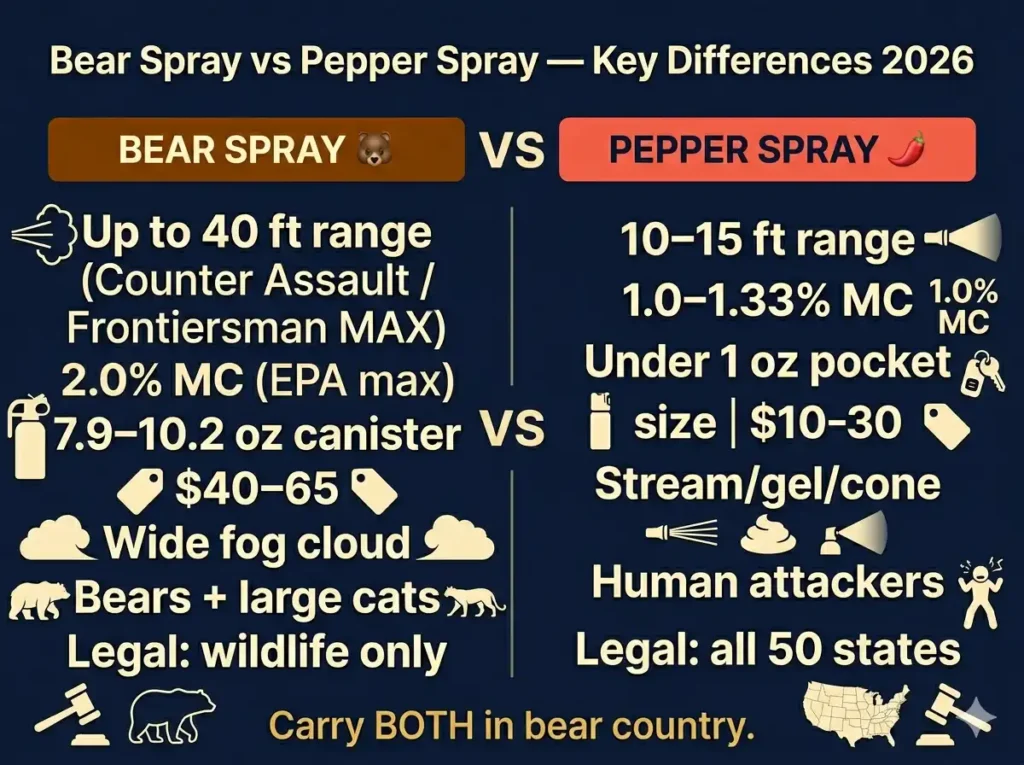
- Bear spray range: up to 40 feet (Counter Assault 10.2 oz and SABRE Frontiersman MAX, 2026). Human pepper spray: 10–15 feet stream, 6–10 feet cone — Counter Assault
- Bear spray OC concentration: up to 2.0% Major Capsaicinoids (EPA maximum). Quality human pepper spray: 1.0–1.33% MC — making bear spray more potent by this measure — Crate Club
- The EPA registers bear spray as a pesticide authorized only for use against bears — using it on a human violates FIFRA (Federal Insecticide, Fungicide, and Rodenticide Act) regardless of intent — LegalClarity.org
- Bear spray requires a minimum 7.9 oz canister per EPA requirements — compared to 0.5–2 oz for typical everyday-carry pepper spray — making it impractical for daily self-defense carry — Field & Stream
- Bear spray effectiveness against bears: 90–98% success rate in deterring attacks — significantly higher than firearms (50% success rate in bear confrontations) — SABRE Red / Outside Online
- The SABRE Frontiersman bear spray label explicitly states it also deters mountain lions, cougars, bobcats, and large cats — making it effective for multi-species backcountry wildlife defense — EPA Frontiersman Label, Feb 2025
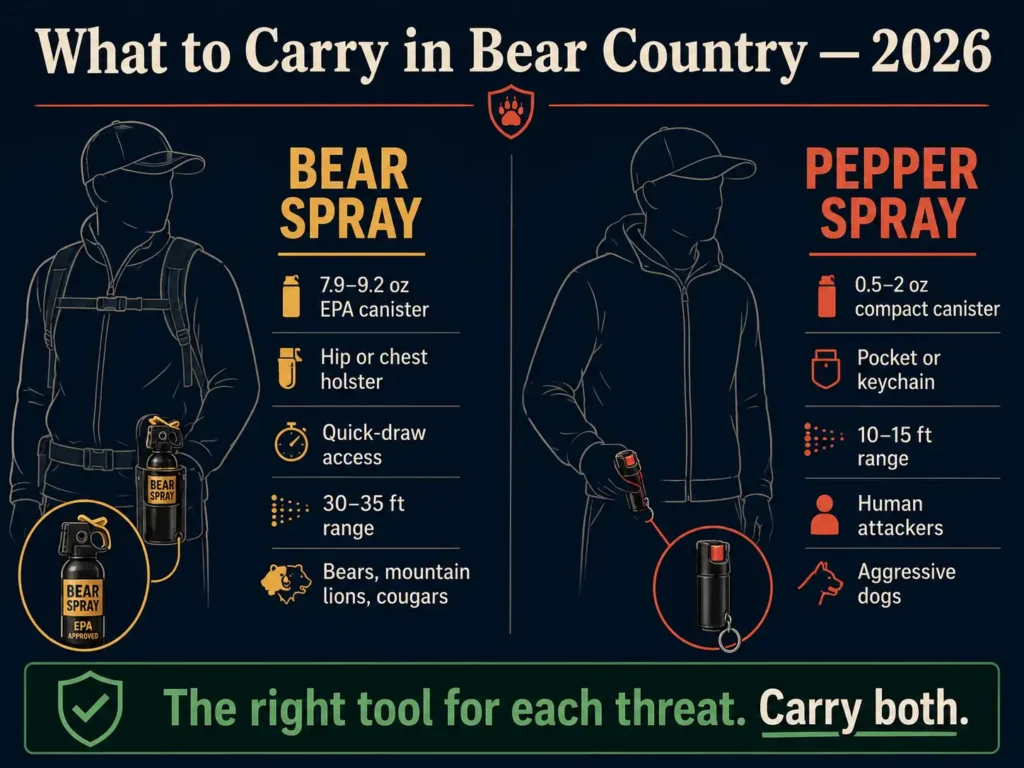
- For hikers in bear country with human threat concerns: carry bear spray in a hip holster AND a compact pepper spray in your pocket — they serve different purposes and neither substitutes for the other
What Is the Actual Difference Between Bear Spray and Pepper Spray?
Both products are built on the same foundation: oleoresin capsicum (OC), a concentrated oil extracted from Capsicum peppers. When OC contacts eyes, skin, or airways, it triggers intense burning, involuntary eye closure (blepharospasm), and respiratory distress. The chemistry is identical. The engineering around it is not.
BearVault’s comparison explains the core distinction: “Bear spray is stronger, longer range, and is designed for wildlife — not people. Pepper spray is for human self-defense.” The differences flow from one fundamental engineering decision: bear spray is optimized to create a large chemical cloud that intercepts a charging 800-pound bear at distance, while pepper spray is optimized to deliver a concentrated, targeted dose to a human face at close range.
That single design objective — cloud vs. stream — produces dramatically different products in terms of canister size, spray pattern, range, OC concentration, and cost. Blingsting’s technical breakdown confirms: “Bear spray shoots a wider mist to stop bears from up to 30–40 feet away. Pepper spray aims at a direct stream, effective at a closer range of 10–12 feet against human attackers.”
How Do Bear Spray and Pepper Spray Compare Head-to-Head?
The table below covers every factor that matters for an outdoor adventurer deciding what to carry — and why — on a backcountry trip.
| Factor | 🐻 Bear Spray | 🌶 Pepper Spray (Human Grade) | Edge |
|---|---|---|---|
| Active Ingredient | Oleoresin Capsicum (OC) | Oleoresin Capsicum (OC) | Tie |
| OC Concentration (MC%) | Up to 2.0% Major Capsaicinoids (EPA max) | 1.0–1.33% MC (quality brands) | Bear Spray |
| Effective Range | 30–40 feet (Counter Assault 10.2 oz & Frontiersman MAX: 40 ft) | 10–15 ft (stream); 6–10 ft (cone) | Bear Spray |
| Spray Pattern | Wide fog / cloud — large dispersal area | Stream, gel, cone, foam — targeted | Purpose-dependent |
| Minimum Canister Size | 7.9 oz minimum (EPA requirement) | 0.5–4 oz (varies by state law) | Pepper Spray |
| Carry Weight | 8–10+ oz — requires hip/chest holster | Under 1 oz — keychain or pocket | Pepper Spray |
| Cost | $40–$65 per canister (2026 retail) | $10–$30 per canister | Pepper Spray |
| Legal Use Against Humans | ❌ Illegal — EPA-registered for bears only; using on humans violates FIFRA + state assault law | ✅ Legal in all 50 states for human self-defense | Pepper Spray |
| Legal Use Against Bears | ✅ Legal and recommended — 90–98% effectiveness | ❌ Not effective — wrong range, wrong dispersal pattern | Bear Spray |
| Wildlife Defense (non-bear) | ✅ Effective on mountain lions, cougars, large cats (per EPA label) | ⚠️ Possible but not optimized for charging wildlife | Bear Spray |
| Indoor Use Safety | ❌ Dangerous — massive fog cloud saturates enclosed spaces | ⚠️ Risky with aerosol; use pepper gel indoors | Pepper Spray |
| Accuracy Required | Low — wide cloud covers large area | Low (cone) to moderate (stream/gel) | Bear Spray |
| Spray Duration | 5–9 seconds (empties full canister) | Multiple shorter bursts | Bear Spray |
| Wind Blowback Risk | High — massive fog cloud is wind-sensitive | Moderate (stream) to High (cone/fog) | Both vulnerable |
| Expiry / Shelf Life | 3–4 years from manufacture date | 2–4 years depending on brand | Tie |
| Allowed in National Parks | ✅ Legal and recommended by NPS | ✅ Legal with standard state restrictions | Tie |
Is Bear Spray Stronger Than Pepper Spray?
This question has a nuanced answer that depends on which measure of “strength” you use — and the answer is often misrepresented in both directions online.
By Major Capsaicinoids (MC%) — the most meaningful potency measure — bear spray is stronger. The EPA caps bear spray at 2.0% MC, while top human pepper spray brands like SABRE Red and Fox Labs typically deliver 1.0–1.33% MC. As Crate Club explains, bear spray contains about 2% capsaicin, “significantly stronger than most human-grade pepper sprays that contain between 1.2% and 1.4% capsaicin.”
However, some retailers present a contradictory claim: that bear spray is actually less potent than human pepper spray. This stems from a different measurement: the total OC oil percentage by volume. Some human pepper sprays are advertised as “18% OC” or “30% OC” — but what that number describes is the raw oleoresin capsicum oil before processing, which may have widely varying capsaicin content. Bear spray is measured differently and typically has lower raw OC percentages. Stun & Run Self Defense notes this directly: “Bear spray also contains a lower concentration of oleoresin capsicum (often referred to as capsaicin) than pepper spray or OC spray.” Both claims can be simultaneously true because they measure different things.
The reliable comparison: Major Capsaicinoids percentage is the only standardized, meaningful potency measure. By that metric, bear spray at 2.0% MC is more potent than most civilian pepper sprays. But that higher concentration is optimized for dispersal across a large fog cloud — not for concentrated contact-delivery to a human face. A direct-stream pepper spray at 1.33% MC hitting an attacker in the eyes delivers very high localized potency. A bear spray cloud that a person walks through delivers lower per-molecule contact despite higher overall MC concentration.
What Are the Legal Consequences of Using Bear Spray on a Human?
This is the most important section of this article for anyone considering bear spray as a self-defense tool against people.
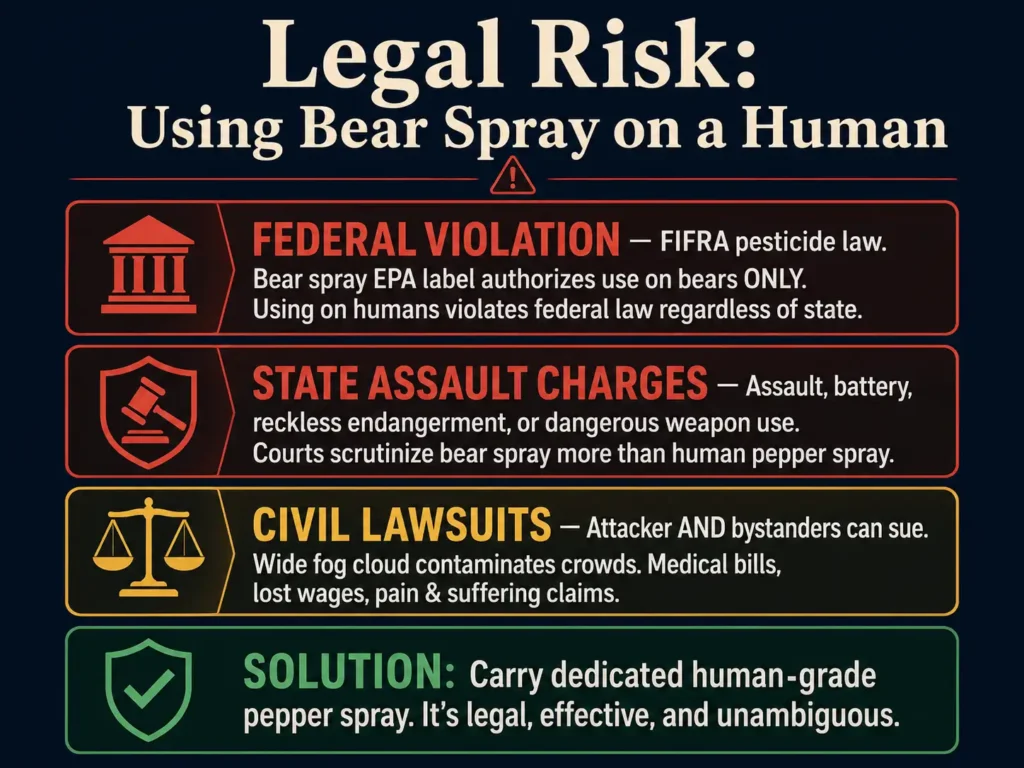
LegalClarity.org’s legal analysis draws the sharpest conclusion: “The law treats bear spray as something with one legitimate purpose: stopping a bear. Using it on a person puts you on the wrong side of federal pesticide law, exposes you to state assault charges, and opens you to civil lawsuits for any injuries you cause.” The simultaneous exposure to three separate legal liabilities is what makes the situation so risky.
Federal pesticide law violation (FIFRA)
Bear spray is registered with the Environmental Protection Agency under the Federal Insecticide, Fungicide, and Rodenticide Act (FIFRA) as a pesticide. Every canister carries an EPA registration number and a label that authorizes use only against bears. LegalClarity confirms that “using it inconsistently with its label violates federal law” — specifically FIFRA — regardless of your state’s self-defense statutes. This is a federal issue that exists in parallel with any state law analysis.
State assault and battery charges
In most states, deploying any chemical irritant against a person constitutes assault or battery — with the self-defense exception available only when you can demonstrate the force was reasonable and proportionate to an imminent threat. The Legal Guide notes that “misusing bear spray against another person can lead to criminal charges such as assault, battery, or brandishing a weapon, depending on circumstances.” Because bear spray is specifically labeled for bears, prosecutors and courts are less sympathetic to self-defense claims involving it than they would be for human-grade pepper spray.
Elevated charges and new 2025–2026 real-world incidents
The prosecutorial environment has hardened significantly in 2025–2026, and new criminal cases illustrate exactly how courts are treating bear spray incidents. In May 2026, Portland prosecutors charged 53-year-old Nathaniel Geigle with assault and animal abuse after he blasted a woman and her dog with bear spray inside a North Portland apartment elevator — the lingering cloud also contaminated multiple residents and responding police officers who began coughing. He was arrested, arraigned, and held in Multnomah County Jail. In May 2025, a Florida woman was charged with felonies after using bear mace on a 3-year-old child and her mother in Ocala — Newsweek reported that physicians noted bear mace can cause lasting neurological and physical damage to children, including asthma and potential nerve damage. These are not edge cases — they illustrate what happens when bear spray is used against humans in routine conflict situations.
The trend extends beyond individual incidents. Hamilton, Ontario police reported in March 2026 a 115% increase in bear spray-related incidents between 2021 and 2025, with 63% of identified offenders aged 10–19. The easy retail availability of bear spray — compared to human pepper spray which faces stricter purchase rules in many jurisdictions — is a documented factor in its misuse as a street weapon.
LegalOverview.com’s April 2026 legal analysis reports that “prosecutors in 2025 and 2026 have increasingly treated bear spray as equivalent to other weapons. Court decisions have upheld convictions where bear spray was classified alongside knives, clubs, and tasers.” Federal prosecutors charged bear spray attackers from the January 6, 2021 Capitol incident under assault statutes carrying up to 20 years. Weapon-related convictions can trigger lifetime firearm prohibitions — a permanent consequence that extends well beyond any criminal sentence. The same analysis is direct: “Legal Bottom Line: Using bear spray on a person violates federal pesticide law and state assault laws simultaneously, regardless of your intent.”
Civil liability
Even if criminal charges are not filed or are dismissed, the person sprayed — or innocent bystanders contaminated by the wide fog cloud — can sue for medical expenses, lost wages, pain and suffering, and property damage. Bridge Legal confirms: “Civil liability is another consideration. Victims can pursue compensation for medical costs, lost wages, pain and suffering, and property damage.” The wide dispersal pattern of bear spray makes bystander contamination in public spaces almost inevitable, multiplying the potential civil exposure.
When Should You Use Bear Spray — and Does It Work?
Bear spray is not merely a larger version of pepper spray. It is a purpose-engineered wildlife deterrent that has been studied extensively in real bear encounter data — and the evidence for its effectiveness is remarkable.
SABRE’s bear spray data cites field studies showing bear spray success rates of 90–98% in deterring bear attacks — compared to 50% effectiveness when firearms are used. The reasons are clear: bears typically charge from a distance, and a 35-foot fog cloud that hits the bear’s eyes and nose at 20 feet gives it time to stop, reverse, and flee. A firearm requires a much more precise shot under extreme stress. A small stream-pattern pepper spray canister with 10-foot range is simply the wrong tool — you’d need the bear within arm’s reach before it was effective.
The EPA requires bear spray to contain a minimum of 7.9 ounces — because testing established that smaller canisters do not produce a sufficient cloud volume to intercept a charging bear reliably. Field & Stream’s bear spray testing guide confirms: “The EPA requires that the minimum amount of spray within a canister is 7.9 ounces; otherwise, it may not contain enough to deter a bear effectively.”
The SABRE Frontiersman EPA product label also explicitly authorizes its use against “mountain lions, cougars, pumas, bobcats, lynxes and all other large cats” — per the February 2025 EPA-registered label. This makes quality bear spray the most comprehensive large-wildlife deterrent available to civilian hikers.
Which Scenario Calls for Bear Spray vs Pepper Spray?
🐻 Use Bear Spray When…
- Hiking, backpacking, or camping in bear country (Rocky Mountains, Alaska, Pacific Northwest, Yellowstone, Glacier)
- You need 30+ foot standoff distance from a charging animal
- Facing bears, mountain lions, cougars, or other large predators
- You want the highest-evidence wildlife deterrent — 90–98% stop rate
- You’re in areas where firearms are restricted but wildlife defense is needed
- A wide-area fog cloud is appropriate (open terrain outdoors)
🌶 Use Pepper Spray When…
- Defending against a human attacker at close range (3–15 feet)
- Everyday carry — walking to car, jogging, commuting
- Indoor environments where a fog cloud would contaminate the space
- You need a product that is unambiguously legal for human self-defense
- You want something that fits in your pocket, purse, or on a keychain
- Defending against aggressive dogs on a trail
What Are the Best Bear Spray Products for Hikers in 2025?
If you’re heading into bear country, these are the EPA-registered options with the strongest field-tested track records. All specs are sourced from manufacturer product pages and the EPA’s registered product label database.
SABRE Frontiersman MAX Bear Spray
~$40–$50 (Walmart / Amazon, June 2026)Upgraded MAX version now reaches 40 feet — matching Counter Assault’s top range. Field-tested by Elmendorf Air Force Base and Brown Bear Resources. Glow-in-the-dark safety clip. Available in 7.9 oz. Ships with belt holster. Effective against all bear species and large cats per EPA label.
Counter Assault Bear Spray 10.2 oz
~$60–$65 (June 2026)First EPA-approved bear spray, now upgraded to 40 ft range on the 10.2 oz model. Longer 8-second spray time than Frontiersman — best suited for deep backcountry. Glow-in-the-dark safety, bright red canister, Clean Air Act compliant. Ships with nylon holster.
UDAP Bear Spray 12VHP with Holster
~$60 (June 2026)Designed by a grizzly attack survivor. Shoots 30+ feet, lightweight at 7.9 oz, includes hip holster. Consistently rated best overall by independent reviewers in 2026 for balance of price, weight, and stopping power.
Guard Alaska Bear Spray
~$35–$45 (June 2026)Only EPA-approved spray certified effective against all bear species including polar bears. Longest spray duration of tested models at 9 seconds. Lower range (20 ft) than other options — choose this for extended encounters, not standoff distance.
How Do You Properly Deploy Bear Spray in a Bear Encounter?
Carrying bear spray is only valuable if you can deploy it correctly in a genuine emergency. Most bear encounters happen fast — knowing the deployment steps before you enter bear country is essential.
- Keep it immediately accessible. Bear spray in the top of your pack is useless — it must be in a hip or chest holster within arm’s reach at all times in bear country. BikehikeSafari’s guide recommends sleeping with it next to your head for tent camping.
- Know your safety mechanism. Both Frontiersman and Counter Assault use a safety clip. Practice removing it and re-engaging it before your trip. Many guides recommend at least one practice draw with an inert canister. The glow-in-the-dark features on Frontiersman and Counter Assault are genuinely useful for nighttime access.
- Wait until the bear is within 30–60 feet. Deploying beyond 60 feet wastes spray and the cloud dissipates before reaching the bear. Begin deploying when the bear is at 30–60 feet and closing.
- Aim slightly downward toward the ground between you and the bear. This creates a chemical cloud wall the bear must pass through. Do not aim directly at the bear’s face — the cloud dispersion is more effective than a narrow direct stream.
- Wind check. Deploy downwind of yourself or crosswind. If the wind is directly toward you, the cloud will contaminate you. Adjust your position before spraying if time allows.
- Back away slowly once the cloud is deployed. Do not run — running triggers prey-chase instinct. Keep spraying bursts as needed until the bear stops its approach or turns.
Is Bear Spray Allowed in National Parks?
Yes — bear spray is not only allowed in most U.S. national parks, it is actively recommended by the National Park Service. Yellowstone, Glacier, Grand Teton, and other bear-country parks encourage hikers to carry EPA-registered bear spray on all backcountry trails. The NPS cites the same 90–98% effectiveness data as the basis for this recommendation.
However, a few caveats: some national park concessionaires and visitor center areas prohibit weapons — check whether this applies to bear spray in the specific facilities you’ll be using. Some parks with very low bear density may not require it. And while bear spray may be carried into national parks, it is still subject to the same federal pesticide labeling restriction on human use. Carry it for bears; carry separate pepper spray for human self-defense concerns on heavily trafficked trails.
Final Verdict: Bear Spray vs Pepper Spray — What Should You Actually Carry?
For wildlife in bear country: carry bear spray, full stop. The 90–98% effectiveness rate against bear attacks, 30–35 foot standoff distance, and wide fog coverage make it the best-evidenced wildlife deterrent available. No human pepper spray is an adequate substitute for a bear encounter.
For human self-defense: carry human-grade pepper spray, full stop. Bear spray is EPA-registered for bears only — using it on a human simultaneously violates federal pesticide law and state assault statutes. Human pepper spray is legal in all 50 states, costs $10–$30, fits in your pocket, and is designed specifically for the distances and scenarios of human self-defense.
For backcountry hikers who face both threats:
- Bear spray in a quick-draw hip holster — for bears, mountain lions, and large predators at distance
- SABRE Red, Fox Labs, or POM pepper spray in your pocket — for human threats at close range
- Combined carry weight: under 12 oz total
- Combined cost: under $70 for both
Never substitute one for the other. Each tool is optimized for a specific threat at a specific distance with a specific legal framework. The situation where bear spray would be your only option against a human attack is one that a $15 keychain pepper spray would have prevented entirely.
Our Methodology
Why Trust The Outdoor Champ?
Frequently Asked Questions
Can I use bear spray for self defense against humans?
Is bear spray stronger than pepper spray?
What is the range of bear spray vs pepper spray?
Can you use bear spray in national parks?
What is the difference between bear spray and pepper spray?
Does bear spray work on mountain lions and other wildlife?
Should I carry both bear spray and pepper spray when hiking?
How long does bear spray last on a person if accidentally exposed?
More Outdoor Safety & Self-Defense at TheOutdoorChamp
Complete guides on pepper spray vs taser, pepper gel vs spray, state legality, and what to do if accidentally sprayed — all in one place.
Browse All Outdoor Safety Guides →