
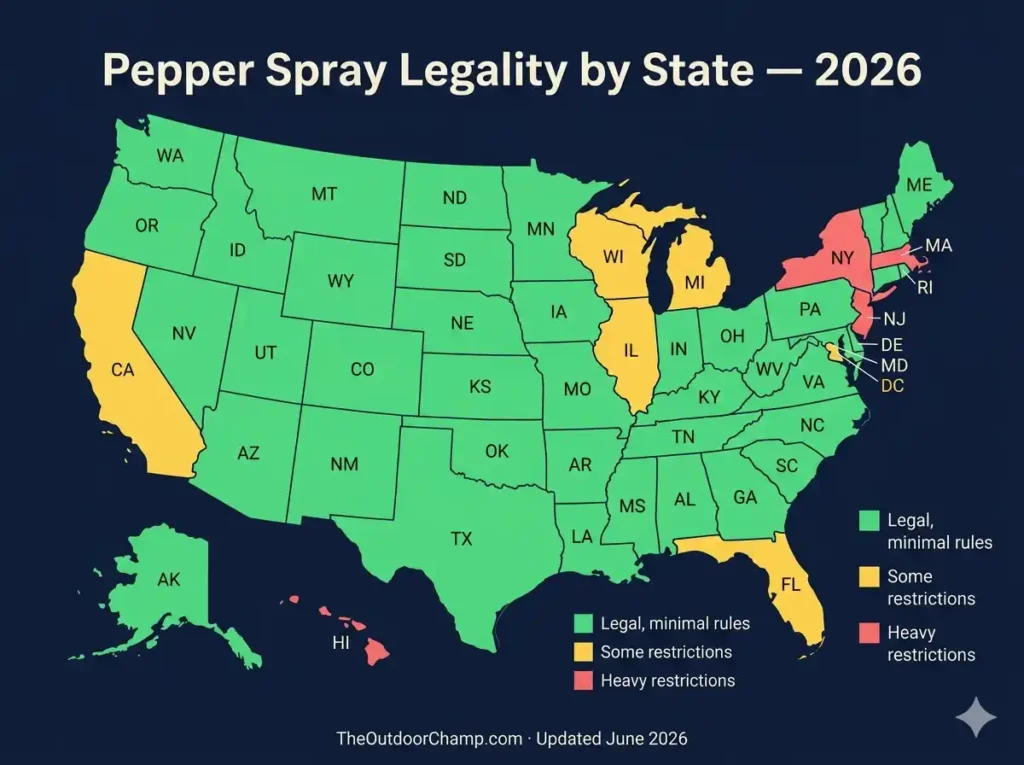
Is pepper spray legal in your state? Yes — pepper spray is legal for civilian self-defense in all 50 U.S. states in 2026, but six states impose heavy restrictions on canister size, purchase method, or who can carry it: Hawaii, Massachusetts, New York, New Jersey, Michigan, and Wisconsin. Every other state allows any adult 18+ with no felony record to buy and carry pepper spray with minimal paperwork.
Key Takeaways
- Pepper spray is legal in all 50 states for civilian self-defense — but state-specific rules on age, canister size, OC concentration, and purchase method vary significantly — SABRE Red
- Most states require buyers to be at least 18, prohibit carry by convicted felons, and restrict use to self-defense purposes only — Self Defense Products LLC, 2026
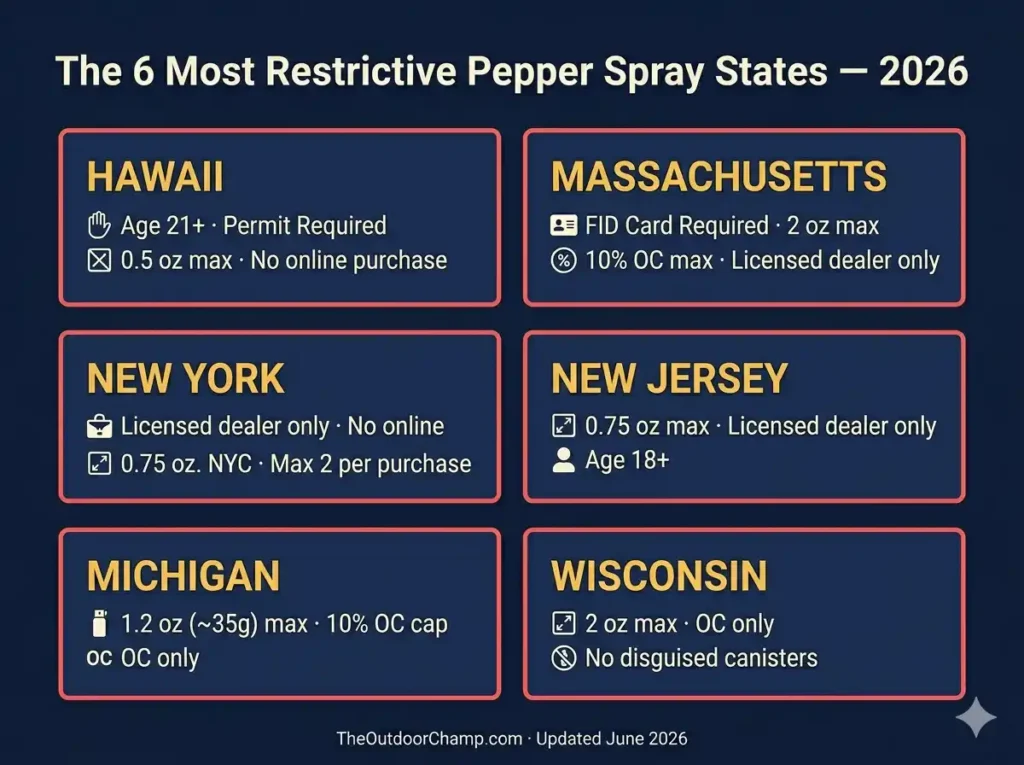
- The six most restrictive states are Hawaii (permit + 0.5 oz limit + age 21), Massachusetts (FID card + 2 oz max), New York (licensed dealer only, no online), New Jersey (0.75 oz max), Michigan (1.2 oz max), and Wisconsin (2 oz, OC only) — Safety Technology
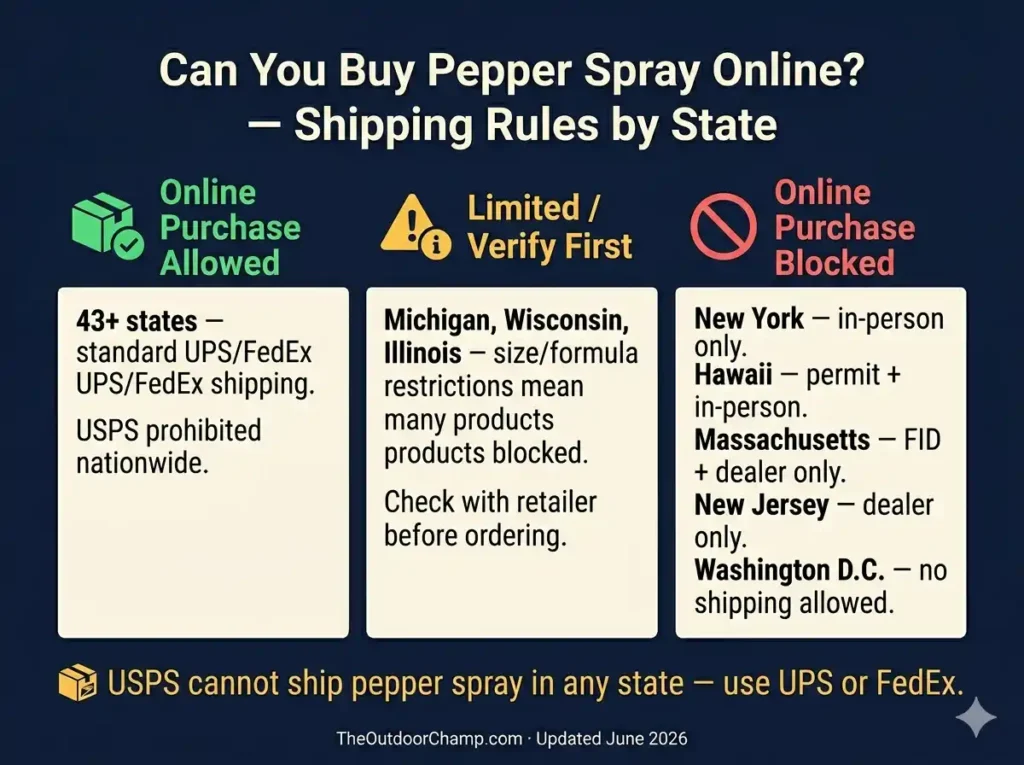
- USPS is federally prohibited from shipping pepper spray; UPS and FedEx are allowed in most states. Online purchase is blocked entirely in New York and Hawaii — Safety Technology
- Even in permissive states, pepper spray is banned in schools, courthouses, federal buildings, and many stadiums — location bans apply everywhere — Self Defense Products LLC
- TSA allows pepper spray only in checked luggage (max 4 fl. oz., safety mechanism required) — never in carry-on bags. Many airlines ban it even in checked bags — SABRE Red / TSA guidelines
- Pepper spray is illegal in many countries including the UK, Germany, Iceland, Ireland, and Greece — international travelers must research destination laws before departure
Jump to your state:
How Does Federal Law Treat Pepper Spray?
At the federal level, pepper spray is treated as a self-defense tool rather than a firearm. As Self Defense Products LLC’s legal guide explains, the federal government leaves most day-to-day regulation to individual states, but a handful of nationwide rules apply regardless of where you live:
- You may only possess pepper spray for lawful self-defense — using it to commit a crime converts it into a weapon under federal law
- USPS cannot ship pepper spray under any circumstances — retailers must use UPS, FedEx, or other private carriers
- Pepper spray is prohibited on all commercial aircraft carry-on luggage under TSA and FAA regulations
- Pepper spray is banned on all federal property including airports, federal courthouses, post offices, and military bases
- Convicted felons are prohibited from possessing pepper spray under most state statutes (federal law does not specifically address this, but state law fills the gap in all 50 states)
Beyond these federal baselines, everything else — age requirements, canister size, OC concentration, purchase channels, and carry rules — is governed by your state’s statutes and local ordinances.
Which States Have the Most and Least Restrictions?
The simplest way to understand the legal landscape is by restriction tier. The vast majority of U.S. states fall into the permissive category — minimal restrictions beyond age and criminal history. A smaller group imposes moderate rules around canister size or purchase channels. Six states stand apart as significantly more restrictive.
✅ Permissive — Minimal Restrictions
- Age 18+ (some have no age minimum)
- No permit, no ID card required
- No canister size limit (or generous limit)
- Online purchase and shipping allowed
- Standard felon and location bans apply
- Includes: TX, AZ, GA, AK, ID, WY, MT, ND, SD, NE, KS, OK, AR, TN, AL, MS, LA, SC, KY, IN, IA, MN, MO, CO, NM, NV, OR, WA, UT, VA, NC, OH, PA, and most others
⚠️ Moderate — Some Restrictions
- Canister size limits (typically 2–2.5 oz)
- May restrict certain formulas (OC only)
- Some require in-state purchase
- Local ordinances may add restrictions
- Includes: CA (2.5 oz, OC only), FL (2 oz), IL (FOID card), MI (1.2 oz, 10% OC max), WI (2 oz, OC only), DC (registration required)
🔴 Most Restrictive — Significant Rules
- Permit or firearms ID card required
- Must buy in-person from licensed dealer
- Very small canister size limits
- No online purchase or shipping
- Age 21+ in some cases
- Includes: HI (permit, 0.5 oz, age 21), MA (FID, 2 oz), NY (licensed dealer, 0.75 oz in NYC), NJ (0.75 oz, licensed dealer)
What Are the Laws in the Most Restrictive States?
If you live in or are traveling through any of the six most restrictive states, you need to know the specific rules before purchasing or carrying. Getting these wrong can result in misdemeanor or felony charges.
Hawaii — Most Restrictive in the Nation
Hawaii treats civilian pepper spray more like a firearm than a consumer product. According to Safety Technology’s legal guide, Hawaii requires a permit to acquire pepper spray, imposes an age minimum of 21 (not 18), limits canisters to just 0.5 oz — roughly the size of a travel-sized bottle — restricts formulas to OC-based only, and bans online purchases entirely. Some counties impose additional rules on top of state law. If you live in Hawaii, you must purchase in person from a licensed dealer after obtaining the required permit, and only certain OC formulations are legal. This is the single state where buying pepper spray online and having it shipped to your home is not an option.
Massachusetts — FID Card Required
Massachusetts requires a Firearms Identification Card (FID) to purchase pepper spray — the same credential used to buy rifles and shotguns in the state. SABRE’s legal summary confirms that Massachusetts requires a license for selling pepper spray, and those aged 15–18 must obtain an FID to purchase. Adults 18+ must also hold an FID. Canisters are limited to 2 oz maximum with no more than 10% OC concentration. Online shipping into Massachusetts is prohibited — purchase must be made in person from a licensed firearms or dealer location. The Home Security Superstore notes that these regulations are designed to standardize sales rather than restrict access, but in practice they create a meaningful barrier compared to other states.
New York — In-Person Purchase Only
New York prohibits online sales and shipping of pepper spray designed for use against humans entirely. POM Industries’ state law guide confirms that OC spray products must be purchased in person under NY Penal Law 265.20 — either at a licensed pharmacy or from a licensed firearms retailer, and the seller must keep a record of the purchase. SABRE also notes that New York restricts consumers to a maximum of two pepper sprays per purchase transaction. In New York City specifically, only pocket-sized canisters (roughly 0.75 oz) containing OC are allowed for civilian use. Buyers must be 18 with no felony record. Note that while some older sources classify New York as banning pepper spray, it is legal — the purchase channel restriction is the critical distinction.
New Jersey — Smallest Legal Canister in the Continental U.S.
New Jersey limits civilian pepper spray to 0.75 oz maximum canister size — among the smallest legal limits outside Hawaii. The Atomic Bear’s 50-state guide confirms: “New Jersey restricts sprays to under three-quarters of an ounce and requires buyers to be at least 18.” Purchase must be made in person from a licensed dealer — online shipping is not permitted. The practical impact: most standard consumer canisters (typically 1–3 oz) are illegal to carry in New Jersey, meaning travelers passing through must leave their standard-size canister at home or in their car.
Michigan — 1.2 oz Limit and 10% OC Cap
Safety Technology’s legal guide lists Michigan as one of the six most restrictive states, with a maximum canister size of 35 grams (approximately 1.2 oz) and an OC concentration cap of 10%. Michigan also limits civilians to OC-only formulations — products combining OC with CS or CN tear gas are illegal for civilian carry. Online purchase is generally permitted within these limits, but many retailers preemptively block Michigan shipping due to the complexity of compliance.
Wisconsin — No Disguised Canisters, OC Only
Wisconsin limits civilian carry to 2 oz maximum, restricts to OC-only formulations (no tear gas blends), and as Pepper Defense’s state law resource explains, prohibits canisters disguised as other objects — your pepper spray cannot be styled to look like a lipstick tube, pen, or any other consumer item. Wisconsin also requires products to carry safety features that prevent accidental discharge. Felons may not own any pepper spray without an official pardon. The Atomic Bear notes that Wisconsin’s combination of restrictions makes many commercially available pepper sprays technically illegal — always verify your specific product against all Wisconsin requirements before carrying.
Complete Pepper Spray Laws — All 50 States + D.C. (2026)
The table below is a simplified overview of the legal status, key restrictions, and notable rules for every U.S. state and Washington D.C. Always verify current local ordinances before purchasing or carrying — city and county rules can be stricter than state law, and statutes can change.
| State | Legal Status | Min. Age | Size Limit | OC Limit | Permit / ID Required | Online Purchase | Key Notes |
|---|---|---|---|---|---|---|---|
| Alabama | ✅ Legal | 18+ | None specified | None | No | Yes | Self-defense use only; no specific statute for spray, general noxious substance law applies |
| Alaska | ✅ Legal | 18+ | None | None | No | Yes | Defined as “defensive weapon” under state law; minimal restrictions |
| Arizona | ✅ Legal | 18+ | None | None | No | Yes | Self-defense only; felons and certain offenders restricted |
| Arkansas | ✅ Legal | 18+ | ~10 oz (300ml) | None | No | Yes | Permissive; generous size limit under §5-73-124 |
| California | ⚠️ Restricted | 18+ (16 w/ parental consent) | 2.5 oz max | OC only | No (authorized vendors) | Yes | Penal Code 22810; exceeding 2.5 oz is a felony. Warning label required. No CS/CN blends. |
| Colorado | ✅ Legal | 18+ | None | None | No | Yes | Standard restrictions; self-defense use only |
| Connecticut | ✅ Legal | 18+ | None specific | None | No | Yes | Self-defense only; local ordinances may apply |
| Delaware | ✅ Legal | 18+ | None | None | No | Yes | Minimal state restrictions beyond age and felon bans |
| Florida | ⚠️ Restricted | 18+ | 2 oz max | None | No | Yes | Specifically defined in statute as “self-defense chemical spray”; 2 oz limit strictly enforced |
| Georgia | ✅ Legal | 18+ | None | None | No | Yes | Very permissive; no size or concentration limits at state level |
| Hawaii | 🔴 Most Restrictive | 21+ | 0.5 oz max | OC only | Yes — permit required | No | Must purchase in person from licensed dealer; permit required before purchase; some counties add further rules |
| Idaho | ✅ Legal | 18+ | None | None | No | Yes | Permissive; standard felon and location bans |
| Illinois | ⚠️ Restricted | 18+ | None specified | None | Yes — FOID card | Yes (with FOID) | Firearm Owner’s Identification (FOID) card required to purchase; Chicago may add local restrictions; banned in schools and public transit |
| Indiana | ✅ Legal | 18+ | None | None | No | Yes | Standard restrictions; permissive for lawful self-defense |
| Iowa | ✅ Legal | 18+ | None | None | No | Yes | Generally permissive; standard felon restrictions |
| Kansas | ✅ Legal | 18+ | None | None | No | Yes | Permissive; prohibited for certain offenders and secure locations |
| Kentucky | ✅ Legal | 18+ | None | None | No | Yes | Self-defense use only; minimal restrictions |
| Louisiana | ✅ Legal | 18+ | None | None | No | Yes | Permissive; standard restrictions apply |
| Maine | ✅ Legal | None (state level) | None | None | No | Yes | 17 M.R.S. Section 1002 authorizes self-defense use; no state age minimum (retailers enforce 18+) |
| Maryland | ✅ Legal | 18+ | None | None | No | Yes | §36 Criminal Code authorizes “pepper mace” as reasonable precaution; permissive |
| Massachusetts | 🔴 Most Restrictive | 18+ (FID req.); 15–17 with FID | 2 oz max | 10% OC max | Yes — FID card | No — licensed dealer only | Firearms Identification Card required; in-person purchase only; no online shipping; licensed seller must keep records |
| Michigan | ⚠️ Restricted | 18+ | 35g (~1.2 oz) | 10% OC max | No | Limited | Very small size limit; OC-only; many retailers block MI shipping due to complexity |
| Minnesota | ✅ Legal | 18+ | None | None | No | Yes | Permissive; self-defense use only; standard felon restrictions |
| Mississippi | ✅ Legal | 18+ | None | None | No | Yes | Minimal restrictions; permissive for adult self-defense |
| Missouri | ✅ Legal | 18+ | None | None | No | Yes | Standard restrictions; permissive state |
| Montana | ✅ Legal | 18+ | None | None | No | Yes | Very permissive; minimal state restrictions |
| Nebraska | ✅ Legal | 18+ | None | None | No | Yes | Permissive; self-defense only; felon restrictions apply |
| Nevada | ⚠️ Restricted | 18+ | 2 oz max | None | No | Yes | 2 oz size restriction; self-defense only; standard felon bans |
| New Hampshire | ✅ Legal | 18+ | None | None | No | Yes | Permissive; no special restrictions beyond age and felons |
| New Jersey | 🔴 Most Restrictive | 18+ | 0.75 oz max | None specified | No (but licensed dealer) | No | Pocket-sized OC canisters only; must purchase from licensed dealer; no online shipping |
| New Mexico | ✅ Legal | 18+ | None | None | No | Yes | Permissive; minimal restrictions at state level |
| New York | 🔴 Most Restrictive | 18+ | ~0.75 oz (NYC); varies upstate | OC only (no CN/CS) | No (but licensed dealer) | No — in-person only | Must purchase from licensed pharmacist or firearms dealer; no internet or mail order sales; seller must record purchase; max 2 per transaction; NYC limits to pocket-sized OC only |
| North Carolina | ✅ Legal | 18+ | None | None | No | Yes | Standard restrictions; permissive for lawful self-defense |
| North Dakota | ✅ Legal | 18+ | None | None | No | Yes | Very permissive; minimal restrictions |
| Ohio | ✅ Legal | 18+ | None | None | No | Yes | Permissive; standard felon and location bans |
| Oklahoma | ✅ Legal | 18+ | None | None | No | Yes | Permissive; self-defense only |
| Oregon | ✅ Legal | 18+ | None | None | No | Yes | Permissive; standard restrictions apply |
| Pennsylvania | ✅ Legal | 18+ | None | None | No | Yes | Standard restrictions; permissive for self-defense |
| Rhode Island | ✅ Legal | 18+ | None | None | No | Yes | Legal for self-defense; standard restrictions |
| South Carolina | ✅ Legal | 18+ | None | None | No | Yes | Permissive; self-defense use only |
| South Dakota | ✅ Legal | 18+ | None | None | No | Yes | Very permissive; minimal restrictions |
| Tennessee | ✅ Legal | 18+ | None | None | No | Yes | Permissive; standard felon restrictions apply |
| Texas | ✅ Legal | 18+ | None | None | No | Yes | Among the most permissive states; no size or concentration limits; felon restrictions apply |
| Utah | ✅ Legal | 18+ | None | None | No | Yes | Permissive; self-defense use only |
| Vermont | ✅ Legal | 18+ | None | None | No | Yes | Permissive; minimal restrictions |
| Virginia | ✅ Legal | 18+ | None | None | No | Yes | Standard restrictions; self-defense use only |
| Washington | ✅ Legal | None (state level) | None | None | No | Yes | More permissive age requirements than most states; Seattle ordinances (2020–2025) regulate police use only, not civilian carry; DC registration required separately |
| West Virginia | ✅ Legal | 18+ | None | None | No | Yes | Permissive; standard restrictions apply |
| Wisconsin | ⚠️ Restricted | 18+ | 2 oz max | OC only | No | Limited | No disguised canisters; no tear gas blends; safety mechanism required; many commercial products non-compliant — verify before buying |
| Wyoming | ✅ Legal | 18+ | None | None | No | Yes | Very permissive; minimal restrictions; adult self-defense standard |
| Washington D.C. | ⚠️ Restricted | 18+ | None specified | None | Registration at purchase | No — cannot ship to D.C. | Registration required at point of sale; cannot be shipped to D.C.; minors under 14 and 14–17 without parental consent prohibited — D.C. Code §7-2502.13 |
Where Is Pepper Spray Banned Even If Legal in Your State?
State-level legality is only half the picture. Even in the most permissive states, carrying pepper spray in certain locations is prohibited by law, institutional policy, or both. Violating location bans can result in criminal charges even where state law fully permits carry.
- K-12 schools and school grounds — prohibited in all 50 states. Some states allow school administration to grant exceptions; most do not.
- College and university campuses — many but not all. Check your specific institution’s policy. Some public universities in permissive states allow carry; most private institutions prohibit it.
- Courthouses, jails, and detention facilities — prohibited without exception by court security policy and state law in virtually every jurisdiction.
- Federal property — airports, federal courthouses, post offices, military installations, national parks visitor centers, and all other federal buildings. Federal law applies here regardless of state law.
- Commercial aircraft — banned from all carry-on luggage under TSA regulations; many airlines ban it from checked luggage too.
- Government buildings — state capitols, DMV offices, and other government facilities typically prohibit weapons including defensive sprays in public areas.
- Stadiums, arenas, and amusement parks — the majority of professional sports venues and theme parks (including Disney parks) prohibit all weapons. Always check venue security policy.
- Public transit systems — many major transit authorities (NYC subway, Chicago CTA, BART, Metro) prohibit pepper spray on trains and buses.
- Private businesses with “no weapons” signage — legally enforceable in most states; entering after seeing a prohibition sign can constitute trespass if you’re asked to leave and don’t.
- Public housing properties — many federally-funded public housing developments prohibit weapons in common areas under HUD policies.
Can You Bring Pepper Spray on a Plane? TSA Rules Explained
✈️ TSA Pepper Spray Rules — 2026
Can a Felon Legally Carry Pepper Spray?
In the vast majority of states, convicted felons are prohibited from possessing pepper spray. This is one of the most consistent rules across all 50 states — more consistent even than age requirements, which vary by state. Self Defense Products LLC advises: “Anyone with a felony or certain violent/weapon convictions should speak with a local attorney before possessing any defensive spray.”
The exact scope of the prohibition varies. Some states bar any felon from carrying any defensive spray permanently. Others restrict only those convicted of specific categories of crime — typically violent offenses, assault, or weapons charges. Wisconsin specifically requires an official pardon before a felon may legally possess any pepper spray. Some states also extend restrictions to persons subject to active domestic violence restraining orders or those convicted of drug offenses.
If you have any criminal history — felony or otherwise — do not assume you can legally carry pepper spray without verifying your state’s specific statute. The penalty for a prohibited person possessing defensive spray can be a felony charge in some states, adding to an existing record.
Can You Buy Pepper Spray Online and Have It Shipped to Your State?
For most Americans, yes. Safety Technology’s legal guide confirms that in most states, pepper spray can be purchased online and shipped via UPS or FedEx — but not USPS, which is federally prohibited from shipping any pepper spray or OC product. Reputable online retailers (SABRE, Amazon, Byrna, POM) automatically block shipping to restricted states at checkout.
The states where online purchase is blocked or severely restricted:
- New York: No internet or mail-order sales. In-person purchase from licensed pharmacist or firearms dealer only.
- Hawaii: No online sales; permit required before purchase; in-person only.
- Massachusetts: Licensed dealer only; no shipping; FID card required at point of sale.
- New Jersey: Licensed dealer required; online shipping blocked by most retailers.
- Washington D.C.: Cannot ship to D.C.; must purchase in-person with registration at point of sale.
- Michigan / Wisconsin: Online purchase technically possible, but many retailers block shipping due to compliance complexity around size and formula restrictions.
What Happens If You Use Pepper Spray and the Law Gets Involved?
Legally carrying pepper spray and legally using it are two separate questions. In every state, use of pepper spray is only legally defensible when it is proportionate and reasonable — meaning you genuinely believed you faced an imminent threat of physical harm, and the level of force used was appropriate to that threat.
As California criminal defense attorneys explain, questions that arise in legal proceedings include: Did you spray too soon, before you were truly in danger? Was there a less-confrontational option available? Did you spray in a crowded place where bystanders were harmed? Using pepper spray during the commission of a crime — even a minor one — converts the canister from a defensive tool into an offensive weapon under the law, with significantly harsher penalties. Failing to comply with state laws can lead to penalties ranging from misdemeanor fines to felony charges in states with stricter statutes.
The practical rule: only use pepper spray when you reasonably believe you are about to be physically attacked. Do not use it to resolve arguments, deter someone who is merely irritating you, or control crowds. Document the incident as soon as possible after and contact law enforcement — in most cases, self-defense use of a legal defensive tool will not result in charges, but having a clear account of the threat is important if it does.
Summary: What You Need to Know Before You Carry
If you live in Texas, Arizona, Georgia, or most other states in the South, Plains, or Mountain West: You can buy pepper spray at any sporting goods store, carry it with no permit, and purchase online with no restrictions beyond being 18 with no felony record. Use it only for self-defense.
If you live in California or Florida: Stay under the 2.5 oz (CA) or 2 oz (FL) canister limit, buy OC-only formula (CA), and you’re fine. Most standard SABRE Red or Fox Labs consumer canisters are compliant.
If you live in Illinois: Get your FOID card — the same one you likely already need for any firearm purchase. Once you have it, the process is straightforward.
If you live in Michigan or Wisconsin: Verify that your specific product — including its exact weight in grams and OC% — complies with state law before carrying. Many standard products are technically non-compliant.
If you live in Massachusetts, New York, New Jersey, or Hawaii:
- Do not buy online and have it shipped — it will be intercepted or is simply illegal.
- Go to a licensed firearms dealer or pharmacist (NY) in person.
- Bring valid ID. In MA, bring your FID card. In HI, get your permit first.
- Buy the smallest compliant canister available — 0.75 oz for NJ/NYC, 0.5 oz for HI, 2 oz for MA.
Everywhere: Leave it in your car when entering schools, courthouses, government buildings, stadiums, or airports. Those location bans apply in every state without exception.
Our Methodology
Why Trust The Outdoor Champ?
Frequently Asked Questions
Is pepper spray legal in all 50 states?
Which states have the strictest pepper spray laws?
What states have no restrictions on pepper spray?
Can you bring pepper spray on an airplane?
Do you need a permit to carry pepper spray?
Can a felon carry pepper spray?
Where is pepper spray banned even if legal in your state?
Can you order pepper spray online and have it shipped to your state?
More Self-Defense & Survival Gear at TheOutdoorChamp
Read our full guides on pepper gel vs spray, pepper spray vs taser, and building your personal emergency safety kit.
Browse Self-Defense Guides →