
When I first heard about a knife that could actually replace an axe, I’ll admit I was skeptical. But after diving deep into the Terava Skrama 240 and testing its capabilities in real-world conditions, I realized this Finnish beast is far more than just marketing hype. If you’re struggling with carrying both a knife and an axe on your outdoor adventures, you’re not alone – and this heavy-duty bush knife might just be the solution you’ve been looking for.
What Exactly Is the Terava Skrama 240?
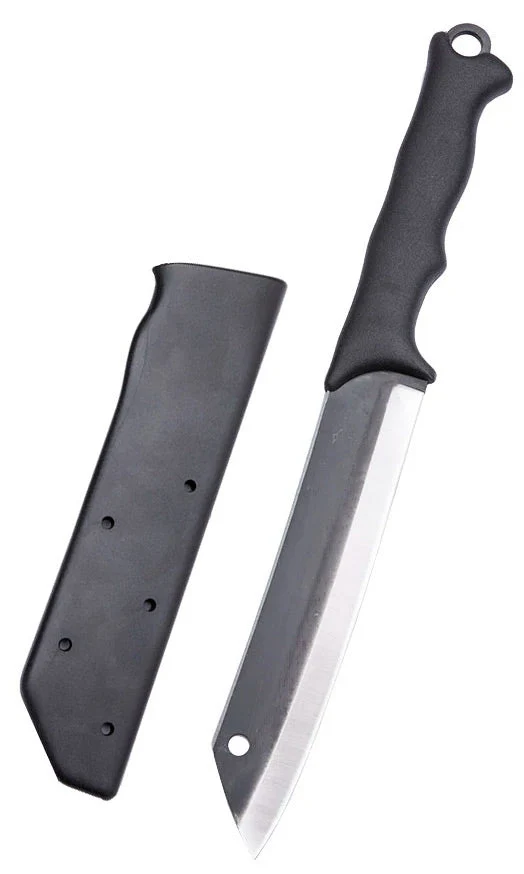
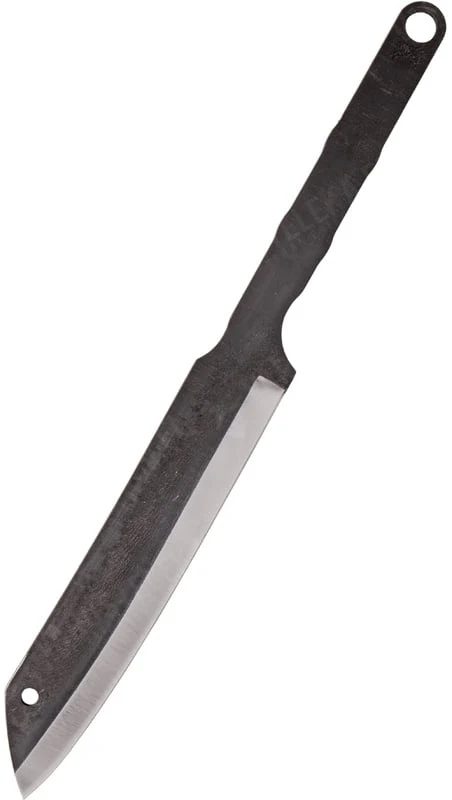
The Terävä Skrama 240 is a Finnish-made heavy-duty bush knife that bridges the gap between a traditional knife and a machete. Made by Varusteleka, a renowned Finnish military surplus and outdoor gear company, this knife draws inspiration from the historical Nordic “broken-back” scramasax design that was popular in Iron Age Europe.
The name “Skrama” itself comes from the scramasax (or seax), a large single-edged knife that doubled as both a tool and defensive implement throughout medieval Scandinavia and Northern Europe. Our 21st-century version would surely meet the demands of any Saxon warrior from “ye good olde days” – but with modern metallurgy and design refinements.
Technical Specifications: What Makes It Special?
Let’s talk numbers, because the specs on this blade are impressive:
- Total Length: 430 mm (16.9 inches)
- Blade Length: 240 mm (9.45 inches)
- Blade Width: 46 mm (1.8 inches)
- Blade Thickness: 4.2 mm (0.17 inches)
- Weight: 525 g (18.5 oz) – knife only
- Steel: 80CrV2 carbon steel, hardened to 59 HRC
- Edge Angles: Older versions featured 25° near the grip for fine work and 34° for the rest of the blade for chopping; newer versions have a uniform 34° edge
- Handle: Molded rubber with rough texture for secure grip
- Tang: Full tang construction with exposed pommel
The Steel: 80CrV2 Carbon Steel Explained
The Skrama 240 uses 80CrV2 carbon steel, which might not sound fancy, but it’s actually an excellent choice for a working blade. This tool steel has earned its reputation over decades as solid and reliable, especially for bushcraft and survival applications.
What makes Varusteleka’s heat treatment special is the differential hardening process. The surface of the steel is softer (approximately 52 HRC) than the core (59 HRC), which functions similarly to expensive differential heat treatments. This gives the blade added strength and makes it highly resistant to microscopic fractures or material defects.
When the blade is ground, the harder inner steel is revealed at the edge, giving you a 59 HRC cutting edge while maintaining that tougher, more resilient outer layer. The spine has been ground and beveled specifically to strike sparks from ferro rods – a thoughtful detail for wilderness fire-starting.
Related: Best Fire Starter Reviews
Design Philosophy: Two Knives in One
The most ingenious aspect of the Terävä Skrama 240 is its dual-purpose design. Designer Stefan Melander created this knife based on his experience during Finnish military service, where he spent countless hours chopping trees for camouflage, firewood, and shelter construction.
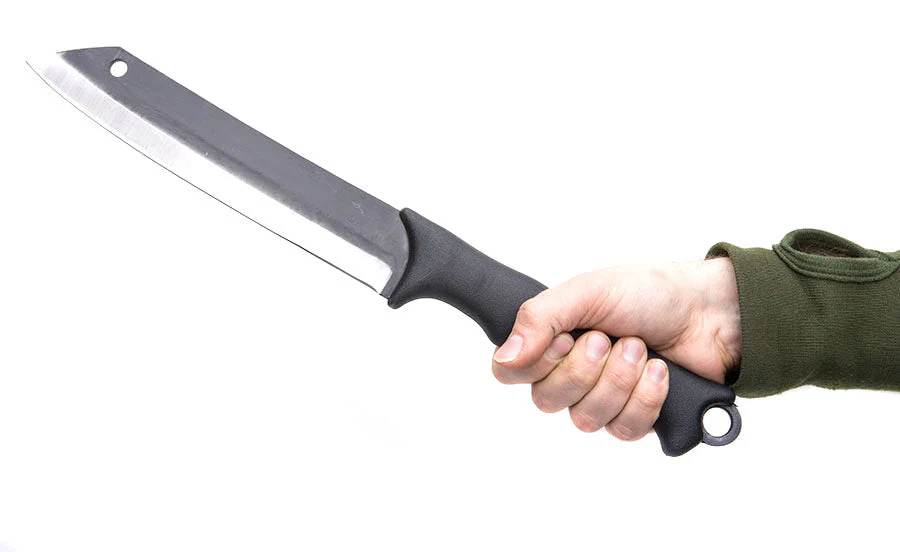
The One-and-a-Half-Handed Grip
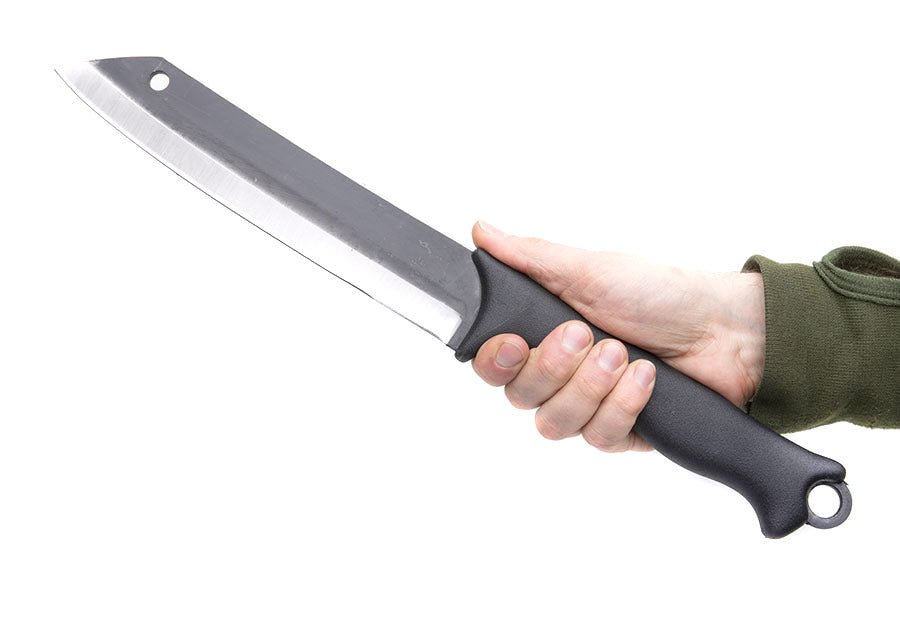
The handle deserves special attention. It’s designed for what Varusteleka calls a “one-and-a-half-handed” grip, giving you essentially two grips in one:
- Near the blade: Shaped for detailed work like carving feather sticks and making kindling
- Near the back end: Provides leverage and power for heavy chopping tasks
This unusually long handle means you don’t need to constantly switch tools. When you need to chop firewood, grip it near the back. When it’s time to prepare tinder or do camp chores, choke up on the handle near the blade. It’s remarkably effective and actually quite fun to use.
The molded rubber grip has a rough texture that provides excellent purchase even when wet or cold. Importantly, the tang is completely covered – a standard feature in Scandinavian knives that prevents your skin from touching freezing metal in subzero temperatures.
Real-World Performance: What Can the Skrama 240 Do?
Theory is great, but how does this knife actually perform in the field? Let me break down its capabilities across different tasks:
Chopping Power
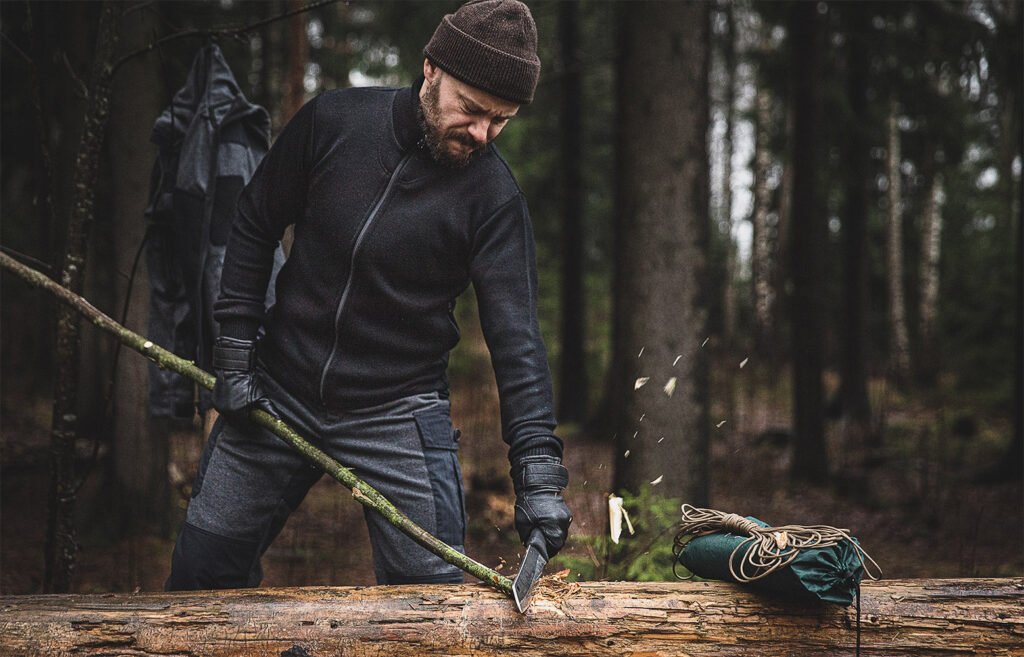
The Skrama 240 can comfortably chop pine branches up to 5cm (2 inches) thick in a single cut, even at a straight angle. That’s comparable to a small hatchet or camp axe. The advantage? The longer edge is far more forgiving than an axe’s short edge, meaning your cuts don’t have to be as precise.
This is especially valuable when you’re tired, it’s getting dark, or conditions are less than ideal. With an axe, a missed swing can be dangerous. With the Skrama’s long blade, you have much more margin for error.
Watch it in action:
- Terävä Skrama 240 Review & Test – The Ultimate Bushcraft Survival Chopper?
- The Ultimate Survival Knife? Varusteleka Terävä Skrama 240
Fine Work and Carving
Here’s where the Skrama surprises most people. Despite being designed primarily as a chopper, it handles detailed work surprisingly well. You can:
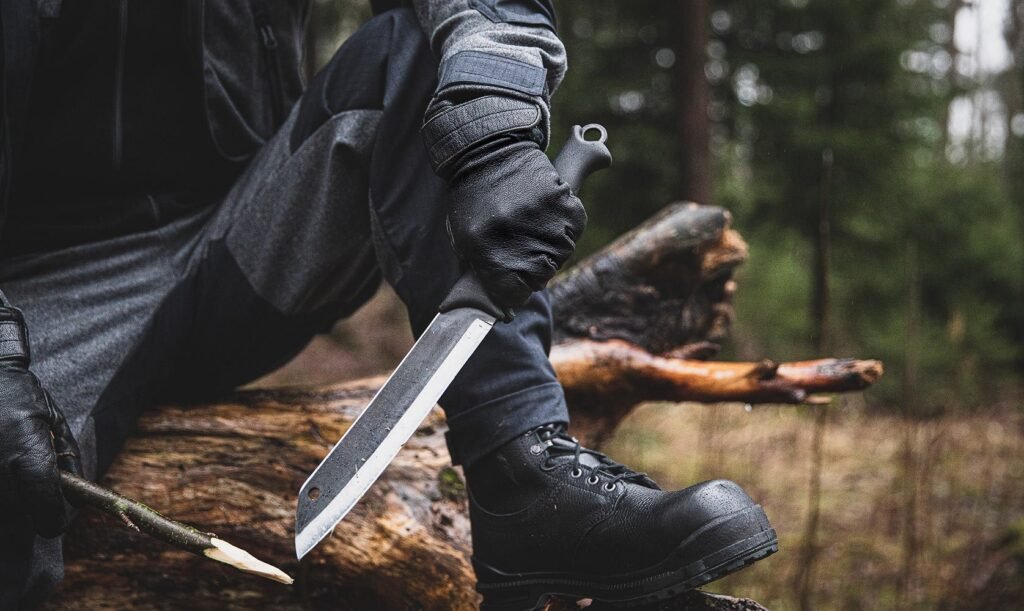
- Carve feather sticks for fire starting
- Make pointed stakes and tent pegs
- Do general whittling and camp craft
- Prepare food
The older versions with the dual-angle edge (25° near the handle, 34° on the rest) were particularly good at this. The newer uniform 34° edge is slightly less refined for detail work but still more than adequate for camp tasks.
Batoning Capability
The flat spine with no saw teeth makes the Skrama excellent for batoning (splitting wood by striking the spine with another piece of wood). The full tang construction and 4.2mm thickness provide the strength needed for this technique.
Important note: Only use wood for batoning – never rocks, axes, or other hard materials, as these will eventually damage the blade.
Related: Best Bushcraft Knife Reviews
Ferro Rod Striking
The beveled spine makes striking ferro rods easy and effective. This is a conscious design choice – without grinding the spine, the softer outer layer wouldn’t be hard enough to create good sparks.
The Sheath Options: Leather vs. MOLLE
The Terävä Skrama 240 comes with sheath options to suit different carrying preferences:
Leather Sheath
- 2mm thick vegetable-tanned cowhide
- 6cm wide belt loop
- D-ring swiveled belt loop
- Press stud strap for secure retention
- Grommet for leg tie at the tip
- Drainage hole at bottom
- Includes the standard plastic insert
MOLLE Sheath
- Same sturdy plastic insert
- MOLLE webbing attachment system
- Perfect for attaching to packs or tactical gear
Both sheaths feature a small thumb knob on the side of the mouth that makes one-handed unsheathing easy and controlled. This simple but brilliant feature is borrowed from military knife designs and works exceptionally well.
Skrama 240 vs. Skrama 200: Which Should You Choose?
Varusteleka also offers a shorter Skrama 200 with an 8-inch blade. So which one should you get?
Here’s Varusteleka’s guidance in two sentences: The Skrama 200 comes out when your regular knife is too short, and the Skrama 240 replaces the machete.
Choose the Skrama 240 if:
- You want to replace your camp axe entirely
- Maximum chopping power is your priority
- You’re doing serious shelter building or firewood processing
- You don’t mind the extra weight and length
Choose the Skrama 200 if:
- You want something more packable and lighter
- You’re pairing it with a smaller detail knife
- Extreme chopping power isn’t your main concern
- You prefer more agile handling
Related: Best Tactical Knife Reviews
Carbon Steel vs. Stainless: Making the Right Choice
The Skrama 240 is available in both carbon steel (80CrV2) and stainless steel (4110) versions. Each has distinct advantages:
Carbon Steel (80CrV2 at 59 HRC)
Pros:
- Superior edge retention
- Easier to sharpen in the field
- Strikes better sparks from ferro rods
- Tougher blade with better impact resistance
Cons:
- Requires regular maintenance to prevent rust
- Will develop a patina over time
- Must be dried and oiled after getting wet
Stainless Steel (4110 at 57 HRC)
Pros:
- Requires less maintenance
- Doesn’t rust as easily
- Good for marine or humid environments
Cons:
- Slightly less edge retention
- Softer at 57 HRC vs. 59 HRC for carbon
- Doesn’t strike ferro rods as effectively
For bushcraft purists and serious outdoorsmen, the carbon steel version is generally recommended. Yes, it requires more care, but the performance benefits are worth it.
Carbon Steel Care Tips
If you choose carbon steel (which I recommend), follow these care guidelines:
- Dry it thoroughly after any use in wet conditions
- Apply a light coat of oil before storage
- Don’t store in leather sheaths for extended periods (leather retains moisture)
- Embrace the patina – it’s not rust, it’s a protective layer
- Touch up the edge regularly rather than letting it get dull
Related: Best Hunting Knife Reviews
Who Is the Terava Skrama 240 For?
This knife isn’t for everyone, and that’s okay. Here’s who will benefit most:
Perfect For:
- Bushcrafters who want one versatile blade for camp tasks
- Preppers and survivalists building the ultimate bug-out kit
- Hunters processing game and setting up camps in remote locations
- Outdoor guides who need reliable, powerful tools
- Anyone doing serious firewood processing without an axe
Not Ideal For:
- Ultralight backpackers focused on minimum weight
- Casual hikers who mainly need a knife for food prep
- Those wanting precision carving as a primary function
- Urban EDC carriers (it’s a bit much for daily carry)
Related: Best EDC Knife Reviews
Price and Value: Is It Worth It?
At approximately $84 USD for the carbon steel version from Varusteleka, the Terävä Skrama 240 represents exceptional value. Consider what you’re getting:
- Finnish craftsmanship and quality control
- High-quality 80CrV2 steel with differential heat treatment
- Full tang construction built to last decades
- Versatile design that replaces multiple tools
- Excellent sheath options included
Comparable knives from other manufacturers often cost $150-250 or more. The fact that Varusteleka can offer this quality at under $100 is remarkable.
Where to buy: The Skrama 240 is available directly from Varusteleka’s website, which ships internationally. They typically have good stock levels, and ordering direct ensures you’re getting an authentic product.
Related: Best Combat Knife Reviews
User Reviews and Long-Term Performance
Don’t just take my word for it. The Terävä Skrama 240 has developed a cult following among bushcraft enthusiasts worldwide. Here’s what long-term users report:
Common Praise:
- Exceptional chopping power for the size
- Surprisingly good at detailed work
- Robust construction that can take abuse
- Excellent value for money
- Great balance despite the heavy blade
Common Criticisms:
- Heavy compared to traditional bushcraft knives
- Too large for some people’s preferences
- Dual-angle edge (on older versions) can be tricky to sharpen
- Some users report loose handles after years of hard use
Watch long-term reviews:
How to Use the Skrama 240 Effectively
Getting the most from your Skrama requires understanding proper technique:
For Chopping:
- Grip near the back of the handle for maximum leverage
- Let the blade do the work – don’t muscle through cuts
- Use smooth, controlled swings rather than wild hacks
- Angle cuts slightly to maximize the long edge advantage
For Carving:
- Choke up on the handle toward the blade
- Use controlled, pulling cuts rather than push cuts
- Take advantage of the sharper angle near the handle (if you have an older version)
- Keep your off-hand clear of the blade path
For Batoning:
- Use only wooden batons – never rocks or metal
- Strike the spine firmly but not violently
- Work with the grain of the wood when possible
- Stop if you feel excessive resistance – adjust your approach
Related: Essentials for Backpacking
Carrying Options and Field Setup
The Skrama’s size means you need to think about carry differently than a typical knife:
Carry Methods:
On Your Pack:
- MOLLE webbing on sides or front
- Side pocket (works well in larger expedition packs)
- Lashed to the outside for quick access
On Your Belt:
- Traditional leather sheath with belt loop
- Works best with sturdy belts rated for knife carry
- Consider a leg tie for stability during movement
Inside Your Pack:
- Remove from sheath and wrap in cloth
- Store in an accessible outer pocket
- Keep sheath attached to pack for quick deployment
Many users pair the Skrama 240 with a smaller neck knife or chest-mounted knife for detail work, keeping the Skrama on their pack or belt for when serious chopping is needed.
Related: Best Bug Out Bags Reviews
Comparison with Competitors
How does the Skrama 240 stack up against other large bushcraft blades?
vs. Cold Steel Trail Master
- Skrama: Better chopping geometry, more versatile grip
- Trail Master: Slightly tougher, better for piercing tasks
vs. Mora Garberg
- Skrama: Much more chopping power, longer blade
- Garberg: Better for detailed carving, lighter weight
vs. ESEE Junglas
- Skrama: More affordable, better balance
- Junglas: Thicker blade, more extreme batoning capability
vs. Condor Bushlore
- Skrama: Superior steel and heat treatment, better longevity
- Bushlore: Lighter, more traditional design
Watch comparison videos:
Modifications and Customization
The Skrama 240 works great out of the box, but some users make modifications:
Popular Mods:
Handle Wrapping:
- Paracord wrap for texture variation
- Adds survival cordage to your kit
- Can improve grip in specific conditions
Custom Sheaths:
- Kydex sheaths for durability
- Custom leather work for aesthetics
- Scout carry modifications
Edge Reprofiling:
- Some users thin the edge for better slicing
- Others maintain the factory angle for durability
Spine Modifications:
- Jimping for thumb placement
- Enhanced striking surface for ferro rods
My advice? Use it stock for at least six months before making modifications. You might find it’s perfect as-is.
Maintenance and Sharpening
Sharpening the Skrama 240
The double bevel grind (or single uniform bevel on newer versions) makes sharpening straightforward:
Tools You’ll Need:
- Medium grit stone (400-600 grit)
- Fine finishing stone (1000 grit or higher)
- Leather strop with compound (optional but recommended)
Process:
- Establish the bevel by matching the factory angle
- Work in sections given the long blade
- Maintain consistent pressure and angle
- Finish with light strokes on fine stone
- Strop for a polished edge
For field sharpening, a DC4 stone from Fallkniven or similar compact stone works excellently.
Related: Best Skinning Knife Reviews
The Verdict: Should You Buy the Terava Skrama 240?
After extensive use and research, here’s my honest assessment:
Buy It If:
✅ You want a legitimate axe replacement that’s more versatile
✅ You appreciate Finnish quality and design heritage
✅ You’re willing to maintain carbon steel properly
✅ You do serious bushcraft or wilderness camping
✅ You want exceptional value for money
Skip It If:
❌ You primarily need a detailed carving knife
❌ Weight is your top concern
❌ You want minimal maintenance requirements
❌ You’re looking for an EDC or urban knife
❌ You already own and love a dedicated camp axe
Related: Best Assisted Opening Knife Reviews
Frequently Asked Questions
Q: Can the Skrama 240 really replace an axe?
A: For most camp tasks, yes. It excels at limbing, processing firewood under 5-6 inches diameter, and shelter building. For splitting large logs, a full-size axe still has advantages.
Q: How do I prevent rust on the carbon steel version?
A: Dry thoroughly after each use, apply a light coat of mineral oil or knife-specific oil, and avoid long-term storage in leather sheaths.
Q: Is the Skrama 240 legal to carry?
A: Laws vary by location. It’s a fixed blade over 3 inches, so check your local knife laws. It’s designed for wilderness use, not urban carry.
Q: Can I use it for self-defense?
A: While capable, it’s designed as a tool, not a weapon. It’s too large and heavy for effective defensive use compared to purpose-built tactical knives.
Q: What’s the warranty?
A: Varusteleka stands behind their products. Contact them directly for specific warranty information.
Q: How does it perform in cold weather?
A: Excellently. The fully covered tang prevents cold steel contact, and the carbon steel remains tough in freezing temperatures.
Final Thoughts: A Modern Classic
The Terävä Skrama 240 represents something increasingly rare in the knife world: honest, functional design at an honest price. It’s not trying to be everything to everyone, and that focused approach is precisely why it works so well.
Is it the ultimate bushcraft knife? That depends on your definition of “ultimate.” But if you’re looking for a single blade that can chop like an axe, carve like a knife, and survive decades of hard use without breaking the bank, the Skrama 240 deserves serious consideration.
Finnish craftsmanship, Viking-inspired design, and modern metallurgy combine to create something genuinely special. Whether you’re building a wilderness survival kit, upgrading your camping gear, or just appreciate well-made knives, the Terävä Skrama 240 won’t disappoint.
Now if you’ll excuse me, I have some firewood to process.
Related Articles:
- Best Hiking Boots Reviews
- Best Camping Pillows
- Best Trekking Poles
- How to Make a Fire
- Best Tent Heater Reviews

Charmaine van Vuuren is a seasoned professional hunter and safari guide turned outdoor gear expert, with over 15 years of experience leading big-game expeditions and wilderness adventures across Southern Africa. That same field-tested expertise now drives every review on TheOutdoorChamp — from hunting gear and survival tools to camping equipment, fishing tackle, and boating accessories. When she recommends a product, it’s because she’s used it in conditions where failure isn’t an option.